Kirjojen hintavertailu. Mukana 12 384 692 kirjaa ja 12 kauppaa.

Kirjailija

Gillian Bennett

Kirjat ja teokset yhdessä paikassa: 4 kirjaa, julkaisuja vuosilta 1999-2012, suosituimpien joukossa The 100 Best British Ghost Stories. Vertaile teosten hintoja ja tarkista saatavuus suomalaisista kirjakaupoista.

4 kirjaa

Kirjojen julkaisuhaarukka 1999-2012.

The 100 Best British Ghost Stories

The 100 Best British Ghost Stories

Gillian Bennett

Amberley Publishing
2012
nidottu
Britain is full of ghostly stories - from the wraith of John Donne's wife to the Cock Lane poltergeist. Gillian Bennett has collected together the 100 best tales told to frighten and enthral over the last four centuries. Famous hauntings and familiar legends are combined with unusual and long-lost accounts of apparitions, boggarts, black dogs and 'unhappy houses' in this lively new collection.
Bodies

Bodies

Gillian Bennett

University Press of Mississippi
2009
nidottu
Because they are so often told as news, contemporary legends force us to reevaluate life as we know it. They confront us with macabre, fantastic, horrific, or hilarious characters and events that seem to come straight out of myths and folktales, but are presented as present day events. The difficulty is that it is not at all easy to decide whether these often disturbing stories should be treated as reliable or dismissed as fantasy. The legends explored in this book are some of the most bizarre, gruesome, and politically sensitive stories in the contemporary legend canon. At any moment a body may be invaded by noxious creatures, deliberately infected with deadly disease, or raided to provide donor organs for sick foreigners. These are ""winter's tales,"" the stuff of nightmares. In this book Gillian Bennett traces the cultural history of six legends, well-known in Europe and America from medieval times to the present day. Appearing in broadsides, ballads, myths, ancient and modern legends, novels, plays, films, television shows, and stories told in the oral tradition, these legends are not just silly tales which can be dismissed as trivial and untrue. They reveal much about the concerns and fears of everyday life and demonstrate the limits of knowledge and power in the modern world. Gillian Bennett is the author of ""Alas, Poor Ghost!"": Traditions of Belief in Story and Discourse and Traditions of Belief: Women and the Supernatural and coauthor of the standard legend bibliography and reader. She lives in Stockport, United Kingdom.
Urban Legends

Urban Legends

Gillian Bennett; Paul Smith

Greenwood Press
2007
sidottu
Don't get in that car without looking in the back seat! Everyone has heard the story about such-and-such, and while it sounds impossible, so-and-so swears that it must be true. Often gory, disgusting, shocking, and surprising, urban legends are central to everyday experience. From high schools and colleges to offices and organizations, urban legends are everywhere. This book collects more than 150 urban legends from around the world, such as The Mutilated Shopper, The Devil at the Disco, and The Thug in the Back Seat. The tales are grouped in thematic chapters, and each entry includes an introductory discussion of the legend and its presence in popular culture, the text of the legend, suggestions for further reading, and cross-references to similar tales. The volume closes with a selected, general bibliography and a detailed index. Literature students will welcome the opportunity to read and write about these legends, social studies students will value them as a reflection of contemporary culture, and general readers will enjoy browsing them and learning more about their background and significance. Don't pick up that hitchhiker! Don't get in that car without looking in the back seat! If you knew what they put in that, no way would you eat it! Urban legends are central to everyday experience. Everyone has heard the story about such-and-such, and while it sounds impossible, so-and-so swears that it must be true. These legends are everywhere, from high schools and colleges to offices and organizations. They appear in films, television series, and novels, and are now widely spread over the Internet. This book collects and annotates more than 150 urban legends from around the world and is a valuable resource for students, general readers, and anyone interested in contemporary culture.
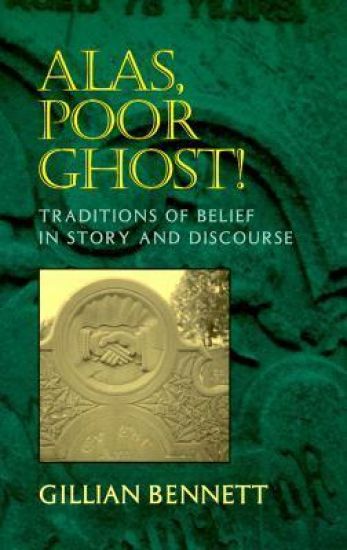
Alas Poor Ghost

Alas Poor Ghost

Gillian Bennett

Utah State University Press
1999
pokkari
In the rational modern world, belief in the supernatural seemingly has been consigned to the worlds of entertainment and fantasy. Yet belief in other worldly phenomena, from poltergeists to telepathy, remains strong, as Gillian Bennett's research shows. Especially common is belief in continuing contact with, or the continuing presence of, dead family members. Bennett interviewed women in Manchester, England, asking them questions about ghosts and other aspects of the supernatural. (Her discussion of how her research methods and interview techniques evolved is in itself valuable.) She first published the results of the study in the well-received Traditions of Belief: Women and the Supernatural, which has been widely used in folklore and women's studies courses. "Alas, Poor Ghost!" extensively revises and expands that work. In addition to a fuller presentation and analysis of the original field research and other added material, the author, assisted by Kate Bennett, a gerontological psychologist, presents and discusses new research with a group of women in Leicester, England. Bennett is interested in more than measuring the extent of belief in other worldly manifestations.Her work explores the relationship between narrative and belief. She anticipated that her questions would elicit from her interviewees not just yes or no replies but stories about their experiences that confirmed or denied notions of the supernatural. The more controversial the subject matter, the more likely individuals were to tell stories, especially if their answers to questions of belief were positive. These were most commonly individualised narratives of personal experience, but they contained many of the traditional motifs and other content, including belief in the supernatural, of legends. Bennett calls them memorates and discusses the cultural processes, including ideas of what is a "proper" experience of the supernatural and a "proper" telling of the story, that make them communal as well as individual. These memorates provide direct and vivid examples of what the storytellers actually believe and disbelieve. In a final section, Bennett places her work in historical context through a discussion of case studies in the history of supernatural belief.