Kirjailija
Giovanni Dosi
Kirjat ja teokset yhdessä paikassa: 10 kirjaa, julkaisuja vuosilta 1984-2025, suosituimpien joukossa Economic Organization, Industrial Dynamics and Development. Vertaile teosten hintoja ja tarkista saatavuus suomalaisista kirjakaupoista.
10 kirjaa
Kirjojen julkaisuhaarukka 1984-2025.
This Element is about agent-based macroeconomics in general, and in particular about a family of evolutionary, agent-based models (ABMs), which are called 'Schumpeter meeting Keynes' (or K+S). The K+S models knit together 'Schumpeterian' endogenous processes of innovation with 'Keynesian' mechanisms of demand generation. As with all well-constructed ABMs, the K+S models are populated by a multiplicity of agents which interact on the grounds of quite simple, empirically based, behavioural rules, whose collective outcomes are 'emergent properties' which cannot be imputed to the intention of any single agent. After the K+S model is empirically validated, the impacts of different combinations of innovation, industrial, fiscal, and monetary policies for different labour-market regimes and inequality scenarios are assessed. The Element offers a new perspective on macroeconomics considering the economy as a complex evolving system.
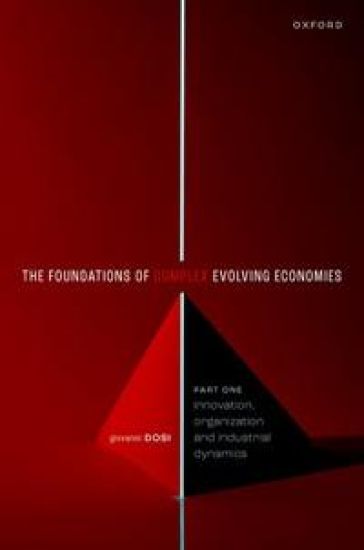
The Foundations of Complex Evolving Economies seeks to offer an integrated analysis of the anatomy and physiology of the capitalist engine of generation and exploitation of technological organizational and institutional innovations - from the drivers of knowledge accumulation, to the modes in which such knowledge is incorporated into business firms, all the way to the processes of innovation-driven “Schumpeterian competition” and macroeconomic growth. In that, it advances the interpretation of such patterns, in terms of economies seen as complex evolving systems. The basic objects of analysis are the history of the emergence and development of modern capitalist economies and their current functionings. Indeed , the tall ambition of the book is to address two basic questions at the core of the whole economic discipline since its inception. They regard, first, the drivers and patterns of change of the capitalistic machine of production and innovation and, second, the mechanisms of coordination among a multitude of self-seeking economic agents often characterized by conflicting interests. In order to do that, this Manual, in addition to the nature of technology and innovation, considers from a profoundly alternative perspective, all domains of analysis typically addressed (or not) by microeconomic texts, including micro behaviours, the theory of the firm, the theory of production, consumption patterns, market dynamics, and industrial evolution.
Modern Evolutionary Economics
Richard R. Nelson; Giovanni Dosi; Constance E. Helfat; Andreas Pyka; Pier Paolo Saviotti; Keun Lee; Kurt Dopfer; Franco Malerba; Sidney G. Winter
Cambridge University Press
2018
pokkari
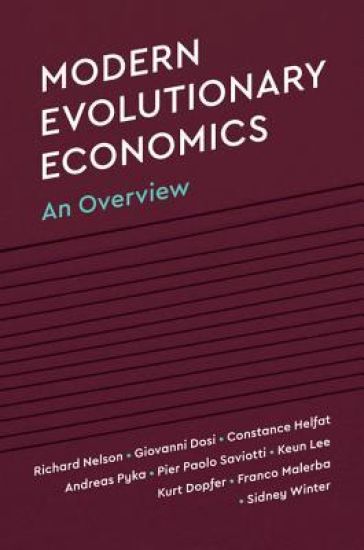
Evolutionary economics sees the economy as always in motion with change being driven largely by continuing innovation. This approach to economics, heavily influenced by the work of Joseph Schumpeter, saw a revival as an alternative way of thinking about economic advancement as a result of Richard Nelson and Sidney Winter's seminal book, An Evolutionary Theory of Economic Change, first published in 1982. In this long-awaited follow-up, Nelson is joined by leading figures in the field of evolutionary economics, reviewing in detail how this perspective has been manifest in various areas of economic inquiry where evolutionary economists have been active. Providing the perfect overview for interested economists and social scientists, readers will learn how in each of the diverse fields featured, evolutionary economics has enabled an improved understanding of how and why economic progress occurs.
Modern Evolutionary Economics
Richard R. Nelson; Giovanni Dosi; Constance E. Helfat; Andreas Pyka; Pier Paolo Saviotti; Keun Lee; Kurt Dopfer; Franco Malerba; Sidney G. Winter
Cambridge University Press
2018
sidottu
Evolutionary economics sees the economy as always in motion with change being driven largely by continuing innovation. This approach to economics, heavily influenced by the work of Joseph Schumpeter, saw a revival as an alternative way of thinking about economic advancement as a result of Richard Nelson and Sidney Winter's seminal book, An Evolutionary Theory of Economic Change, first published in 1982. In this long-awaited follow-up, Nelson is joined by leading figures in the field of evolutionary economics, reviewing in detail how this perspective has been manifest in various areas of economic inquiry where evolutionary economists have been active. Providing the perfect overview for interested economists and social scientists, readers will learn how in each of the diverse fields featured, evolutionary economics has enabled an improved understanding of how and why economic progress occurs.
Economic Organization, Industrial Dynamics and Development
Giovanni Dosi
Edward Elgar Publishing Ltd
2014
nidottu
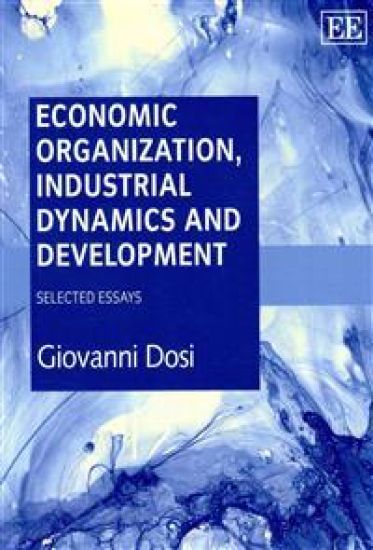
This volume collects some of Giovanni Dosi's most important publications in the new millennium, following his earlier 2000 collection, Innovation, Organization and Economic Dynamics. It begins by offering quite a few advances in the analysis of individual learning in evolving environments, and of organizational structures and learning, thereby contributing to an emerging knowledge-centred theory of the firm and to a related theory of production. A second group of papers addresses the workings of markets, the importance of their institutional architectures, their diverse effectiveness as selection devices, and the evolutionary patterns of demand formation. A third set of chapters continues the exploration of the characteristics, drivers and performance outcomes of industrial evolution. The fourth part of the book is a reassessment of the role of history and path dependence in evolutionary processes. Finally, Part five addresses both the empirics and the modeling of the processes of growth and development nested into coupled evolution of technologies, corporate organizations and institutions.
Economic Organization, Industrial Dynamics and Development
Giovanni Dosi
Edward Elgar Publishing Ltd
2012
sidottu
This volume collects some of Giovanni Dosi's most important publications in the new millennium, following his earlier 2000 collection, Innovation, Organization and Economic Dynamics. It begins by offering quite a few advances in the analysis of individual learning in evolving environments, and of organizational structures and learning, thereby contributing to an emerging knowledge-centred theory of the firm and to a related theory of production. A second group of papers addresses the workings of markets, the importance of their institutional architectures, their diverse effectiveness as selection devices, and the evolutionary patterns of demand formation. A third set of chapters continues the exploration of the characteristics, drivers and performance outcomes of industrial evolution. The fourth part of the book is a reassessment of the role of history and path dependence in evolutionary processes. Finally, Part five addresses both the empirics and the modeling of the processes of growth and development nested into coupled evolution of technologies, corporate organizations and institutions.
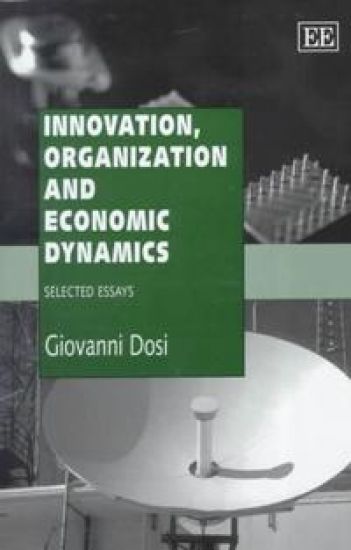
Innovation, Organization and Economic Dynamics
Giovanni Dosi
Edward Elgar Publishing Ltd
2000
sidottu
Giovanni Dosi is recognized as one of the world's leading scholars in industrial economics and corporate change. This volume contains a selection of his most important work and provides an excellent overview of the contribution he has made to the economics of innovation and technical change.Key topics include:technological paradigms and innovation diffusioneconomic behaviour and learningorganizational structures and behaviour in a changing environmentcorporate finance and innovationindustrial dynamicsevolutionary theories in economicsinstitutions, technical change and economic growth.The book will be welcomed by scholars and students of innovation, industrial organization, business and institutional and evolutionary economics.