Kirjojen hintavertailu. Mukana 12 595 353 kirjaa ja 12 kauppaa.

Kirjailija

Giuliana Bruno

Kirjat ja teokset yhdessä paikassa: 7 kirjaa, julkaisuja vuosilta 1992-2025, suosituimpien joukossa Isaac Julien. Vertaile teosten hintoja ja tarkista saatavuus suomalaisista kirjakaupoista.

7 kirjaa

Kirjojen julkaisuhaarukka 1992-2025.

Isaac Julien

Isaac Julien

Isaac Julien; Giuliana Bruno; Mark Nash; Rafaela Mendes Ferreira

Yale Center for British Art
2025
sidottu
A visual record and philosophical investigation of Isaac Julien’s immersive installation on the modernist architect Lina Bo Bardi Isaac Julien’s multiscreen installation Lina Bo Bardi—A Marvellous Entanglement is a poetic portrait exploring the life, work, and legacy of the Italian-born Brazilian architect Lina Bo Bardi (1914–1992). The installation enfolds viewers in a narrative that exemplifies Bo Bardi’s observation that “time is not linear, it is a marvellous entanglement.” In this book, Julien combines elements of his recent video installation, works from his related photographic series, and a rich selection of archival materials, offering a deeper understanding of Bo Bardi and her influence. The publication features an essay by theorist Giuliana Bruno, a behind-the-scenes account of the project by curator and scholar Mark Nash, and a conversation between Julien and members of Brazilian art collective Araká, who performed in A Marvellous Entanglement. Distributed for Yale Center for British Art
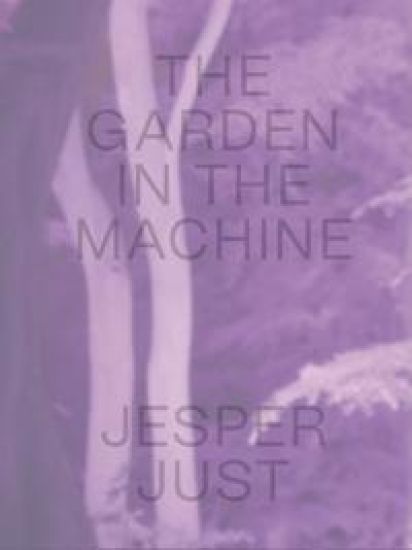
JESPER JUST – THE GARDEN IN THE MACHINE

JESPER JUST – THE GARDEN IN THE MACHINE

Giuliana Bruno; Pernille Taagaard Dinesen; Jesper Just

Roulette Russe
2025
sidottu
The Garden in the Machine is a groundbreaking total installation by renowned artist Jesper Just that explores the intricate relationship between natural and digitally produced environments. Set against the striking façade of Filmby Aarhus, this immersive work transforms the building into a canvas, projecting an interactive image sequence of a slowly rotating forest from sunset until midnight.At the heart of this installation is a solitary Scots Pine, equipped with sensors that continuously register its photosynthetic processes, dictating the film’s flow in real-time. Spanning an impressive 1,400 square meters and utilising 13.2 kilometres of LED strips, The Garden in the Machine stands as one of the largest video installations in the world.This book offers an in-depth exploration of Just’s artistic vision, technical ingenuity, and the profound questions his work raises about reality, perception, and the intertwining of the organic and the artificial.
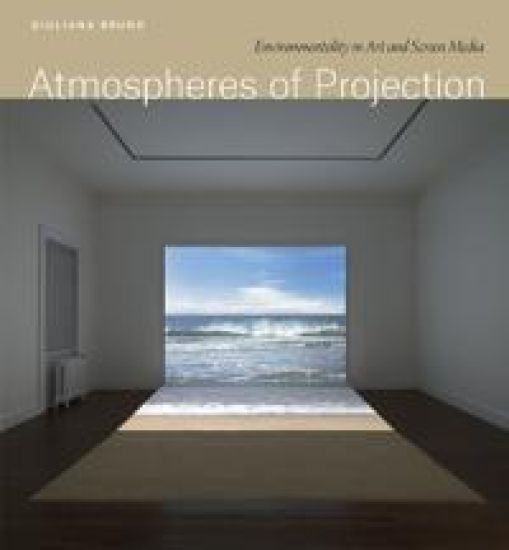
Atmospheres of Projection

Atmospheres of Projection

Giuliana Bruno

THE UNIVERSITY OF CHICAGO PRESS
2022
sidottu
Bringing together cultural history, visual studies, and media archaeology, Bruno considers the interrelations of projection, atmosphere, and environment. Projection has long been transforming space, from shadow plays to camera obscuras and magic lantern shows. Our fascination with projection is alive on the walls of museums and galleries and woven into our daily lives. Giuliana Bruno explores the histories of projection and atmosphere in visual culture and their continued importance to contemporary artists who are reinventing the projective imagination with atmospheric thinking and the use of elemental media. To explain our fascination with projection and atmosphere, Bruno traverses psychoanalysis, environmental philosophy, architecture, the history of science, visual art, and moving image culture to see how projective mechanisms and their environments have developed over time. She reveals how atmosphere is formed and mediated, how it can change, and what projection can do to modify a site. In so doing, she gives new life to the alchemic possibilities of transformative projective atmospheres. Showing how their “environmentality” produces sites of exchange and relationality, this book binds art to the ecology of atmosphere.
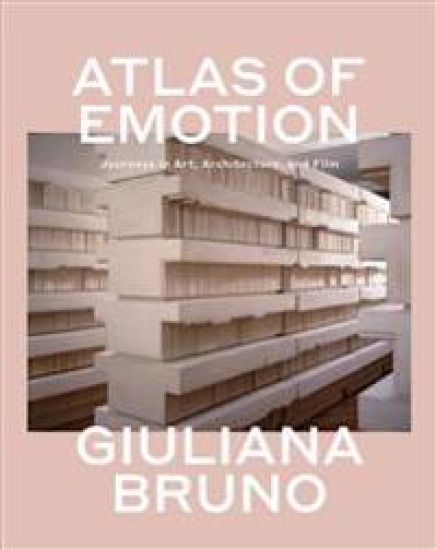
Atlas of Emotion

Atlas of Emotion

Giuliana Bruno

Verso Books
2018
nidottu
Atlas of Emotion is a highly original endeavour to map a cultural history of spatio-visual arts. In an evocative montage of words and pictures, emphasises that "sight" and "site" but also "motion" and "emotion" are irrevocably connected. In so doing, Giuliana Bruno touches on the art of Gerhard Richter and Annette Message, the film making of Peter Greenaway and Michelangelo Antonioni, the origins of the movie palace and its precursors, and her own journeys to her native Naples. Visually luscious and daring in conception, Bruno opens new vistas and understandings at every turn.
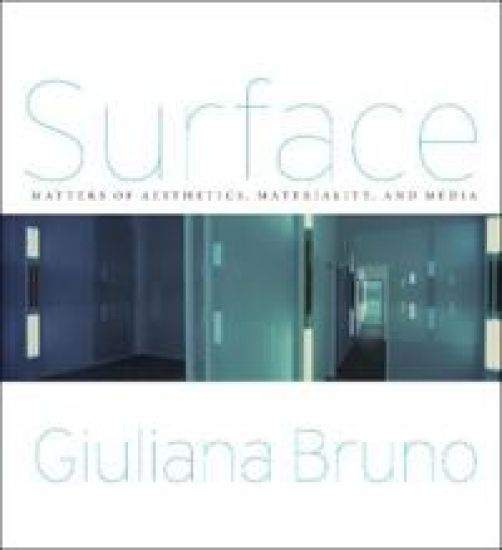
Surface

Surface

Giuliana Bruno

University of Chicago Press
2016
nidottu
What is the place of materiality the expression or condition of physical substance in our visual age of rapidly changing materials and media? How is it fashioned in the arts or manifested in virtual forms? In Surface, cultural critic and theorist Giuliana Bruno deftly explores these questions, seeking to understand materiality in the contemporary world. Arguing that materiality is not a question of the materials themselves but rather the substance of material relations, Bruno investigates the space of those relations, examining how they appear on the surface of different media on film and video screens, in gallery installations, or on the skins of buildings and people. The object of visual studies, she contends, goes well beyond the image and engages the surface as a place of contact between people and art objects. As Bruno threads through these surface encounters, she unveils the fabrics of the visual the textural qualities of works of art, whether manifested on canvas, wall, or screen. Illuminating the modern surface condition, she notes how fa ades are becoming virtual screens and the art of projection is reinvented on gallery walls. She traverses the light spaces of artists Robert Irwin, James Turrell, Tacita Dean, and Anthony McCall; touches on the textured surfaces of Isaac Julien's and Wong Kar-wai's filmic screens; and travels across the surface materiality in the architectural practices of Diller Scofidio + Renfro and Herzog & de Meuron to the art of Doris Salcedo and Rachel Whiteread, where the surface tension of media becomes concrete. In performing these critical operations on the surface, she articulates it as a site in which different forms of mediation, memory, and transformation can take place. Surveying object relations across art, architecture, fashion, design, film, and new media, Surface is a magisterial account of contemporary visual culture.
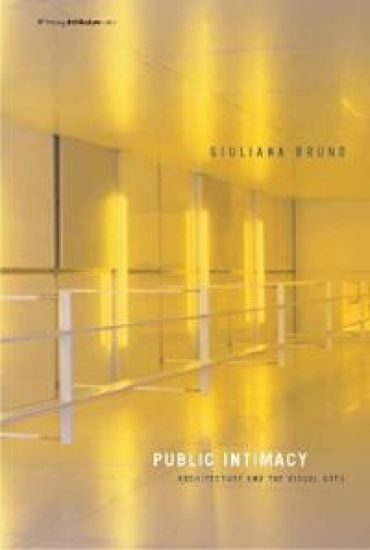
Public Intimacy

Public Intimacy

Giuliana Bruno

MIT Press
2007
pokkari
An examination of architecture and art as a screen of vital cultural memory that considers museum culture, visual technology, and the border of public and private space.In this thoughtful collection of essays on the relationship of architecture and the arts, Giuliana Bruno addresses the crucial role that architecture plays in the production of art and the making of public intimacy. As art melts into spatial construction and architecture mobilizes artistic vision, Bruno argues, a new moving space-a screen of vital cultural memory-has come to shape our visual culture. Taking on the central topic of museum culture, Bruno leads the reader on a series of architectural promenades from modernity to our times. Through these "museum walks," she demonstrates how artistic collection has become a culture of recollection, and examines the public space of the pavilion as reinvented in the moving-image art installation of Turner Prize nominees Jane and Louise Wilson. Investigating the intersection of science and art, Bruno looks at our cultural obsession with techniques of imaging and its effect on the privacy of bodies and space. She finds in the work of artist Rebecca Horn a notable combination of the artistic and the scientific that creates an architecture of public intimacy. Considering the role of architecture in contemporary art that refashions our "lived space"-and the work of contemporary artists including Rachel Whiteread, Mona Hatoum, and Guillermo Kuitca-Bruno argues that architecture is used to define the frame of memory, the border of public and private space, and the permeability of exterior and interior space. Architecture, Bruno contends, is not merely a matter of space, but an art of time.
Streetwalking on a Ruined Map

Streetwalking on a Ruined Map

Giuliana Bruno

Princeton University Press
1992
pokkari
Emphasizing the importance of cultural theory for film history, Giuliana Bruno enriches our understanding of early Italian film as she guides us on a series of "inferential walks" through Italian culture in the first decades of this century. This innovative approach---the interweaving of examples of cinema with architecture, art history, medical discourse, photography, and literature--addresses the challenge posed by feminism to film study while calling attention to marginalized artists. An object of this critical remapping is Elvira Notari (1875-1946), Italy's first and most prolific woman filmmaker, whose documentary-style work on street life in Naples, a forerunner of neorealism, was popularly acclaimed in Italy and the United States until its suppression during the Fascist regime. Since only fragments of Notari's films exist today, Bruno illuminates the filmmaker's contributions to early Italian cinematography by evoking the cultural terrain in which she operated. What emerges is an intertextual montage of urban film culture highlighting a woman's view on love, violence, poverty, desire, and death. This panorama ranges from the city's exteriors to the body's interiors. Reclaiming an alternative history of women's filmmaking and reception, Bruno draws a cultural history that persuasively argues for a spatial, corporal interpretation of film language.