Kirjojen hintavertailu. Mukana 12 290 406 kirjaa ja 12 kauppaa.

Kirjailija

Giuseppe Bertola

Kirjat ja teokset yhdessä paikassa: 6 kirjaa, julkaisuja vuosilta 2004-2014, suosituimpien joukossa An Agenda for a Growing Europe. Vertaile teosten hintoja ja tarkista saatavuus suomalaisista kirjakaupoista.

6 kirjaa

Kirjojen julkaisuhaarukka 2004-2014.

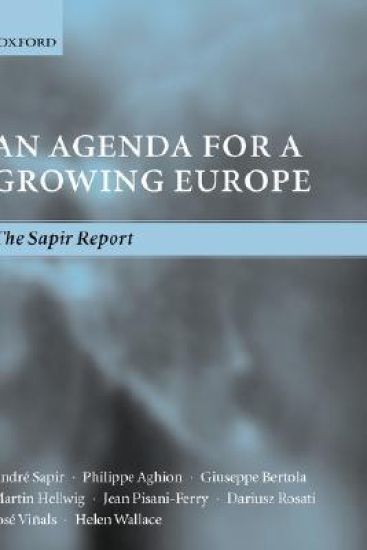
An Agenda for a Growing Europe

An Agenda for a Growing Europe

André Sapir; Philippe Aghion; Giuseppe Bertola; Martin Hellwig; Jean Pisani-Ferry; Dariusz Rosati; José Viñals; Helen Wallace; Marco Buti; Mario Nava; Peter M. Smith

Oxford University Press
2004
sidottu
Over the past decade European economic integration has seen considerable institutional success, but the economic performance of the EU has been varied. While macroeconomic stability has improved and an emphasis on cohesion preserved, the EU economic system has not delivered satisfactory growth performance. This book is the report of a high-level group commissioned by the President of the European Commission to review the EU economic system and propose a blueprint for an economic system capable of delivering faster growth along with stability and cohesion. It assesses the EU s economic performance, examines the challenges facing the EU in the coming years, and presents a series of recommendations. The report views Europe's unsatisfactory growth performance during the last decades as a symptom of its failure to transform into an innovation-based economy. It has now become clear that the context in which economic policies have been developed has changed fundamentally over the past thirty years. A system built around the assimilation of existing technologies, mass production generating economics of scale, and an industrial structure dominated by large firms with stable markets and long term employment patterns no longer delivers in the world of today, characterized by economic globalization and strong external competition. What is needed now is more opportunity for new entrants, greater mobility of employees within and across firms, more retraining, greater reliance on market financing, and higher investment in both R&D and higher education. This requires a massive and urgent change in economic policies in Europe.

Income Distribution in Macroeconomic Models

Income Distribution in Macroeconomic Models

Giuseppe Bertola; Reto Foellmi; Josef Zweimüller

Princeton University Press
2014
pokkari
This book looks at the distribution of income and wealth and the effects that this has on the macroeconomy, and vice versa. Is a more equal distribution of income beneficial or harmful for macroeconomic growth, and how does the distribution of wealth evolve in a market economy? Taking stock of results and methods developed in the context of the 1990s revival of growth theory, the authors focus on capital accumulation and long-run growth. They show how rigorous, optimization-based technical tools can be applied, beyond the representative-agent framework of analysis, to account for realistic market imperfections and for political-economic interactions. The treatment is thorough, yet accessible to students and nonspecialist economists, and it offers specialist readers a wide-ranging and innovative treatment of an increasingly important research field. The book follows a single analytical thread through a series of different growth models, allowing readers to appreciate their structure and crucial assumptions. This is particularly useful at a time when the literature on income distribution and growth has developed quickly and in several different directions, becoming difficult to overview.
Models for Dynamic Macroeconomics

Models for Dynamic Macroeconomics

Fabio-Cesare Bagliano; Giuseppe Bertola

Oxford University Press
2007
nidottu
Models for Dynamic Macroeconomics provides the advanced student with key methodological tools for the dynamic analysis of a core selection of macroeconomic phenomena, including consumption and investment choices, employment and unemployment outcomes, and economic growth. The technical treatment of these tools will enable the student to handle current journal literature, while not assuming any particular familiarity with advanced analytical tools or mathematical notions. As these tools are introduced, they are related to particular applications to illustrate their use. Each chapter includes exercises which propose extensions to the model discussed in the text as well as end of chapter review exercises designed to consolidate learning. All exercise solutions are provided at the end of the book and further reading is discussed at the end of each chapter. By bridging the gap between undergraduate economics and modern microfounded macroeconomic research, this book will be of interest to graduate students in economics, and as a technical reference for economic researchers.
Income Distribution in Macroeconomic Models

Income Distribution in Macroeconomic Models

Giuseppe Bertola; Reto Foellmi; Josef Zweimüller

Princeton University Press
2005
sidottu
This book looks at the distribution of income and wealth and the effects that this has on the macroeconomy, and vice versa. Is a more equal distribution of income beneficial or harmful for macroeconomic growth, and how does the distribution of wealth evolve in a market economy? Taking stock of results and methods developed in the context of the 1990s revival of growth theory, the authors focus on capital accumulation and long-run growth. They show how rigorous, optimization-based technical tools can be applied, beyond the representative-agent framework of analysis, to account for realistic market imperfections and for political-economic interactions. The treatment is thorough, yet accessible to students and nonspecialist economists, and it offers specialist readers a wide-ranging and innovative treatment of an increasingly important research field. The book follows a single analytical thread through a series of different growth models, allowing readers to appreciate their structure and crucial assumptions. This is particularly useful at a time when the literature on income distribution and growth has developed quickly and in several different directions, becoming difficult to overview.
An Agenda for a Growing Europe

An Agenda for a Growing Europe

André Sapir; Philippe Aghion; Giuseppe Bertola; Martin Hellwig; Jean Pisani-Ferry; Dariusz Rosati; José Viñals; Helen Wallace; Marco Buti; Mario Nava; Peter M. Smith

Oxford University Press
2004
nidottu
Over the past decade European economic integration has seen considerable institutional success, but the economic performance of the EU has been varied. While macroeconomic stability has improved and an emphasis on cohesion preserved, the EU economic system has not delivered satisfactory growth performance. This book is the report of a high-level group commissioned by the President of the European Commission to review the EU economic system and propose a blueprint for an economic system capable of delivering faster growth along with stability and cohesion. It assesses the EU s economic performance, examines the challenges facing the EU in the coming years, and presents a series of recommendations. The report views Europe's unsatisfactory growth performance during the last decades as a symptom of its failure to transform into an innovation-based economy. It has now become clear that the context in which economic policies have been developed has changed fundamentally over the past thirty years. A system built around the assimilation of existing technologies, mass production generating economics of scale, and an industrial structure dominated by large firms with stable markets and long term employment patterns no longer delivers in the world of today, characterized by economic globalization and strong external competition. What is needed now is more opportunity for new entrants, greater mobility of employees within and across firms, more retraining, greater reliance on market financing, and higher investment in both R&D and higher education. This requires a massive and urgent change in economic policies in Europe.
Models for Dynamic Macroeconomics

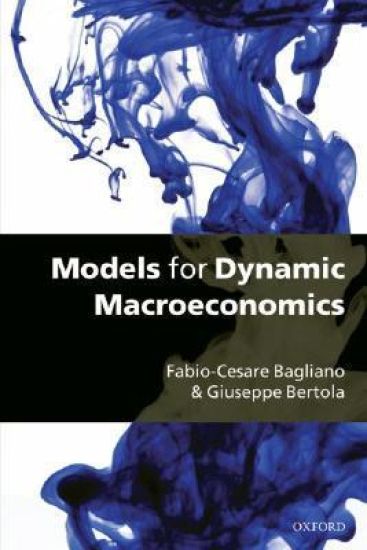
Models for Dynamic Macroeconomics

Fabio-Cesare Bagliano; Giuseppe Bertola

Oxford University Press
2004
sidottu
Dynamic Approaches to Macroeconomics provides the advanced student with key methodological tools for the dynamic analysis of a core selection of macroeconomic phenomena, including consumption and investment choices, employment and unemployment outcomes, and economic growth. The technical treatment of these tools will enable the student to handle current journal literature, while not assuming any particular familiarity with advanced analytical tools or mathematical notions. As these tools are introduced, they are related to particular applications to illustrate their use. Chapters are linked by various formal and substantive threads. Discrete-time optimization under uncertainty, introduced in Chapter 1, is motivated and discussed by applications to consumption theory, with particular attention to empirical implementation. Chapter 2 focuses on continuous-time optimization techniques, and discusses the relevant insights in the context of partial-equilibrium investment models. Chapter 3 revisits many of the previous chapters' formal derivations with applications to dynamic labour demand, in comparison to optimal investment models, and characterizes labor market equilibrium when not only individual firms' labor demand, but also individual labor supply by workers, is subject to adjustment costs. Chapter 4 proposes broader applications of methods introduced in the previous chapters and studies continuous-time equilibrium dynamics of representative agent economies, featuring both consumption and investment choices, with applications to long-run growth frameworks of analysis. Chapter 5 illustrates the role of decentralized trading in determining aggregate equilibria, and characterizes aggregate labor market dynamics in the presence of frictional unemployment. Chapters 4 and 5 pay particular attention to strategic interactions and externalities: even when each agent correctly solves his or her individual dynamic problem, modern microfounded macroeconomic models recognize that macroeconomic equilibrium need not have unambiguously desirable properties. By bridging the gap between undergraduate economics and modern microfounded macroeconomic research, this book will be of interest to graduate students in economics, and as a technical reference for economic researchers.