Kirjojen hintavertailu. Mukana 12 595 353 kirjaa ja 12 kauppaa.

Kirjailija

Giuseppe Ciaburro

Kirjat ja teokset yhdessä paikassa: 15 kirjaa, julkaisuja vuosilta 2015-2024, suosituimpien joukossa Guida alla programmazione con PYTHON: Corso completo per imparare a programmare in poco tempo. Vertaile teosten hintoja ja tarkista saatavuus suomalaisista kirjakaupoista.

15 kirjaa

Kirjojen julkaisuhaarukka 2015-2024.

Guida alla programmazione con R: Corso completo per imparare a programmare in poco tempo

Guida alla programmazione con R: Corso completo per imparare a programmare in poco tempo

Giuseppe Ciaburro

Createspace Independent Publishing Platform
2016
nidottu
R rappresenta un ambiente per il calcolo numerico e per la produzione di grafici di qualit . Si compone di un linguaggio e di un ambiente di runtime con un'interfaccia grafica, un debugger, l'accesso ad alcune funzioni di sistema, e offre la possibilit di eseguire programmi memorizzati in file di script. Ma R molto di pi , rappresenta infatti un vero linguaggio di programmazione, anzi un linguaggio di programmazione molto avanzato, e ci permette di adattarlo ad ogni nostra esigenza. In questa guida sono affrontati tutti gli argomenti necessari per iniziare a programmare in R, in maniera semplice ed immediata partendo da zero. Ricca di esempi ed esercizi la guida ci aiuta nel percorso di apprendimento di un nuovo linguaggio di programmazione senza la necessit di competenze preventive sull'argomento. Tra gli argomenti trattati: -Variabili ed operatori -Array e matrici -Liste e dataframe -Strutture per il controllo del flusso -Operazioni di ingresso/uscita -Gestione delle eccezioni -Visualizzazione dei dati -Tipi di grafici
Guida alla programmazione con PYTHON: Corso completo per imparare a programmare in poco tempo
Python un linguaggio di programmazione orientato agli oggetti particolarmente indicato per tutti i tipi di sviluppo software. facilmente integrabile con altri linguaggi e programmi, dispone di una estesa libreria standard e pu essere imparato in pochi giorni. In questa guida sono affrontati tutti gli argomenti necessari per iniziare a programmare in Python, in maniera semplice ed immediata partendo da zero. Ricca di esempi ed esercizi la guida ci aiuta nel percorso di apprendimento di un nuovo linguaggio di programmazione senza la necessit di competenze preventive sull'argomento. Tra gli argomenti trattati: -Stringhe ed espressioni regolari -Array ed Hash -Strutture per il controllo del flusso -Classi, metodi, oggetti e moduli -Operazioni di ingresso/uscita -Gestione delle eccezioni -Database -Creare delle GUI con Python
MATLAB for Machine Learning

MATLAB for Machine Learning

Giuseppe Ciaburro

PACKT PUBLISHING LIMITED
2024
nidottu
Master MATLAB tools for creating machine learning applications through effective code writing, guided by practical examples showcasing the versatility of machine learning in real-world applications Key Features Work with the MATLAB Machine Learning Toolbox to implement a variety of machine learning algorithms Evaluate, deploy, and operationalize your custom models, incorporating bias detection and pipeline monitoring Uncover effective approaches to deep learning for computer vision, time series analysis, and forecasting Purchase of the print or Kindle book includes a free PDF eBook Book DescriptionDiscover why the MATLAB programming environment is highly favored by researchers and math experts for machine learning with this guide which is designed to enhance your proficiency in both machine learning and deep learning using MATLAB, paving the way for advanced applications. By navigating the versatile machine learning tools in the MATLAB environment, you’ll learn how to seamlessly interact with the workspace. You’ll then move on to data cleansing, data mining, and analyzing various types of data in machine learning, and visualize data values on a graph. As you progress, you’ll explore various classification and regression techniques, skillfully applying them with MATLAB functions. This book teaches you the essentials of neural networks, guiding you through data fitting, pattern recognition, and cluster analysis. You’ll also explore feature selection and extraction techniques for performance improvement through dimensionality reduction. Finally, you’ll leverage MATLAB tools for deep learning and managing convolutional neural networks. By the end of the book, you’ll be able to put it all together by applying major machine learning algorithms in real-world scenarios.What you will learn Discover different ways to transform data into valuable insights Explore the different types of regression techniques Grasp the basics of classification through Naive Bayes and decision trees Use clustering to group data based on similarity measures Perform data fitting, pattern recognition, and cluster analysis Implement feature selection and extraction for dimensionality reduction Harness MATLAB tools for deep learning exploration Who this book is forThis book is for ML engineers, data scientists, DL engineers, and CV/NLP engineers who want to use MATLAB for machine learning and deep learning. A fundamental understanding of programming concepts is necessary to get started.
Hands-On Simulation Modeling with Python

Hands-On Simulation Modeling with Python

Giuseppe Ciaburro

PACKT PUBLISHING LIMITED
2022
nidottu
Learn to construct state-of-the-art simulation models with Python and enhance your simulation modelling skills, as well as create and analyze digital prototypes of physical models with easeKey FeaturesUnderstand various statistical and physical simulations to improve systems using PythonLearn to create the numerical prototype of a real model using hands-on examplesEvaluate performance and output results based on how the prototype would work in the real worldBook DescriptionSimulation modelling is an exploration method that aims to imitate physical systems in a virtual environment and retrieve useful statistical inferences from it. The ability to analyze the model as it runs sets simulation modelling apart from other methods used in conventional analyses. This book is your comprehensive and hands-on guide to understanding various computational statistical simulations using Python. The book begins by helping you get familiarized with the fundamental concepts of simulation modelling, that’ll enable you to understand the various methods and techniques needed to explore complex topics. Data scientists working with simulation models will be able to put their knowledge to work with this practical guide. As you advance, you’ll dive deep into numerical simulation algorithms, including an overview of relevant applications, with the help of real-world use cases and practical examples. You'll also find out how to use Python to develop simulation models and how to use several Python packages. Finally, you’ll get to grips with various numerical simulation algorithms and concepts, such as Markov Decision Processes, Monte Carlo methods, and bootstrapping techniques.By the end of this book, you'll have learned how to construct and deploy simulation models of your own to overcome real-world challenges.What you will learnGet to grips with the concept of randomness and the data generation processDelve into resampling methodsDiscover how to work with Monte Carlo simulationsUtilize simulations to improve or optimize systemsFind out how to run efficient simulations to analyze real-world systemsUnderstand how to simulate random walks using Markov chainsWho this book is forThis book is for data scientists, simulation engineers, and anyone who is already familiar with the basic computational methods and wants to implement various simulation techniques such as Monte-Carlo methods and statistical simulation using Python.
Hands-On Simulation Modeling with Python

Hands-On Simulation Modeling with Python

Giuseppe Ciaburro

Packt Publishing Limited
2020
nidottu
Enhance your simulation modeling skills by creating and analyzing digital prototypes of a physical model using Python programming with this comprehensive guideKey FeaturesLearn to create a digital prototype of a real model using hands-on examplesEvaluate the performance and output of your prototype using simulation modeling techniquesUnderstand various statistical and physical simulations to improve systems using PythonBook DescriptionSimulation modeling helps you to create digital prototypes of physical models to analyze how they work and predict their performance in the real world. With this comprehensive guide, you'll understand various computational statistical simulations using Python.Starting with the fundamentals of simulation modeling, you'll understand concepts such as randomness and explore data generating processes, resampling methods, and bootstrapping techniques. You'll then cover key algorithms such as Monte Carlo simulations and Markov decision processes, which are used to develop numerical simulation models, and discover how they can be used to solve real-world problems. As you advance, you'll develop simulation models to help you get accurate results and enhance decision-making processes. Using optimization techniques, you'll learn to modify the performance of a model to improve results and make optimal use of resources. The book will guide you in creating a digital prototype using practical use cases for financial engineering, prototyping project management to improve planning, and simulating physical phenomena using neural networks.By the end of this book, you'll have learned how to construct and deploy simulation models of your own to overcome real-world challenges.What you will learnGain an overview of the different types of simulation modelsGet to grips with the concepts of randomness and data generation processUnderstand how to work with discrete and continuous distributionsWork with Monte Carlo simulations to calculate a definite integralFind out how to simulate random walks using Markov chainsObtain robust estimates of confidence intervals and standard errors of population parametersDiscover how to use optimization methods in real-life applicationsRun efficient simulations to analyze real-world systemsWho this book is forHands-On Simulation Modeling with Python is for simulation developers and engineers, model designers, and anyone already familiar with the basic computational methods that are used to study the behavior of systems. This book will help you explore advanced simulation techniques such as Monte Carlo methods, statistical simulations, and much more using Python. Working knowledge of Python programming language is required.
Python Machine Learning Cookbook

Python Machine Learning Cookbook

Giuseppe Ciaburro; Prateek Joshi

Packt Publishing Limited
2019
nidottu
Discover powerful ways to effectively solve real-world machine learning problems using key libraries including scikit-learn, TensorFlow, and PyTorchKey FeaturesLearn and implement machine learning algorithms in a variety of real-life scenariosCover a range of tasks catering to supervised, unsupervised and reinforcement learning techniquesFind easy-to-follow code solutions for tackling common and not-so-common challengesBook DescriptionThis eagerly anticipated second edition of the popular Python Machine Learning Cookbook will enable you to adopt a fresh approach to dealing with real-world machine learning and deep learning tasks.With the help of over 100 recipes, you will learn to build powerful machine learning applications using modern libraries from the Python ecosystem. The book will also guide you on how to implement various machine learning algorithms for classification, clustering, and recommendation engines, using a recipe-based approach. With emphasis on practical solutions, dedicated sections in the book will help you to apply supervised and unsupervised learning techniques to real-world problems. Toward the concluding chapters, you will get to grips with recipes that teach you advanced techniques including reinforcement learning, deep neural networks, and automated machine learning.By the end of this book, you will be equipped with the skills you need to apply machine learning techniques and leverage the full capabilities of the Python ecosystem through real-world examples.What you will learnUse predictive modeling and apply it to real-world problemsExplore data visualization techniques to interact with your dataLearn how to build a recommendation engineUnderstand how to interact with text data and build models to analyze itWork with speech data and recognize spoken words using Hidden Markov ModelsGet well versed with reinforcement learning, automated ML, and transfer learningWork with image data and build systems for image recognition and biometric face recognitionUse deep neural networks to build an optical character recognition systemWho this book is forThis book is for data scientists, machine learning developers, deep learning enthusiasts and Python programmers who want to solve real-world challenges using machine-learning techniques and algorithms. If you are facing challenges at work and want ready-to-use code solutions to cover key tasks in machine learning and the deep learning domain, then this book is what you need. Familiarity with Python programming and machine learning concepts will be useful.
Keras 2.x Projects

Keras 2.x Projects

Giuseppe Ciaburro

Packt Publishing Limited
2018
nidottu
Demonstrate fundamentals of Deep Learning and neural network methodologies using Keras 2.xKey FeaturesExperimental projects showcasing the implementation of high-performance deep learning models with Keras.Use-cases across reinforcement learning, natural language processing, GANs and computer vision.Build strong fundamentals of Keras in the area of deep learning and artificial intelligence.Book DescriptionKeras 2.x Projects explains how to leverage the power of Keras to build and train state-of-the-art deep learning models through a series of practical projects that look at a range of real-world application areas.To begin with, you will quickly set up a deep learning environment by installing the Keras library. Through each of the projects, you will explore and learn the advanced concepts of deep learning and will learn how to compute and run your deep learning models using the advanced offerings of Keras. You will train fully-connected multilayer networks, convolutional neural networks, recurrent neural networks, autoencoders and generative adversarial networks using real-world training datasets. The projects you will undertake are all based on real-world scenarios of all complexity levels, covering topics such as language recognition, stock volatility, energy consumption prediction, faster object classification for self-driving vehicles, and more.By the end of this book, you will be well versed with deep learning and its implementation with Keras. You will have all the knowledge you need to train your own deep learning models to solve different kinds of problems.What you will learnApply regression methods to your data and understand how the regression algorithm worksUnderstand the basic concepts of classification methods and how to implement them in the Keras environmentImport and organize data for neural network classification analysisLearn about the role of rectified linear units in the Keras network architectureImplement a recurrent neural network to classify the sentiment of sentences from movie reviewsSet the embedding layer and the tensor sizes of a networkWho this book is forIf you are a data scientist, machine learning engineer, deep learning practitioner or an AI engineer who wants to build speedy intelligent applications with minimal lines of codes, then this book is the best fit for you. Sound knowledge of machine learning and basic familiarity with Keras library would be useful.
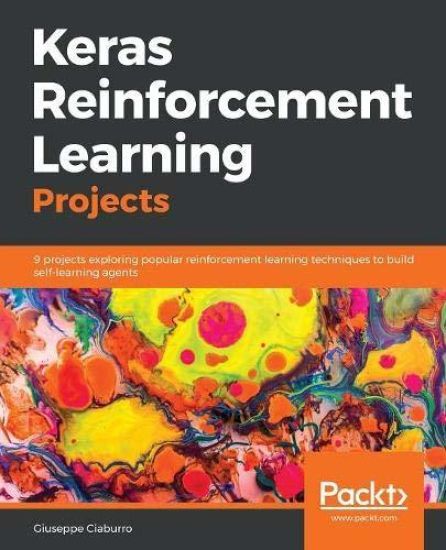
Keras Reinforcement Learning Projects

Keras Reinforcement Learning Projects

Giuseppe Ciaburro

Packt Publishing Limited
2018
nidottu
A practical guide to mastering reinforcement learning algorithms using KerasKey FeaturesBuild projects across robotics, gaming, and finance fields, putting reinforcement learning (RL) into actionGet to grips with Keras and practice on real-world unstructured datasetsUncover advanced deep learning algorithms such as Monte Carlo, Markov Decision, and Q-learningBook DescriptionReinforcement learning has evolved a lot in the last couple of years and proven to be a successful technique in building smart and intelligent AI networks. Keras Reinforcement Learning Projects installs human-level performance into your applications using algorithms and techniques of reinforcement learning, coupled with Keras, a faster experimental library.The book begins with getting you up and running with the concepts of reinforcement learning using Keras. You’ll learn how to simulate a random walk using Markov chains and select the best portfolio using dynamic programming (DP) and Python. You’ll also explore projects such as forecasting stock prices using Monte Carlo methods, delivering vehicle routing application using Temporal Distance (TD) learning algorithms, and balancing a Rotating Mechanical System using Markov decision processes.Once you’ve understood the basics, you’ll move on to Modeling of a Segway, running a robot control system using deep reinforcement learning, and building a handwritten digit recognition model in Python using an image dataset. Finally, you’ll excel in playing the board game Go with the help of Q-Learning and reinforcement learning algorithms.By the end of this book, you’ll not only have developed hands-on training on concepts, algorithms, and techniques of reinforcement learning but also be all set to explore the world of AI.What you will learnPractice the Markov decision process in prediction and betting evaluationsImplement Monte Carlo methods to forecast environment behaviorsExplore TD learning algorithms to manage warehouse operationsConstruct a Deep Q-Network using Python and Keras to control robot movementsApply reinforcement concepts to build a handwritten digit recognition model using an image datasetAddress a game theory problem using Q-Learning and OpenAI GymWho this book is forKeras Reinforcement Learning Projects is for you if you are data scientist, machine learning developer, or AI engineer who wants to understand the fundamentals of reinforcement learning by developing practical projects. Sound knowledge of machine learning and basic familiarity with Keras is useful to get the most out of this book
Hands-On Data Warehousing with Azure Data Factory

Hands-On Data Warehousing with Azure Data Factory

Christian Coté; Michelle Kamrat Gutzait; Giuseppe Ciaburro

Packt Publishing Limited
2018
nidottu
Leverage the power of Microsoft Azure Data Factory v2 to build hybrid data solutionsKey FeaturesCombine the power of Azure Data Factory v2 and SQL Server Integration ServicesDesign and enhance performance and scalability of a modern ETL hybrid solutionInteract with the loaded data in data warehouse and data lake using Power BIBook DescriptionETL is one of the essential techniques in data processing. Given data is everywhere, ETL will always be the vital process to handle data from different sources.Hands-On Data Warehousing with Azure Data Factory starts with the basic concepts of data warehousing and ETL process. You will learn how Azure Data Factory and SSIS can be used to understand the key components of an ETL solution. You will go through different services offered by Azure that can be used by ADF and SSIS, such as Azure Data Lake Analytics, Machine Learning and Databrick’s Spark with the help of practical examples. You will explore how to design and implement ETL hybrid solutions using different integration services with a step-by-step approach. Once you get to grips with all this, you will use Power BI to interact with data coming from different sources in order to reveal valuable insights.By the end of this book, you will not only learn how to build your own ETL solutions but also address the key challenges that are faced while building them.What you will learnUnderstand the key components of an ETL solution using Azure Data Factory and Integration ServicesDesign the architecture of a modern ETL hybrid solutionImplement ETL solutions for both on-premises and Azure dataImprove the performance and scalability of your ETL solutionGain thorough knowledge of new capabilities and features added to Azure Data Factory and Integration ServicesWho this book is forThis book is for you if you are a software professional who develops and implements ETL solutions using Microsoft SQL Server or Azure cloud. It will be an added advantage if you are a software engineer, DW/ETL architect, or ETL developer, and know how to create a new ETL implementation or enhance an existing one with ADF or SSIS.
Hands-On Machine Learning on Google Cloud Platform

Hands-On Machine Learning on Google Cloud Platform

Giuseppe Ciaburro; V Kishore Ayyadevara; Alexis Perrier

Packt Publishing Limited
2018
nidottu
Unleash Google's Cloud Platform to build, train and optimize machine learning models About This Book • Get well versed in GCP pre-existing services to build your own smart models • A comprehensive guide covering aspects from data processing, analyzing to building and training ML models • A practical approach to produce your trained ML models and port them to your mobile for easy access Who This Book Is For This book is for data scientists, machine learning developers and AI developers who want to learn Google Cloud Platform services to build machine learning applications. Since the interaction with the Google ML platform is mostly done via the command line, the reader is supposed to have some familiarity with the bash shell and Python scripting. Some understanding of machine learning and data science concepts will be handy What You Will Learn • Use Google Cloud Platform to build data-based applications for dashboards, web, and mobile • Create, train and optimize deep learning models for various data science problems on big data • Learn how to leverage BigQuery to explore big datasets • Use Google's pre-trained TensorFlow models for NLP, image, video and much more • Create models and architectures for Time series, Reinforcement Learning, and generative models • Create, evaluate, and optimize TensorFlow and Keras models for a wide range of applications In Detail Google Cloud Machine Learning Engine combines the services of Google Cloud Platform with the power and flexibility of TensorFlow. With this book, you will not only learn to build and train different complexities of machine learning models at scale but also host them in the cloud to make predictions. This book is focused on making the most of the Google Machine Learning Platform for large datasets and complex problems. You will learn from scratch how to create powerful machine learning based applications for a wide variety of problems by leveraging different data services from the Google Cloud Platform. Applications include NLP, Speech to text, Reinforcement learning, Time series, recommender systems, image classification, video content inference and many other. We will implement a wide variety of deep learning use cases and also make extensive use of data related services comprising the Google Cloud Platform ecosystem such as Firebase, Storage APIs, Datalab and so forth. This will enable you to integrate Machine Learning and data processing features into your web and mobile applications. By the end of this book, you will know the main difficulties that you may encounter and get appropriate strategies to overcome these difficulties and build efficient systems. Style and approach An easy-to-follow step by step guide which will help you get to the grips with real-world applications of Google Cloud Machine Learning.
Regression Analysis with R

Regression Analysis with R

Giuseppe Ciaburro

Packt Publishing Limited
2018
nidottu
Build effective regression models in R to extract valuable insights from real data About This Book • Implement different regression analysis techniques to solve common problems in data science - from data exploration to dealing with missing values • From Simple Linear Regression to Logistic Regression - this book covers all regression techniques and their implementation in R • A complete guide to building effective regression models in R and interpreting results from them to make valuable predictions Who This Book Is For This book is intended for budding data scientists and data analysts who want to implement regression analysis techniques using R. If you are interested in statistics, data science, machine learning and wants to get an easy introduction to the topic, then this book is what you need! Basic understanding of statistics and math will help you to get the most out of the book. Some programming experience with R will also be helpful What You Will Learn • Get started with the journey of data science using Simple linear regression • Deal with interaction, collinearity and other problems using multiple linear regression • Understand diagnostics and what to do if the assumptions fail with proper analysis • Load your dataset, treat missing values, and plot relationships with exploratory data analysis • Develop a perfect model keeping overfitting, under-fitting, and cross-validation into consideration • Deal with classification problems by applying Logistic regression • Explore other regression techniques – Decision trees, Bagging, and Boosting techniques • Learn by getting it all in action with the help of a real world case study. In Detail Regression analysis is a statistical process which enables prediction of relationships between variables. The predictions are based on the casual effect of one variable upon another. Regression techniques for modeling and analyzing are employed on large set of data in order to reveal hidden relationship among the variables. This book will give you a rundown explaining what regression analysis is, explaining you the process from scratch. The first few chapters give an understanding of what the different types of learning are – supervised and unsupervised, how these learnings differ from each other. We then move to covering the supervised learning in details covering the various aspects of regression analysis. The outline of chapters are arranged in a way that gives a feel of all the steps covered in a data science process – loading the training dataset, handling missing values, EDA on the dataset, transformations and feature engineering, model building, assessing the model fitting and performance, and finally making predictions on unseen datasets. Each chapter starts with explaining the theoretical concepts and once the reader gets comfortable with the theory, we move to the practical examples to support the understanding. The practical examples are illustrated using R code including the different packages in R such as R Stats, Caret and so on. Each chapter is a mix of theory and practical examples. By the end of this book you will know all the concepts and pain-points related to regression analysis, and you will be able to implement your learning in your projects. Style and approach An easy-to-follow step by step guide which will help you get to grips with real world application of Regression Analysis with R
Neural Networks with R

Neural Networks with R

Giuseppe Ciaburro; Balaji Venkateswaran

Packt Publishing Limited
2017
nidottu
Uncover the power of artificial neural networks by implementing them through R code. About This Book • Develop a strong background in neural networks with R, to implement them in your applications • Build smart systems using the power of deep learning • Real-world case studies to illustrate the power of neural network models Who This Book Is For This book is intended for anyone who has a statistical background with knowledge in R and wants to work with neural networks to get better results from complex data. If you are interested in artificial intelligence and deep learning and you want to level up, then this book is what you need! What You Will Learn • Set up R packages for neural networks and deep learning • Understand the core concepts of artificial neural networks • Understand neurons, perceptrons, bias, weights, and activation functions • Implement supervised and unsupervised machine learning in R for neural networks • Predict and classify data automatically using neural networks • Evaluate and fine-tune the models you build. In Detail Neural networks are one of the most fascinating machine learning models for solving complex computational problems efficiently. Neural networks are used to solve wide range of problems in different areas of AI and machine learning. This book explains the niche aspects of neural networking and provides you with foundation to get started with advanced topics. The book begins with neural network design using the neural net package, then you'll build a solid foundation knowledge of how a neural network learns from data, and the principles behind it. This book covers various types of neural network including recurrent neural networks and convoluted neural networks. You will not only learn how to train neural networks, but will also explore generalization of these networks. Later we will delve into combining different neural network models and work with the real-world use cases. By the end of this book, you will learn to implement neural network models in your applications with the help of practical examples in the book. Style and approach A step-by-step guide filled with real-world practical examples.
MATLAB for Machine Learning

MATLAB for Machine Learning

Giuseppe Ciaburro

Packt Publishing Limited
2017
nidottu
Extract patterns and knowledge from your data in easy way using MATLAB About This Book • Get your first steps into machine learning with the help of this easy-to-follow guide • Learn regression, clustering, classification, predictive analytics, artificial neural networks and more with MATLAB • Understand how your data works and identify hidden layers in the data with the power of machine learning. Who This Book Is For This book is for data analysts, data scientists, students, or anyone who is looking to get started with machine learning and want to build efficient data processing and predicting applications. A mathematical and statistical background will really help in following this book well. What You Will Learn • Learn the introductory concepts of machine learning. • Discover different ways to transform data using SAS XPORT, import and export tools, • Explore the different types of regression techniques such as simple & multiple linear regression, ordinary least squares estimation, correlations and how to apply them to your data. • Discover the basics of classification methods and how to implement Naive Bayes algorithm and Decision Trees in the Matlab environment. • Uncover how to use clustering methods like hierarchical clustering to grouping data using the similarity measures. • Know how to perform data fitting, pattern recognition, and clustering analysis with the help of MATLAB Neural Network Toolbox. • Learn feature selection and extraction for dimensionality reduction leading to improved performance. In Detail MATLAB is the language of choice for many researchers and mathematics experts for machine learning. This book will help you build a foundation in machine learning using MATLAB for beginners. You'll start by getting your system ready with t he MATLAB environment for machine learning and you'll see how to easily interact with the Matlab workspace. We'll then move on to data cleansing, mining and analyzing various data types in machine learning and you'll see how to display data values on a plot. Next, you'll get to know about the different types of regression techniques and how to apply them to your data using the MATLAB functions. You'll understand the basic concepts of neural networks and perform data fitting, pattern recognition, and clustering analysis. Finally, you'll explore feature selection and extraction techniques for dimensionality reduction for performance improvement. At the end of the book, you will learn to put it all together into real-world cases covering major machine learning algorithms and be comfortable in performing machine learning with MATLAB. Style and approach The book takes a very comprehensive approach to enhance your understanding of machine learning using MATLAB. Sufficient real-world examples and use cases are included in the book to help you grasp the concepts quickly and apply them easily in your day-to-day work.
Elementi di programmazione in Matlab

Elementi di programmazione in Matlab

Giuseppe Ciaburro

Createspace Independent Publishing Platform
2017
nidottu
MATLAB rappresenta una piattaforma software ottimizzata per la risoluzione di problemi scientifici e di progettazione. In essa sono integrati il calcolo, la visualizzazione e la programmazione in un ambiente di facile impiego, in cui i problemi e le soluzioni sono espressi in una notazione matematica familiare. In questo libro sono affrontati tutti gli argomenti necessari per iniziare a programmare in ambiente MATLAB partendo da zero. Ricco di esempi ed esercizi il testo ci aiuta nel percorso di apprendimento dell'ambiente di programmazione senza la necessit di competenze preventive sull'argomento. Tra gli argomenti trattati: - Concetti di base - Visualizzazione dei dati - Tipologie di grafici - Strutture per il controllo del flusso - Operazioni d'ingresso e di uscita - Debugging e gestione delle eccezioni - Strutture di dati avanzate - Sviluppo di App in Matlab L'autore ingegnere chimico, svolge la sua attivit di tecnico presso l'Universit degli Studi della Campania. Esperto di acustica, vanta una vasta esperienza nella docenza di corsi professionali di informatica e nel campo dell'e-learning; autore e titolare del sito www.ciaburro.it. Ha al suo attivo diverse publicazioni: monografie, riviste scientifiche e convegni tematici.
Guida alla programmazione con Ruby: Come sviluppare applicazioni partendo da zero

Guida alla programmazione con Ruby: Come sviluppare applicazioni partendo da zero

Giuseppe Ciaburro

Createspace Independent Publishing Platform
2015
nidottu
Ruby rappresenta un linguaggio di scripting interpretato, per la pro-grammazione orientata agli oggetti, dove il termine interpretato sta a significare che un'applicazione Ruby sar eseguita senza che la stessa necessiti preventivamente di essere compilata. In questa guida vengono affrontati tutti gli argomenti necessari per iniziare a programmare in Ruby, in maniera semplice ed immediata partendo da zero. Ricca di esempi ed esercizi la guida ci aiuta nel percorso di apprendimento di un nuovo linguaggio di programmazione senza la necessit di competenze preventive sull'argomento. Tra gli argomenti trattati: Stringe ed espressioni regolari Array ed Hash Strutture per il controllo del flusso Classi, metodi, oggetti e moduli Operazioni di ingresso/uscita Gestione delle eccezioni Database Creare delle GUI con Ruby Ruby un linguaggio di programmazione soprattutto semplice; il suo utilizzo si apprende in pochi giorni, senza presentare grosse difficolt grazie ad una sintassi snella e davvero pratica. In aggiunta presentando a corredo un numero davvero corposo di librerie incluse nella distribuzione, ed integrabili con quelle installabili tramite RubyGems ci consente di realizzare i nostri programmi in brevissimo tempo.