Kirjojen hintavertailu. Mukana 12 595 353 kirjaa ja 12 kauppaa.

Kirjailija

Giuseppe Marmo

Kirjat ja teokset yhdessä paikassa: 6 kirjaa, julkaisuja vuosilta 1991-2016, suosituimpien joukossa Classical Topology And Quantum States. Vertaile teosten hintoja ja tarkista saatavuus suomalaisista kirjakaupoista.

6 kirjaa

Kirjojen julkaisuhaarukka 1991-2016.

Geometry from Dynamics, Classical and Quantum

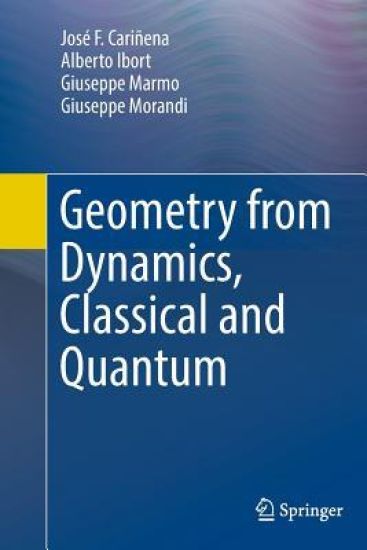
Geometry from Dynamics, Classical and Quantum

José F. Cariñena; Alberto Ibort; Giuseppe Marmo; Giuseppe Morandi

Springer
2016
nidottu
This book describes, by using elementary techniques, how some geometrical structures widely used today in many areas of physics, like symplectic, Poisson, Lagrangian, Hermitian, etc., emerge from dynamics. It is assumed that what can be accessed in actual experiences when studying a given system is just its dynamical behavior that is described by using a family of variables ("observables" of the system). The book departs from the principle that ''dynamics is first'' and then tries to answer in what sense the sole dynamics determines the geometrical structures that have proved so useful to describe the dynamics in so many important instances. In this vein it is shown that most of the geometrical structures that are used in the standard presentations of classical dynamics (Jacobi, Poisson, symplectic, Hamiltonian, Lagrangian) are determined, though in general not uniquely, by the dynamics alone. The same program is accomplished for the geometrical structures relevant to describe quantum dynamics. Finally, it is shown that further properties that allow the explicit description of the dynamics of certain dynamical systems, like integrability and super integrability, are deeply related to the previous development and will be covered in the last part of the book. The mathematical framework used to present the previous program is kept to an elementary level throughout the text, indicating where more advanced notions will be needed to proceed further. A family of relevant examples is discussed at length and the necessary ideas from geometry are elaborated along the text. However no effort is made to present an ''all-inclusive'' introduction to differential geometry as many other books already exist on the market doing exactly that. However, the development of the previous program, considered as the posing and solution of a generalized inverse problem for geometry, leads to new ways of thinking and relating some of the most conspicuous geometrical structures appearing in Mathematical and Theoretical Physics.

Advanced Concepts in Quantum Mechanics

Advanced Concepts in Quantum Mechanics

Giampiero Esposito; Giuseppe Marmo; Gennaro Miele; George Sudarshan

Cambridge University Press
2014
sidottu
Introducing a geometric view of fundamental physics, starting from quantum mechanics and its experimental foundations, this book is ideal for advanced undergraduate and graduate students in quantum mechanics and mathematical physics. Focusing on structural issues and geometric ideas, this book guides readers from the concepts of classical mechanics to those of quantum mechanics. The book features an original presentation of classical mechanics, with the choice of topics motivated by the subsequent development of quantum mechanics, especially wave equations, Poisson brackets and harmonic oscillators. It also presents new treatments of waves and particles and the symmetries in quantum mechanics, as well as extensive coverage of the experimental foundations.
Geometry from Dynamics, Classical and Quantum

Geometry from Dynamics, Classical and Quantum

José F. Cariñena; Alberto Ibort; Giuseppe Marmo; Giuseppe Morandi

Springer
2014
sidottu
This book describes, by using elementary techniques, how some geometrical structures widely used today in many areas of physics, like symplectic, Poisson, Lagrangian, Hermitian, etc., emerge from dynamics. It is assumed that what can be accessed in actual experiences when studying a given system is just its dynamical behavior that is described by using a family of variables ("observables" of the system). The book departs from the principle that ''dynamics is first'' and then tries to answer in what sense the sole dynamics determines the geometrical structures that have proved so useful to describe the dynamics in so many important instances. In this vein it is shown that most of the geometrical structures that are used in the standard presentations of classical dynamics (Jacobi, Poisson, symplectic, Hamiltonian, Lagrangian) are determined, though in general not uniquely, by the dynamics alone. The same program is accomplished for the geometrical structures relevant to describe quantum dynamics. Finally, it is shown that further properties that allow the explicit description of the dynamics of certain dynamical systems, like integrability and super integrability, are deeply related to the previous development and will be covered in the last part of the book. The mathematical framework used to present the previous program is kept to an elementary level throughout the text, indicating where more advanced notions will be needed to proceed further. A family of relevant examples is discussed at length and the necessary ideas from geometry are elaborated along the text. However no effort is made to present an ''all-inclusive'' introduction to differential geometry as many other books already exist on the market doing exactly that. However, the development of the previous program, considered as the posing and solution of a generalized inverse problem for geometry, leads to new ways of thinking and relating some of the most conspicuous geometrical structures appearing in Mathematical and Theoretical Physics.
Group Theory And Hopf Algebras: Lectures For Physicists

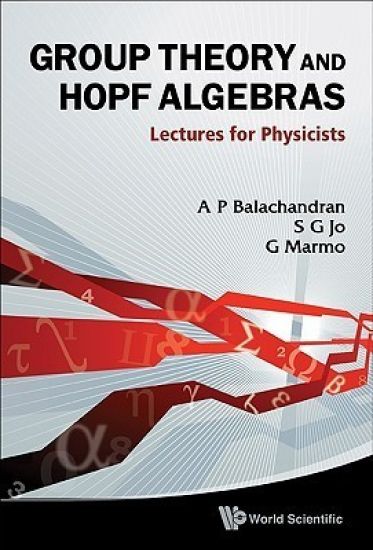
Group Theory And Hopf Algebras: Lectures For Physicists

Aiyalam P Balachandran; Sang G Jo; Giuseppe Marmo

World Scientific Publishing Co Pte Ltd
2010
sidottu
This book is addressed to graduate students and research workers in theoretical physics who want a thorough introduction to group theory and Hopf algebras. It is suitable for a one-semester course in group theory or a two-semester course which also treats advanced topics. Starting from basic definitions, it goes on to treat both finite and Lie groups as well as Hopf algebras. Because of the diversity in the choice of topics, which does not place undue emphasis on finite or Lie groups, it should be useful to physicists working in many branches.A unique aspect of the book is its treatment of Hopf algebras in a form accessible to physicists. Hopf algebras are generalizations of groups and their concepts are acquiring importance in the treatment of conformal field theories, noncommutative spacetimes, topological quantum computation and other important domains of investigation. But there is a scarcity of treatments of Hopf algebras at a level and in a manner that physicists are comfortable with. This book addresses this need superbly.There are illustrative examples from physics scattered throughout the book and in its set of problems. It also has a good bibliography. These features should enhance its value to readers.The authors are senior physicists with considerable research and teaching experience in diverse aspects of fundamental physics. The book, being the outcome of their combined efforts, stands testament to their knowledge and pedagogical skills.
From Classical to Quantum Mechanics

From Classical to Quantum Mechanics

Giampiero Esposito; Giuseppe Marmo; George Sudarshan

Cambridge University Press
2004
sidottu
This textbook provides a pedagogical introduction to the formalism, foundations and applications of quantum mechanics. Part I covers the basic material which is necessary to understand the transition from classical to wave mechanics. Topics include classical dynamics, with emphasis on canonical transformations and the Hamilton-Jacobi equation, the Cauchy problem for the wave equation, Helmholtz equation and eikonal approximation, introduction to spin, perturbation theory and scattering theory. The Weyl quantisation is presented in Part II, along with the postulates of quantum mechanics. Part III is devoted to topics such as statistical mechanics and black-body radiation, Lagrangian and phase-space formulations of quantum mechanics, and the Dirac equation. This book is intended for use as a textbook for beginning graduate and advanced undergraduate courses. It is self-contained and includes problems to aid the reader’s understanding.
Classical Topology And Quantum States

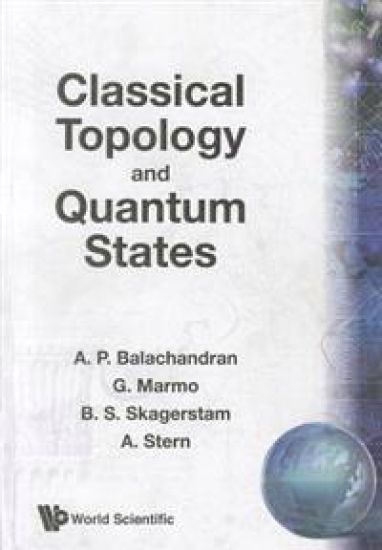
Classical Topology And Quantum States

Aiyalam P Balachandran; Giuseppe Marmo; A Stern; Bo-sture Skagerstam

World Scientific Publishing Co Pte Ltd
1991
nidottu
This book is an introduction to the role of topology in the quantization of classical systems. It is also an introduction to topological solitons with special emphasis on Skyrmions. As regards the first aspect, several issues of current interest are dealt with at a reasonably elementary level. Examples are principal fibre bundles and their role in quantum physics, the possibility of spinorial quantum states in a Lagrangian theory based on tensorial variables, and multiply connected configuration spaces and associated quantum phenomena like the QCD q angle and exotic statistics. The ideas are also illustrated by simple examples such as the spinning particle, the charge-monopole system and strings in 3+1 dimensions. The application of these ideas to quantum gravity is another subject treated at an introductory level. An attempt has been made in this book to introduce the reader to the significance of topology for many distinct physical systems such as spinning particles, the charge- monopole system, strings, Skyrmions, QCD and gravity. The book is an outgrowth of lectures given by the authors at various institutions and conferences.