Kirjojen hintavertailu. Mukana 12 595 353 kirjaa ja 12 kauppaa.

Kirjailija

Giuseppe Savare

Kirjat ja teokset yhdessä paikassa: 2 kirjaa, julkaisuja vuosilta 2008-2022, suosituimpien joukossa New Trends on Analysis and Geometry in Metric Spaces. Vertaile teosten hintoja ja tarkista saatavuus suomalaisista kirjakaupoista.

Mukana myös kirjoitusasut: Giuseppe Savaré

2 kirjaa

Kirjojen julkaisuhaarukka 2008-2022.

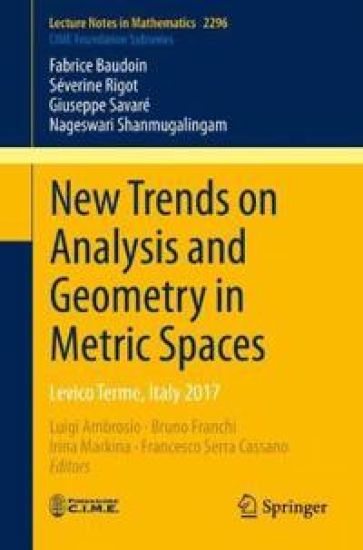
New Trends on Analysis and Geometry in Metric Spaces

New Trends on Analysis and Geometry in Metric Spaces

Fabrice Baudoin; Séverine Rigot; Giuseppe Savaré; Nageswari Shanmugalingam

Springer Nature Switzerland AG
2022
nidottu
This book includes four courses on geometric measure theory, the calculus of variations, partial differential equations, and differential geometry. Authored by leading experts in their fields, the lectures present different approaches to research topics with the common background of a relevant underlying, usually non-Riemannian, geometric structure. In particular, the topics covered concern differentiation and functions of bounded variation in metric spaces, Sobolev spaces, and differential geometry in the so-called Carnot–Carathéodory spaces. The text is based on lectures presented at the 10th School on "Analysis and Geometry in Metric Spaces" held in Levico Terme (TN), Italy, in collaboration with the University of Trento, Fondazione Bruno Kessler and CIME, Italy. The book is addressed to both graduate students and researchers.
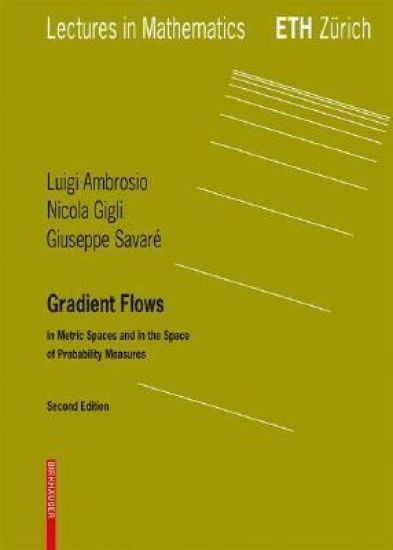
Gradient Flows

Gradient Flows

Luigi Ambrosio; Nicola Gigli; Giuseppe Savare

Birkhauser Verlag AG
2008
nidottu
The book is devoted to the theory of gradient flows in the general framework of metric spaces, and in the more specific setting of the space of probability measures, which provide a surprising link between optimal transportation theory and many evolutionary PDE's related to (non)linear diffusion. Particular emphasis is given to the convergence of the implicit time discretization method and to the error estimates for this discretization, extending the well established theory in Hilbert spaces. The book is split in two main parts that can be read independently of each other.