Kirjojen hintavertailu. Mukana 12 595 353 kirjaa ja 12 kauppaa.

Kirjailija

Glenn D. Hook

Kirjat ja teokset yhdessä paikassa: 11 kirjaa, julkaisuja vuosilta 1995-2019, suosituimpien joukossa Environmental Pollution and the Media. Vertaile teosten hintoja ja tarkista saatavuus suomalaisista kirjakaupoista.

11 kirjaa

Kirjojen julkaisuhaarukka 1995-2019.

Environmental Pollution and the Media

Environmental Pollution and the Media

Glenn D. Hook; Libby Lester; Meng Ji; Kingsley Edney; Chris G. Pope; Luli van der Does-Ishikawa

Routledge
2019
nidottu
This book offers a theoretically informed empirical investigation of national media reporting and political discourse on environmental issues in Australia, China and Japan. It illuminates the risks, harms and responsibilities associated with climate change through an analysis of pollution, adopting an interdisciplinary approach drawing on both the social sciences and humanities. A particular strength of the work is the detailed analysis of the data using a range of both quantitative and qualitative techniques, enabling the authors to reveal in rich and compelling detail the complex relationship between risk and responsibility in the climate change discourse.The case studies of Australia, China and Japan are set in the current literature as well as in the historical context of climate change in these three countries. The analysis of the media discourse on the Great Barrier Reef in Australia demonstrates how the mining of coal for overseas markets has led to devastating harm to the life of the reef. A critical discussion of the Chinese documentary, Under the Dome, shows how this medium has played a crucial role in building awareness of the harm from atmospheric pollution among the citizens, shaping attitudes and promoting action. The first case study of Japan elucidates how cross-border atmospheric pollution from China forges a chain of responsibility for responding to climate change, running from the state to society. The other case study of Japan demonstrates how ‘smart cities’ have emerged as a way to mitigate the risks and harms of climate change. The Conclusion draws together the similarities and differences in how climate change is addressed in the three countries.In all, Environmental Pollution and the Media: Political Discourses of Risk and Responsibility in Australia, China and Japan uncovers the dynamics of the triadic relationship among risk, harm and climate change in Australia, China and Japan. By so doing, the book makes an original and timely contribution to understanding comparative media, discourse and political debates on climate change.
Environmental Pollution and the Media

Environmental Pollution and the Media

Glenn D. Hook; Libby Lester; Meng Ji; Kingsley Edney; Chris G. Pope; Luli van der Does-Ishikawa

Routledge
2017
sidottu
This book offers a theoretically informed empirical investigation of national media reporting and political discourse on environmental issues in Australia, China and Japan. It illuminates the risks, harms and responsibilities associated with climate change through an analysis of pollution, adopting an interdisciplinary approach drawing on both the social sciences and humanities. A particular strength of the work is the detailed analysis of the data using a range of both quantitative and qualitative techniques, enabling the authors to reveal in rich and compelling detail the complex relationship between risk and responsibility in the climate change discourse.The case studies of Australia, China and Japan are set in the current literature as well as in the historical context of climate change in these three countries. The analysis of the media discourse on the Great Barrier Reef in Australia demonstrates how the mining of coal for overseas markets has led to devastating harm to the life of the reef. A critical discussion of the Chinese documentary, Under the Dome, shows how this medium has played a crucial role in building awareness of the harm from atmospheric pollution among the citizens, shaping attitudes and promoting action. The first case study of Japan elucidates how cross-border atmospheric pollution from China forges a chain of responsibility for responding to climate change, running from the state to society. The other case study of Japan demonstrates how ‘smart cities’ have emerged as a way to mitigate the risks and harms of climate change. The Conclusion draws together the similarities and differences in how climate change is addressed in the three countries.In all, Environmental Pollution and the Media: Political Discourses of Risk and Responsibility in Australia, China and Japan uncovers the dynamics of the triadic relationship among risk, harm and climate change in Australia, China and Japan. By so doing, the book makes an original and timely contribution to understanding comparative media, discourse and political debates on climate change.
Militarisation and Demilitarisation in Contemporary Japan
The intertwined issues of Japanese `identity' and `normality' are at the centre of the tension between internal and external pressures on Japanese defence and security policies. With chapters on peace thought, the militarisation and demilitarisation of language as well as the `hard' aspects of the Japanese military build up in the 1980s and the response to the Gulf War in the 1990s, this study challenges many of the preconceived notions on Japanese defence and security policies and the policy making process in Japan.
Regional Risk and Security in Japan

Regional Risk and Security in Japan

Glenn D. Hook; Ra Mason; Paul O'Shea

Routledge
2015
sidottu
Japan’s unusual position in the realm of international politics encapsulates a three-fold juxtaposition: both in and out of Asia, both occupied by and a close ally of the United States, and both a key trade partner and a strategic rival of China. Whilst international relations theory offers a number of ways to analyse these relations, this book instead utilizes the concept of risk to provide an innovative perspective on Japan’s relations with China, North Korea and the US.The book elucidates how risk, potential harm and harm are faced disproportionately by certain groups in society. This is demonstrated by providing an empirically rich analysis of the domestic implications of security relations with China, North Korea and the United States through the presence of US troops in Okinawa. Beginning with a theoretical discussion of risk, it goes on to demonstrate how the concept of risk adds value to the study of international relations in three senses. First, the concept helps to break down the boundaries between the international and domestic. Second, the focus on risk and the everyday directs us to ask basic questions about the costs and benefits of a security policy meant to secure the national population. Third, what implications do these two points have for governance? The question is one of governance as Japan’s externally oriented security policy produces domestic insecurity shared disproportionately, not equally, as this volume makes clear. Developing the theory of risk as a tool for understanding international relations, this book will be of great interest to students and scholars of Asian politics, Japanese politics, international relations and security studies, as well as to policy makers and practitioners working in the field.
Regional Risk and Security in Japan

Regional Risk and Security in Japan

Glenn D. Hook; Ra Mason; Paul O'Shea

Routledge
2015
nidottu
Japan’s unusual position in the realm of international politics encapsulates a three-fold juxtaposition: both in and out of Asia, both occupied by and a close ally of the United States, and both a key trade partner and a strategic rival of China. Whilst international relations theory offers a number of ways to analyse these relations, this book instead utilizes the concept of risk to provide an innovative perspective on Japan’s relations with China, North Korea and the US.The book elucidates how risk, potential harm and harm are faced disproportionately by certain groups in society. This is demonstrated by providing an empirically rich analysis of the domestic implications of security relations with China, North Korea and the United States through the presence of US troops in Okinawa. Beginning with a theoretical discussion of risk, it goes on to demonstrate how the concept of risk adds value to the study of international relations in three senses. First, the concept helps to break down the boundaries between the international and domestic. Second, the focus on risk and the everyday directs us to ask basic questions about the costs and benefits of a security policy meant to secure the national population. Third, what implications do these two points have for governance? The question is one of governance as Japan’s externally oriented security policy produces domestic insecurity shared disproportionately, not equally, as this volume makes clear. Developing the theory of risk as a tool for understanding international relations, this book will be of great interest to students and scholars of Asian politics, Japanese politics, international relations and security studies, as well as to policy makers and practitioners working in the field.
Japan's International Relations

Japan's International Relations

Glenn D. Hook; Julie Gilson; Christopher W. Hughes; Hugo Dobson

Routledge
2011
sidottu
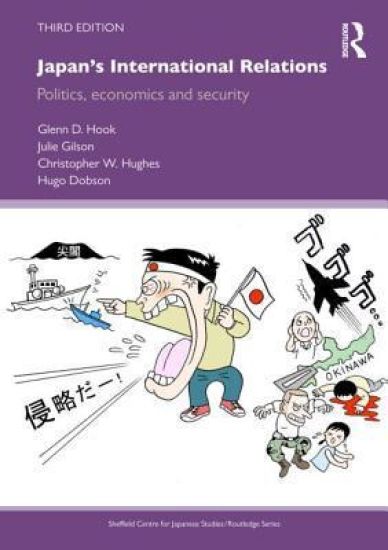
The latest edition of this comprehensive and user-friendly textbook provides a single volume resource for all those studying Japan's international relations. It offers a clear and concise introduction to the most important aspects of Japan's role in the globalized economy of the twenty-first century. The book has been fully updated and revised to include comprehensive discussions of contemporary key issues for Japan’s IR, including: the rise of China; reaction to the global economic and financial crisis since 2008; Japan’s proactive role after 9/11 and the war on terror; responses to events on the Korean Peninsula; relations with the USA and the Obama administration; relations with Russia, Central Asia and the Middle East; changing responses to an expanding and deepening European Union. Extensively illustrated, the text includes statistics, maps, photographs, summaries and suggestions for further reading, making it essential reading for those studying Japanese politics and the international relations of the Asia Pacific.A note on the cover:The cover illustration entitled 'Double Standard' is a Japanese manga penned by satirical artist Ichihanahana in November 2010 regarding rising Japanese nationalism, Japan-China tensions over the disputed territory of the Senkaku islands and the US presence in Okinawa. This manga demonstrates many of the key themes in Japan’s ties with China and the US, but also a number of other central features of Japan’s international relations as explored throughout this text.
Japan's International Relations

Japan's International Relations

Glenn D. Hook; Julie Gilson; Christopher W. Hughes; Hugo Dobson

Routledge
2011
nidottu
The latest edition of this comprehensive and user-friendly textbook provides a single volume resource for all those studying Japan's international relations. It offers a clear and concise introduction to the most important aspects of Japan's role in the globalized economy of the twenty-first century. The book has been fully updated and revised to include comprehensive discussions of contemporary key issues for Japan’s IR, including: the rise of China; reaction to the global economic and financial crisis since 2008; Japan’s proactive role after 9/11 and the war on terror; responses to events on the Korean Peninsula; relations with the USA and the Obama administration; relations with Russia, Central Asia and the Middle East; changing responses to an expanding and deepening European Union. Extensively illustrated, the text includes statistics, maps, photographs, summaries and suggestions for further reading, making it essential reading for those studying Japanese politics and the international relations of the Asia Pacific.A note on the cover:The cover illustration entitled 'Double Standard' is a Japanese manga penned by satirical artist Ichihanahana in November 2010 regarding rising Japanese nationalism, Japan-China tensions over the disputed territory of the Senkaku islands and the US presence in Okinawa. This manga demonstrates many of the key themes in Japan’s ties with China and the US, but also a number of other central features of Japan’s international relations as explored throughout this text.
Japan and Britain in the Contemporary World

Japan and Britain in the Contemporary World

Hugo Dobson; Glenn D. Hook

Routledge
2003
sidottu
Britian and Japan in the Contemporary World provides up-to-date analyses of these two countries in terms of economics, politics, security and identity on the global, regional, subnational and civic levels.The book moves beyond an analysis of state-to-state relations between Britain and Japan by examining the role of civil society in the relationship and analyzing the way the two countries deal with common issues, such as the 'special relationship' both maintain with the US; the relationship with the continents that both of these island nations border; the question of the degree of decentralization to allow within their contested borders. Both countries also face the pressures of globalization, as seen by the responses of the global cities of London and Tokyo.The editors have brought a selection of top scholars in a collection of chapters aimed at examining the similarities and differences in the way Britian and Japan respond to issues of common concern on these different levels.
Japan's Contested Constitution

Japan's Contested Constitution

Glenn D. Hook; Gavan McCormack

Routledge
2001
nidottu
Japan's Contested Constitution is essential reading for anyone with an interest in Japanese domestic politics and the international role of Japan. Subjects covered include;* the no war, `pacifist' clause* tension between the constitution and the US-Japan security treaty* the political import of the constitution for Japanese political parties* the significance of the constitution for the Japanese people
Japan's Contested Constitution

Japan's Contested Constitution

Glenn D. Hook; Gavan McCormack

Routledge
2001
sidottu
Japan's Contested Constitution is essential reading for anyone with an interest in Japanese domestic politics and the international role of Japan. Subjects covered include;* the no war, `pacifist' clause* tension between the constitution and the US-Japan security treaty* the political import of the constitution for Japanese political parties* the significance of the constitution for the Japanese people
Militarisation and Demilitarisation in Contemporary Japan
The intertwined issues of Japanese `identity' and `normality' are at the centre of the tension between internal and external pressures on Japanese defence and security policies. With chapters on peace thought, the militarisation and demilitarisation of language as well as the `hard' aspects of the Japanese military build up in the 1980s and the response to the Gulf War in the 1990s, this study challenges many of the preconceived notions on Japanese defence and security policies and the policy making process in Japan.