Kirjojen hintavertailu. Mukana 12 595 353 kirjaa ja 12 kauppaa.

Kirjailija

Goong Chen

Kirjat ja teokset yhdessä paikassa: 6 kirjaa, julkaisuja vuosilta 2006-2025, suosituimpien joukossa Chaotic Maps. Vertaile teosten hintoja ja tarkista saatavuus suomalaisista kirjakaupoista.

6 kirjaa

Kirjojen julkaisuhaarukka 2006-2025.

Chaotic Maps, Fractals, and Rapid Fluctuations

Chaotic Maps, Fractals, and Rapid Fluctuations

Liangliang Li; Yu Huang; Goong Chen

Springer International Publishing AG
2025
nidottu
This book was developed from lecture notes for an introductory graduate course and provides an essential introduction to chaotic maps in finite-dimensional spaces. Furthermore, the authors show how to apply this theory to infinite-dimensional systems corresponding to partial differential equations to study chaotic vibration of the wave equation subject to various types of nonlinear boundary conditions. The book provides background on chaos as a highly interesting nonlinear phenomenon and explains why it is one of the most important scientific findings of the past three decades. In addition, the book covers key topics including one-dimensional dynamical systems, bifurcations, general topological, symbolic dynamical systems, and fractals. The authors also show a class of infinite-dimensional nonlinear dynamical systems, which are reducible to interval maps, plus rapid fluctuations of chaotic maps. This second edition includes updated and expanded chapters as well as additional problems.
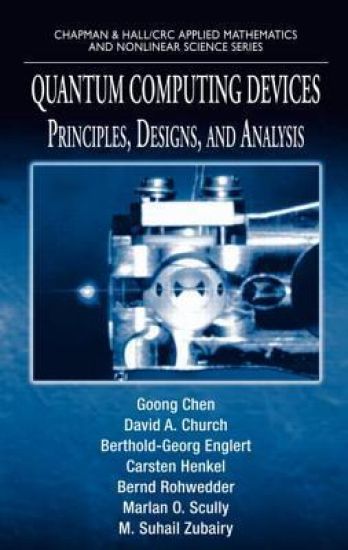
Quantum Computing Devices

Quantum Computing Devices

Goong Chen; David A. Church; Berthold-Georg Englert; Carsten Henkel; Bernd Rohwedder; Marlan O. Scully; M. Suhail Zubairy

CRC Press
2019
nidottu
One of the first books to thoroughly examine the subject, Quantum Computing Devices: Principles, Designs, and Analysis covers the essential components in the design of a "real" quantum computer. It explores contemporary and important aspects of quantum computation, particularly focusing on the role of quantum electronic devices as quantum gates. Largely self-contained and written in a tutorial style, this reference presents the analysis, design, and modeling of the major types of quantum computing devices: ion traps, cavity quantum electrodynamics (QED), linear optics, quantum dots, nuclear magnetic resonance (NMR), superconducting quantum interference devices (SQUID), and neutral atom traps. It begins by explaining the fundamentals and algorithms of quantum computing, followed by the operations and formalisms of quantum systems. For each electronic device, the subsequent chapters discuss physical properties, the setup of qubits, control actions that produce the quantum gates that are universal for quantum computing, relevant measurements, and decoherence properties of the systems. The book also includes tables, diagrams, and figures that illustrate various data, uses, and designs of quantum computing. As nanoelectronics will inevitably replace microelectronics, the development of quantum information science and quantum computing technology is imperative to the future of information science and technology. Quantum Computing Devices: Principles, Designs, and Analysis helps fulfill this need by providing a comprehensive collection of the most promising devices for the future.
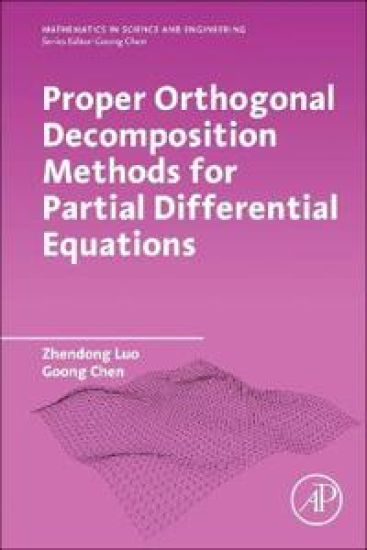
Proper Orthogonal Decomposition Methods for Partial Differential Equations
Proper Orthogonal Decomposition Methods for Partial Differential Equations evaluates the potential applications of POD reduced-order numerical methods in increasing computational efficiency, decreasing calculating load and alleviating the accumulation of truncation error in the computational process. Introduces the foundations of finite-differences, finite-elements and finite-volume-elements. Models of time-dependent PDEs are presented, with detailed numerical procedures, implementation and error analysis. Output numerical data are plotted in graphics and compared using standard traditional methods. These models contain parabolic, hyperbolic and nonlinear systems of PDEs, suitable for the user to learn and adapt methods to their own R&D problems.
Chaotic Maps

Chaotic Maps

Goong Chen; Yu Huang

Springer International Publishing AG
2011
nidottu
This book consists of lecture notes for a semester-long introductory graduate course on dynamical systems and chaos taught by the authors at Texas A&M University and Zhongshan University, China. There are ten chapters in the main body of the book, covering an elementary theory of chaotic maps in finite-dimensional spaces. The topics include one-dimensional dynamical systems (interval maps), bifurcations, general topological, symbolic dynamical systems, fractals and a class of infinite-dimensional dynamical systems which are induced by interval maps, plus rapid fluctuations of chaotic maps as a new viewpoint developed by the authors in recent years. Two appendices are also provided in order to ease the transitions for the readership from discrete-time dynamical systems to continuous-time dynamical systems, governed by ordinary and partial differential equations. Table of Contents: Simple Interval Maps and Their Iterations / Total Variations of Iterates of Maps / Ordering among Periods: The Sharkovski Theorem / Bifurcation Theorems for Maps / Homoclinicity. Lyapunoff Exponents / Symbolic Dynamics, Conjugacy and Shift Invariant Sets / The Smale Horseshoe / Fractals / Rapid Fluctuations of Chaotic Maps on RN / Infinite-dimensional Systems Induced by Continuous-Time Difference Equations
Quantum Computing Devices

Quantum Computing Devices

Goong Chen; David A. Church; Berthold-Georg Englert; Carsten Henkel; Bernd Rohwedder; Marlan O. Scully; M. Suhail Zubairy

Chapman Hall/CRC
2006
sidottu
One of the first books to thoroughly examine the subject, Quantum Computing Devices: Principles, Designs, and Analysis covers the essential components in the design of a "real" quantum computer. It explores contemporary and important aspects of quantum computation, particularly focusing on the role of quantum electronic devices as quantum gates. Largely self-contained and written in a tutorial style, this reference presents the analysis, design, and modeling of the major types of quantum computing devices: ion traps, cavity quantum electrodynamics (QED), linear optics, quantum dots, nuclear magnetic resonance (NMR), superconducting quantum interference devices (SQUID), and neutral atom traps. It begins by explaining the fundamentals and algorithms of quantum computing, followed by the operations and formalisms of quantum systems. For each electronic device, the subsequent chapters discuss physical properties, the setup of qubits, control actions that produce the quantum gates that are universal for quantum computing, relevant measurements, and decoherence properties of the systems. The book also includes tables, diagrams, and figures that illustrate various data, uses, and designs of quantum computing. As nanoelectronics will inevitably replace microelectronics, the development of quantum information science and quantum computing technology is imperative to the future of information science and technology. Quantum Computing Devices: Principles, Designs, and Analysis helps fulfill this need by providing a comprehensive collection of the most promising devices for the future.