Kirjojen hintavertailu. Mukana 12 595 353 kirjaa ja 12 kauppaa.

Kirjailija

Gordon B. Willis

Kirjat ja teokset yhdessä paikassa: 3 kirjaa, julkaisuja vuosilta 2004-2011, suosituimpien joukossa Cognitive Interviewing. Vertaile teosten hintoja ja tarkista saatavuus suomalaisista kirjakaupoista.

3 kirjaa

Kirjojen julkaisuhaarukka 2004-2011.

Question Evaluation Methods

Question Evaluation Methods

Jennifer Madans; Kristen Miller; Aaron Maitland; Gordon B. Willis

John Wiley Sons Inc
2011
nidottu
Insightful observations on common question evaluation methods and best practices for data collection in survey research Featuring contributions from leading researchers and academicians in the field of survey research, Question Evaluation Methods: Contributing to the Science of Data Quality sheds light on question response error and introduces an interdisciplinary, cross-method approach that is essential for advancing knowledge about data quality and ensuring the credibility of conclusions drawn from surveys and censuses. Offering a variety of expert analyses of question evaluation methods, the book provides recommendations and best practices for researchers working with data in the health and social sciences. Based on a workshop held at the National Center for Health Statistics (NCHS), this book presents and compares various question evaluation methods that are used in modern-day data collection and analysis. Each section includes an introduction to a method by a leading authority in the field, followed by responses from other experts that outline related strengths, weaknesses, and underlying assumptions. Topics covered include: Behavior codingCognitive interviewingItem response theoryLatent class analysisSplit-sample experimentsMultitrait-multimethod experimentsField-based data methods A concluding discussion identifies common themes across the presented material and their relevance to the future of survey methods, data analysis, and the production of Federal statistics. Together, the methods presented in this book offer researchers various scientific approaches to evaluating survey quality to ensure that the responses to these questions result in reliable, high-quality data. Question Evaluation Methods is a valuable supplement for courses on questionnaire design, survey methods, and evaluation methods at the upper-undergraduate and graduate levels. it also serves as a reference for government statisticians, survey methodologists, and researchers and practitioners who carry out survey research in the areas of the social and health sciences.
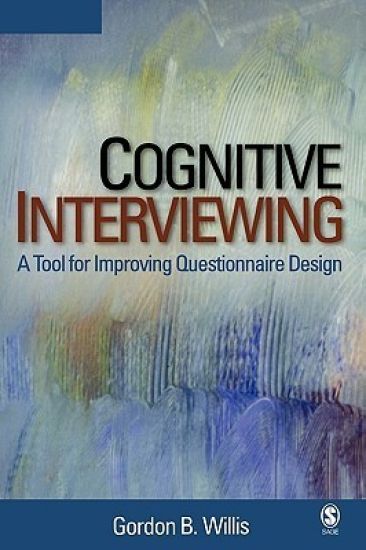
Cognitive Interviewing

Cognitive Interviewing

Gordon B. Willis

SAGE Publications Inc
2005
sidottu
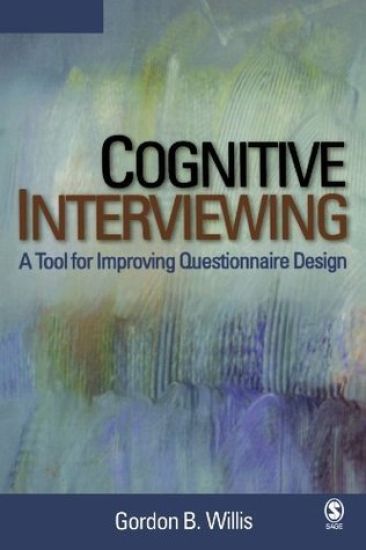
"As both an academic instructor in questionnaire design and a research design methodologist for the federal government, I feel this book is very timely, useful for students and practitioners, and unique in its use of real world practical examples that most everyone can relate."—Terry Richardson, General Accounting Office "The combination of theory and practical application will make this a useful book for students as well as professionals who want to learn how to incorporate cognitive interviewing into the questionnaire design process."—Rachel Caspar, RTI International The design and evaluation of questionnaires—and of other written and oral materials—is a challenging endeavor, fraught with potential pitfalls. Cognitive Interviewing: A Tool for Improving Questionnaire Design describes a means of systematically developing survey questions through investigations that intensively probe the thought processes of individuals who are presented with those inquiries. The work provides general guidance about questionnaire design, development, and pre-testing sequence, with an emphasis on the cognitive interview. In particular, the book gives detailed instructions about the use of verbal probing techniques, and how one can elicit additional information from subjects about their thinking and about the manner in which they react to tested questions. These tools help researchers discover how well their questions are working, where they are failing, and determine what they can do to rectify the wide variety of problems that may surface while working with questionnaires. Cognitive Interviewing is ideally suited as a course text for advanced undergraduate and graduate research courses across the social sciences. Professional researchers and faculty in the social sciences, as well as practice fields such as medicine, business, and education, will also find this an invaluable reference for survey research. There is no other book on the market that covers cognitive interviewing as applied to questionnaire design.
Cognitive Interviewing

Cognitive Interviewing

Gordon B. Willis

SAGE Publications Inc
2004
nidottu
"As both an academic instructor in questionnaire design and a research design methodologist for the federal government, I feel this book is very timely, useful for students and practitioners, and unique in its use of real world practical examples that most everyone can relate."—Terry Richardson, General Accounting Office "The combination of theory and practical application will make this a useful book for students as well as professionals who want to learn how to incorporate cognitive interviewing into the questionnaire design process."—Rachel Caspar, RTI International The design and evaluation of questionnaires—and of other written and oral materials—is a challenging endeavor, fraught with potential pitfalls. Cognitive Interviewing: A Tool for Improving Questionnaire Design describes a means of systematically developing survey questions through investigations that intensively probe the thought processes of individuals who are presented with those inquiries. The work provides general guidance about questionnaire design, development, and pre-testing sequence, with an emphasis on the cognitive interview. In particular, the book gives detailed instructions about the use of verbal probing techniques, and how one can elicit additional information from subjects about their thinking and about the manner in which they react to tested questions. These tools help researchers discover how well their questions are working, where they are failing, and determine what they can do to rectify the wide variety of problems that may surface while working with questionnaires. Cognitive Interviewing is ideally suited as a course text for advanced undergraduate and graduate research courses across the social sciences. Professional researchers and faculty in the social sciences, as well as practice fields such as medicine, business, and education, will also find this an invaluable reference for survey research. There is no other book on the market that covers cognitive interviewing as applied to questionnaire design.