Kirjojen hintavertailu. Mukana 12 390 323 kirjaa ja 12 kauppaa.
Kirjailija
Gordon E. Willmot
Kirjat ja teokset yhdessä paikassa: 10 kirjaa, julkaisuja vuosilta 2000-2019, suosituimpien joukossa Lundberg Approximations for Compound Distributions with Insurance Applications. Vertaile teosten hintoja ja tarkista saatavuus suomalaisista kirjakaupoista.
This set includes the textbook, Loss Models: From Data to Decisions, Third Edition, the solutions manual, Loss Models: From Data to Decisions, Solutions Manual, Third Edition and the ExamPrep for Loss Models: From Data to Decisions, Online, 3rd Edition. To explore our additional offerings in actuarial exam preparation visit www. wiley.
These notes represent our summary of much of the recent research that has been done in recent years on approximations and bounds that have been developed for compound distributions and related quantities which are of interest in insurance and other areas of application in applied probability. The basic technique employed in the derivation of many bounds is induc tive, an approach that is motivated by arguments used by Sparre-Andersen (1957) in connection with a renewal risk model in insurance. This technique is both simple and powerful, and yields quite general results. The bounds themselves are motivated by the classical Lundberg exponential bounds which apply to ruin probabilities, and the connection to compound dis tributions is through the interpretation of the ruin probability as the tail probability of a compound geometric distribution. The initial exponential bounds were given in Willmot and Lin (1994), followed by the nonexpo nential generalization in Willmot (1994). Other related work on approximations for compound distributions and applications to various problems in insurance in particular and applied probability in general is also discussed in subsequent chapters. The results obtained or the arguments employed in these situations are similar to those for the compound distributions, and thus we felt it useful to include them in the notes. In many cases we have included exact results, since these are useful in conjunction with the bounds and approximations developed.
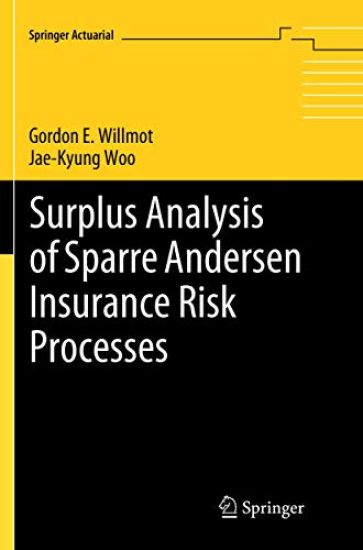
This carefully written monograph covers the Sparre Andersen process in an actuarial context using the renewal process as the model for claim counts. A unified reference on Sparre Andersen (renewal risk) processes is included, often missing from existing literature. The authors explore recent results and analyse various risk theoretic quantities associated with the event of ruin, including the time of ruin and the deficit of ruin. Particular attention is given to the explicit identification of defective renewal equation components, which are needed to analyse various risk theoretic quantities and are also relevant in other subject areas of applied probability such as dams and storage processes, as well as queuing theory. Aimed at researchers interested in risk/ruin theory and related areas, this work will also appeal to graduate students in classical and modern risk theory and Gerber-Shiu analysis.
A guide that provides in-depth coverage of modeling techniques used throughout many branches of actuarial science, revised and updated Now in its fifth edition, Loss Models: From Data to Decisions puts the focus on material tested in the Society of Actuaries (SOA) newly revised Exams STAM (Short-Term Actuarial Mathematics) and LTAM (Long-Term Actuarial Mathematics). Updated to reflect these exam changes, this vital resource offers actuaries, and those aspiring to the profession, a practical approach to the concepts and techniques needed to succeed in the profession. The techniques are also valuable for anyone who uses loss data to build models for assessing risks of any kind. Loss Models contains a wealth of examples that highlight the real-world applications of the concepts presented, and puts the emphasis on calculations and spreadsheet implementation. With a focus on the loss process, the book reviews the essential quantitative techniques such as random variables, basic distributional quantities, and the recursive method, and discusses techniques for classifying and creating distributions. Parametric, non-parametric, and Bayesian estimation methods are thoroughly covered. In addition, the authors offer practical advice for choosing an appropriate model. This important text: • Presents a revised and updated edition of the classic guide for actuaries that aligns with newly introduced Exams STAM and LTAM • Contains a wealth of exercises taken from previous exams • Includes fresh and additional content related to the material required by the Society of Actuaries (SOA) and the Canadian Institute of Actuaries (CIA) • Offers a solutions manual available for further insight, and all the data sets and supplemental material are posted on a companion site Written for students and aspiring actuaries who are preparing to take the SOA examinations, Loss Models offers an essential guide to the concepts and techniques of actuarial science.
Loss Models: From Data to Decisions, Fifth Edition continues to supply actuaries with a practical approach to the key concepts and techniques needed on the job. With updated material and extensive examples, the book successfully provides the essential methods for using available data to construct models for the frequency and severity of future adverse outcomes. The book continues to equip readers with the tools needed for the construction and analysis of mathematical models that describe the process by which funds flow into and out of an insurance system. Focusing on the loss process, the authors explore key quantitative techniques including random variables, basic distributional quantities, and the recursive method, and discuss techniques for classifying and creating distributions. Parametric, non-parametric, and Bayesian estimation methods are thoroughly covered along with advice for choosing an appropriate model. Throughout the book, numerous examples showcase the real-world applications of the presented concepts, with an emphasis on calculations and spreadsheet implementation. Loss Models: From Data to Decisions, Fifth Edition is an indispensable resource for students and aspiring actuaries who are preparing to take the SOA and CAS examinations. The book is also a valuable reference for professional actuaries, actuarial students, and anyone who works with loss and risk models.
This carefully written monograph covers the Sparre Andersen process in an actuarial context using the renewal process as the model for claim counts. A unified reference on Sparre Andersen (renewal risk) processes is included, often missing from existing literature. The authors explore recent results and analyse various risk theoretic quantities associated with the event of ruin, including the time of ruin and the deficit of ruin. Particular attention is given to the explicit identification of defective renewal equation components, which are needed to analyse various risk theoretic quantities and are also relevant in other subject areas of applied probability such as dams and storage processes, as well as queuing theory. Aimed at researchers interested in risk/ruin theory and related areas, this work will also appeal to graduate students in classical and modern risk theory and Gerber-Shiu analysis.
An essential resource for constructing and analyzing advanced actuarial models Loss Models: Further Topics presents extended coverage of modeling through the use of tools related to risk theory, loss distributions, and survival models. The book uses these methods to construct and evaluate actuarial models in the fields of insurance and business. Providing an advanced study of actuarial methods, the book features extended discussions of risk modeling and risk measures, including Tail-Value-at-Risk. Loss Models: Further Topics contains additional material to accompany the Fourth Edition of Loss Models: From Data to Decisions, such as: Extreme value distributionsCoxian and related distributionsMixed Erlang distributionsComputational and analytical methods for aggregate claim modelsCounting processesCompound distributions with time-dependent claim amountsCopula modelsContinuous time ruin modelsInterpolation and smoothing The book is an essential reference for practicing actuaries and actuarial researchers who want to go beyond the material required for actuarial qualification. Loss Models: Further Topics is also an excellent resource for graduate students in the actuarial field.
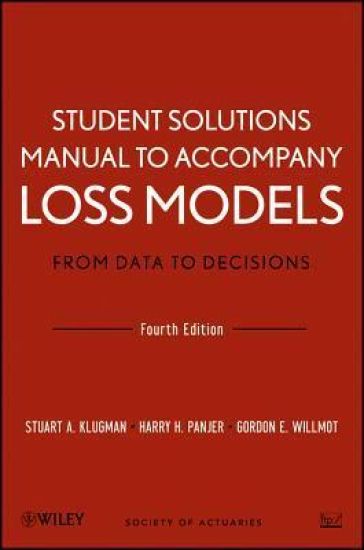
Student Solutions Manual to Accompany Loss Models: From Data to Decisions, Fourth Edition. This volume is organised around the principle that much of actuarial science consists of the construction and analysis of mathematical models which describe the process by which funds flow into and out of an insurance system.
This set includes the textbook, "Loss Models: From Data to Decisions, Third Edition, " ISBN 978-0-470-18781-4 and the "ExamPrep for Loss Models: From Data to Decisions, Online, 3rd Edition" ISBN 978-0-470-30857-8. To explore our additional offerings in actuarial exam preparation, visit www.wiley.com/go/actuarialexamprep
An update of one of the most trusted books on constructing and analyzing actuarial models for the C/4 actuarial exam This new, abridged edition has been thoroughly revised and updated to include the essential material related to Exam C of the Society of Actuaries' and Casualty Actuarial Society's accreditation programs. The book maintains an approach to modeling and forecasting that utilizes tools related to risk theory, loss distributions, and survival models. Random variables, basic distributional quantities, the recursive method, and techniques for classifying and creating distributions are also discussed. Both parametric and non-parametric estimation methods are thoroughly covered along with advice for choosing an appropriate model. The book continues to distinguish itself by providing over 400 exercises that have appeared on previous examinations.The emphasis throughout is now placed on calculations and spreadsheet implementation.Additional features of the Fourth Edition include: extended discussions of risk management and risk measures, including Tail-Value-at-Risk; expanded coverage of copula models and their estimation; new sections on extreme value distributions and their estimations, compound frequency class of distributions, and estimation for the compound class; and motivating examples from fields of insurance and business. All data sets are available on an FTP site. An assortment of supplements (both print and electronic) is available. Loss Models, Fourth Edition is an essential resource for students and aspiring actuaries who are preparing to take the SOA and CAS preliminary examinations C/4. It is also a must-have reference for professional actuaries, graduate students in the actuarial field, and anyone who works with loss and risk models in their everyday work. To explore our additional offerings in actuarial exam preparationvisit www.wiley.com/go/c4actuarial .