Kirjojen hintavertailu. Mukana 12 442 041 kirjaa ja 12 kauppaa.

Kirjailija

Gordon S. Wood

Kirjat ja teokset yhdessä paikassa: 14 kirjaa, julkaisuja vuosilta 1969-2026, suosituimpien joukossa Common Sense. Vertaile teosten hintoja ja tarkista saatavuus suomalaisista kirjakaupoista.

14 kirjaa

Kirjojen julkaisuhaarukka 1969-2026.

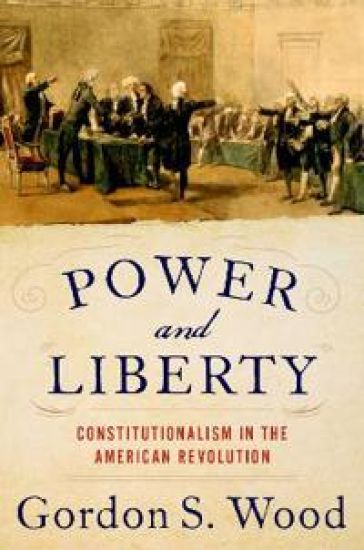
Power and Liberty

Power and Liberty

Gordon S. Wood

OXFORD UNIVERSITY PRESS INC
2026
nidottu
New York Times bestseller and Pulitzer Prize-winning author Gordon S. Wood elucidates the debates over the founding documents of the United States, featuring a new afterword reflecting on the 250th anniversary of American independence. The half century extending from the imperial crisis between Britain and its colonies in the 1760s to the early decades of the new republic of the United States was the greatest and most creative era of constitutionalism in American history, and perhaps in the world. During these decades, Americans explored and debated all aspects of politics and constitutionalism--the nature of power, liberty, representation, rights, the division of authority between different spheres of government, sovereignty, judicial authority, and written constitutions. The results of these issues produced institutions that have lasted for over two centuries. In this book, eminent historian Gordon S. Wood distills a lifetime of work on constitutional innovations during the Revolutionary era. In concise form, he illuminates critical events in the nation's founding, ranging from the imperial debate that led to the Declaration of Independence to the revolutionary state constitution making in 1776 and the creation of the Federal Constitution in 1787. Among other topics, he discusses slavery and constitutionalism, the emergence of the judiciary as one of the major tripartite institutions of government, the demarcation between public and private, and the formation of states' rights. In a new afterword, he addresses issues of constitutionalism in light of the semiquincentennial in 2026. Here is an immensely readable synthesis of the key era in the making of the history of the United States, presenting timely insights on the Constitution and the nation's foundational legal and political documents.

Power and Liberty

Power and Liberty

Gordon S. Wood

Oxford University Press Inc
2021
sidottu
New York Times bestseller and Pulitzer Prize-winning author Gordon S. Wood elucidates the debates over the founding documents of the United States. The half century extending from the imperial crisis between Britain and its colonies in the 1760s to the early decades of the new republic of the United States was the greatest and most creative era of constitutionalism in American history, and perhaps in the world. During these decades, Americans explored and debated all aspects of politics and constitutionalism--the nature of power, liberty, representation, rights, the division of authority between different spheres of government, sovereignty, judicial authority, and written constitutions. The results of these issues produced institutions that have lasted for over two centuries. In this new book, eminent historian Gordon S. Wood distills a lifetime of work on constitutional innovations during the Revolutionary era. In concise form, he illuminates critical events in the nation's founding, ranging from the imperial debate that led to the Declaration of Independence to the revolutionary state constitution making in 1776 and the creation of the Federal Constitution in 1787. Among other topics, he discusses slavery and constitutionalism, the emergence of the judiciary as one of the major tripartite institutions of government, the demarcation between public and private, and the formation of states' rights. Here is an immensely readable synthesis of the key era in the making of the history of the United States, presenting timely insights on the Constitution and the nation's foundational legal and political documents.
The Idea of America: Reflections on the Birth of the United States
"Exceptional... a remarkable study of the key chapter of American history and its ongoing influence on American character."--Publishers Weekly (starred review) The Pulitzer Prize-winning historian of the Founding Era reflects on the birth of American nationhood and explains why the American Revolution remains so essential to our identity and culture. For Gordon S. Wood, the American Revolution is the most important event in our history, bar none. Since American identity is so fluid and complex, we have had to continually return to our nation's founding to understand who we are. In a series of illuminating essays, he explores the ideological origins of the Revolution--from Ancient Rome to the European Enlightenment--and the founders' attempts to forge a new democracy. He reflects on the origins of American exceptionalism, the radicalism and failed hopes of the founding generation, and the "terrifying gap" between us and the men who created the democratic state we now take for granted. Gracefully written and filled with insight, The Idea of America is a profoundly revealing look at the event that forged the United States and its enduring power to define us.
Empire of Liberty

Empire of Liberty

Gordon S. Wood

Oxford University Press Inc
2011
nidottu
The Oxford History of the United States is by far the most respected multi-volume history of the USA. The series includes three Pulitzer Prize winners, two New York Times bestsellers, and winners of the Bancroft and Parkman Prizes. Now, in the newest volume in the series, one of America's most esteemed historians, Gordon S. Wood, offers a brilliant account of the early American Republic, ranging from 1789 and the beginning of the national government to the end of the War of 1812. As Wood reveals, the period was marked by tumultuous change in all aspects of American life--in politics, society, economy, and culture. The men who founded the new government had high hopes for the future, but few of their hopes and dreams worked out quite as they expected. They hated political parties but parties nonetheless emerged. Some wanted the United States to become a great fiscal-military state like those of Britain and France; others wanted the country to remain a rural agricultural state very different from the European states. Instead, by 1815 the United States became something neither group anticipated. Many leaders expected American culture to flourish and surpass that of Europe; instead it became popularized and vulgarized. The leaders also hope to see the end of slavery; instead, despite the release of many slaves and the end of slavery in the North, slavery was stronger in 1815 than it had been in 1789. Many wanted to avoid entanglements with Europe, but instead the country became involved in Europe's wars and ended up waging another war with the former mother country. Still, with a new generation emerging by 1815, most Americans were confident and optimistic about the future of their country. Integrating all aspects of life, from politics and law to the economy and culture, Empire of Liberty offers a marvelous account of this pivotal era when America took its first unsteady steps as a new and rapidly expanding nation. A Finalist for the Pulitzer Prize for History Winner of the New-York Historical Society American History Book Prize A New York Times Bestseller Selected as one of the Top 25 Books of 2009 by The Atlantic "On every page of this book, Wood's subtlety and erudition show. Grand in scope and a landmark achievement of scholarship, Empire of Liberty is a tour de force, the culmination of a lifetime of brilliant thinking and writing." --The New York Times Book Review "Empire of Liberty will rightly take its place among the authoritative volumes in this important and influential series." --The Washington Post
Empire of Liberty

Empire of Liberty

Gordon S. Wood

Oxford University Press Inc
2010
sidottu
The Oxford History of the United States is by far the most respected multi-volume history of the USA. The series includes three Pulitzer Prize winners, two New York Times bestsellers, and winners of the Bancroft and Parkman Prizes. Now, in the newest volume in the series, one of America's most esteemed historians, Gordon S. Wood, offers a brilliant account of the early American Republic, ranging from 1789 and the beginning of the national government to the end of the War of 1812. As Wood reveals, the period was marked by tumultuous change in all aspects of American life--in politics, society, economy, and culture. The men who founded the new government had high hopes for the future, but few of their hopes and dreams worked out quite as they expected. They hated political parties but parties nonetheless emerged. Some wanted the United States to become a great fiscal-military state like those of Britain and France; others wanted the country to remain a rural agricultural state very different from the European states. Instead, by 1815 the United States became something neither group anticipated. Many leaders expected American culture to flourish and surpass that of Europe; instead it became popularized and vulgarized. The leaders also hope to see the end of slavery; instead, despite the release of many slaves and the end of slavery in the North, slavery was stronger in 1815 than it had been in 1789. Many wanted to avoid entanglements with Europe, but instead the country became involved in Europe's wars and ended up waging another war with the former mother country. Still, with a new generation emerging by 1815, most Americans were confident and optimistic about the future of their country. Integrating all aspects of life, from politics and law to the economy and culture, Empire of Liberty offers a marvelous account of this pivotal era when America took its first unsteady steps as a new and rapidly expanding nation.
The Purpose of the Past: Reflections on the Uses of History
An erudite scholar and an elegant writer, Gordon S. Wood has won both numerous awards and a broad readership since the 1969 publication of his widely acclaimed The Creation of the American Republic. With The Purpose of the Past, Wood has essentially created a history of American history, assessing the current state of the narrative vis- -vis the work of some of its most important scholars--doling out praise and scorn with equal measure. In this wise, passionate defense of history's ongoing necessity, Wood argues that we cannot make intelligent decisions about the future without understanding our past, offering a master's insight into what history--at its best--can be and its essential role in our culture.
Representation in the American Revolution

Representation in the American Revolution

Gordon S. Wood

University of Virginia Press
2008
nidottu
From one of America's most celebrated historians, the Pulitzer Prize winner Gordon S. Wood, comes an early work whose relevance is undiminished. Originally published in 1969, now revised and with a new preface, ""Representation in the American Revolution"" examines the ways in which a government is created and how, in the face of great difficulties as well as great possibilities, its citizens are represented. Written immediately after the completion of Wood's Bancroft Award - winning ""The Creation of the American Republic"", this book elaborates on issues also explored in that landmark work.The subject is one that lies at the heart of any discussion of democracy. Establishing a proper method of representation was a goal and measure of the American Revolution, or as Thomas Jefferson said in 1776, ""the whole object of the present controversy."" A fine example of political and constitutional history, this timeless little book will serve as an excellent introduction to issues of representation for students in the fields of political science, as well as history and law.
Revolutionary Characters: What Made the Founders Different
A New York Times bestseller "Of those writing about the founding fathers, Gordon Wood] is quite simply the best." --The Philadelphia InquirerIn this brilliantly illuminating group portrait of the men who came to be known as the Founding Fathers, the incomparable Gordon Wood has written a book that seriously asks, What made these men great, and shows us, among many other things, just how much character did in fact matter. The life of each--Washington, Adams, Jefferson, Franklin, Hamilton, Madison, Paine--is presented individually as well as collectively, but the thread that binds these portraits together is the idea of character as a lived reality. They were members of the first generation in history that was self-consciously self-made men who understood that the arc of lives, as of nations, is one of moral progress.
The Americanization of Benjamin Franklin

The Americanization of Benjamin Franklin

Gordon S. Wood

PENGUIN BOOKS
2005
nidottu
"I cannot remember ever reading a work of history and biography that is quite so fluent, so perfectly composed and balanced . . ." --The New York Sun"Exceptionally rich perspective on one of the most accomplished, complex, and unpredictable Americans of his own time or any other." --The Washington Post Book WorldFrom the most respected chronicler of the early days of the Republic--and winner of both the Pulitzer and Bancroft prizes--comes a landmark work that rescues Benjamin Franklin from a mythology that has blinded generations of Americans to the man he really was and makes sense of aspects of his life and career that would have otherwise remained mysterious. In place of the genial polymath, self-improver, and quintessential American, Gordon S. Wood reveals a figure much more ambiguous and complex--and much more interesting. Charting the passage of Franklin's life and reputation from relative popular indifference (his death, while the occasion for mass mourning in France, was widely ignored in America) to posthumous glory, The Americanization of Benjamin Franklin sheds invaluable light on the emergence of our country's idea of itself.
The American Revolution: A History

The American Revolution: A History

Gordon S. Wood

Modern Library
2003
nidottu
The distinguished, Pulitzer Prize-winning historian presents a concise history of the American Revolution and the birth of the American republic, from the earliest hints of revolt and unrest through the ratification of the Constitution. Reprint. 50,000 first printing.