Kirjojen hintavertailu. Mukana 12 390 323 kirjaa ja 12 kauppaa.
Kirjailija
Gordon T. Lee
Kirjat ja teokset yhdessä paikassa: 12 kirjaa, julkaisuja vuosilta 2005-2020, suosituimpien joukossa Keeping a Competitive U.S. Military Aircraft Industry Aloft. Vertaile teosten hintoja ja tarkista saatavuus suomalaisista kirjakaupoista.
John Birkler; John F. Schank; Mark V. Arena; Edward G. Keating; Joel B. Predd; James Black; Irina Danescu; Dan Jenkins; James G. Kallimani; Gordon T. Lee; Roger Lough; Robert Murphy; David Nicholls; Deborah Peetz; Brian Perkinson; Jerry M. Sollinger; Shane Tierney; Obaid Younossi
To prepare for its next Defence White Paper, Australia is examining an enterprise-level naval shipbuilding plan. To support this effort, RAND researchers explore the feasibility of Australia sustaining a domestic naval shipbuilding industry compared with buying ships from foreign shipbuilders. The authors outline the complex consequences and trade-offs of both options.
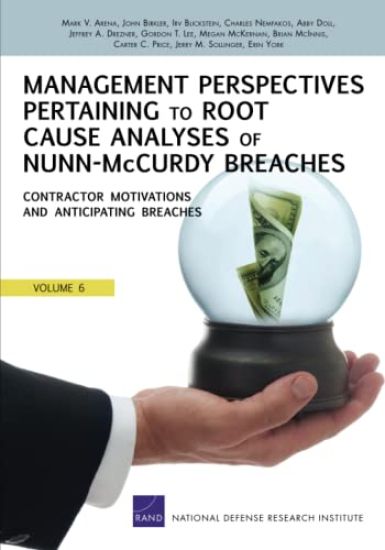
Mark V. Arena; Irv Blickstein; Abby Doll; Jeffrey A. Drezner; Megan McKErnan; Charles Nemfakos; Jerry M. Sollinger; John Birkler; Gordon T. Lee; Brian McInnis; Carter C. Price; Erin York
The authors explore defense contractor motivations and identify mechanisms that might more closely align those incentives with Department of Defense goals. They also analyze major defense acquisition programs to determine if it is possible to identify programs that might incur a future Nunn-McCurdy breach by reviewing a number of acquisition programs that have incurred breaches and analyzing them for common characteristics.
This volume presents a set of lessons learned from Australia's Collins submarine program that could help inform future program managers. Collins was the first submarine built in Australia. RAND investigated how operational requirements were set for the Collins class; explored the acquisition, contracting, design, and build processes that the program employed; and assessed the activities surrounding integrated logistics support for the class.
The United States, the United Kingdom, and Australia asked the RAND Corporation to develop a set of lessons learned from previous submarine programs that could help inform future program managers. This volume presents an overview of five submarine programs in the three countries - the UK's Astute program; the U.S. Navy's Ohio, Seawolf, and Virginia programs; and Australia's Collins program - and identifies lessons that apply to all of them.
This volume presents a set of lessons learned from the United Kingdom's Astute submarine program that could help inform future program managers. Designing and building a submarine requires careful management and oversight and a delegation of roles and responsibilities that recognizes which party - the shipbuilder or the government - is best positioned to manage risks.
The U.S. Navy asked the RAND Corporation to develop a set of lessons learned from previous submarine programs that could help inform future program managers. This volume presents lessons from three U.S. submarine programs. The RAND team looked at how the programs were managed, the issues that affected management decisions, and the outcomes of those decisions. An overarching lesson from the three programs is the importance of program stability. One-liner: This volume presents an overview of lessons learned from three U.S. Navy submarine programs that could help inform future program managers.
This study provides a program overview of acquisition options available for the Commonwealth of Australia s next generation naval surface combatant and identifies internal and external factors that can influence a major ship acquisition program. The authors address questions relating to available ship design and build options; various phases, options, and decisions; and aspects that can contribute to the success of an acquisition program."
Building on prior RAND research, this monograph explores the need for and retention of technical skills in the UK's maritime industry, particularly among designers and engineers involved with surface ship and submarine acquisition and support. The results reveal that the UK's future naval programme likely will have to be modified or augmented to sustain these technical skills in the long term.
Assesses whether shipyards, other naval firms, and suppliers in the United Kingdom have sufficient capacity to meet the demands of the Ministry of Defence's construction of new ships and submarines over the next 15 years. The United Kingdom has many contracted and prospective shipbuilding programmes on the horizon over the next two decades. The UK Ministry of Defence wants to know whether its country's diminishing industrial base will be able to meet the requirements of this shipbuilding plan. Using extensive surveys and a breadth of data, RAND researchers look at the capacity of the UK shipbuilding industrial base and how alternative acquisition requirements, programmes, and schedules might affect this capability.
Advises how the United Kingdom should best use modern outsourcing and outfitting practices for shipbuilding in the years to come. The United Kingdom's Ministry of Defence (MOD) is preparing for the construction of the Royal Navy's two new Future Aircraft Carriers (CVFs), slated to enter service in 2012 and 2015, respectively. The CVFs will be the largest warships built in the United Kingdom in decades. At the request of the MOD, the RAND Corporation looked at the risks of current contractor plans and estimated the cost implications of using alternative manufacturing options in the coming years.