Kirjojen hintavertailu. Mukana 12 657 676 kirjaa ja 12 kauppaa.

Kirjailija

Grady McWhiney

Kirjat ja teokset yhdessä paikassa: 14 kirjaa, julkaisuja vuosilta 1982-2021, suosituimpien joukossa The Emergence of Total War. Vertaile teosten hintoja ja tarkista saatavuus suomalaisista kirjakaupoista.

14 kirjaa

Kirjojen julkaisuhaarukka 1982-2021.

Reconstruction and the Freedmen

Reconstruction and the Freedmen

Grady McWhiney

Hassell Street Press
2021
sidottu
This work has been selected by scholars as being culturally important and is part of the knowledge base of civilization as we know it.This work is in the public domain in the United States of America, and possibly other nations. Within the United States, you may freely copy and distribute this work, as no entity (individual or corporate) has a copyright on the body of the work.Scholars believe, and we concur, that this work is important enough to be preserved, reproduced, and made generally available to the public. To ensure a quality reading experience, this work has been proofread and republished using a format that seamlessly blends the original graphical elements with text in an easy-to-read typeface.We appreciate your support of the preservation process, and thank you for being an important part of keeping this knowledge alive and relevant.
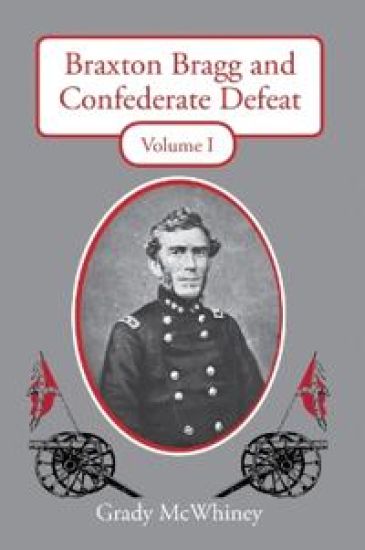
Braxton Bragg and Confederate Defeat, Volume I

Braxton Bragg and Confederate Defeat, Volume I

Grady McWhiney

The University of Alabama Press
2017
nidottu
Braxton Bragg and Confederate Defeat, Volume I , examines General Braxton Bragg's military prowess beginning with his enlistment in the Confederate Army in 1862 to the spring of 1863. First published in 1969, this is the first of two volumes covering the life of the Confederacy's most problematic general. It is now back in print and available in paperback for the first time. A West Point graduate, Mexican War hero, and retired army lieutenant colonel–Bragg was one of the most distinguished soldiers to join the Confederacy, and for a time one of the most impressive. Grady McWhiney's research shows that Bragg was neither as outstanding nor as incompetent as scholars and contemporaries suggest, but held positions of high responsibility throughout the war. Not an overwhelming success as commander of the Confederacy's principal western army, Bragg nevertheless directed the Army of Tennessee longer than any other general and, after being relieved of army command, he served as President Davis's military adviser. Of all the Confederacy's generals, only Robert E. Lee exercised more authority over such an extended period as Bragg. Yet less than two years later Bragg was the South's most discredited commander. Much of this criticism was justified, for he had done as much as any Confederate general to lose the war. The army's failures were Bragg's failures, and after his defeat at Chattanooga in November 1863 Bragg was relieved of field command.
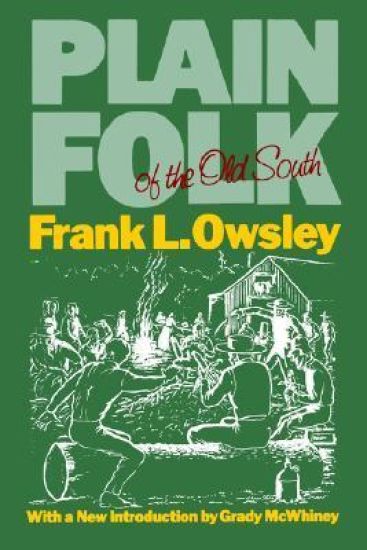
Plain Folk of the Old South

Plain Folk of the Old South

Frank Lawrence Owsley; Grady McWhiney

Louisiana State University Press
2008
nidottu
First published in 1949, Frank Lawrence Owsley's Plain Folk of the Old South refuted the popular myth that the antebellum South contained only three classes, planters, poor whites, and slaves. Owsley draws on a wide range of source materials, firsthand accounts such as diaries and the published observations of travelers and journalists; church records; and county records, including wills, deeds, tax lists, and grand-jury reports, to accurately reconstruct the prewar South's large and significant ""yeoman farmer"" middle class. He follows the history of this group, beginning with their migration from the Atlantic states into the frontier South, charts their property holdings and economic standing, and tells of the rich texture of their lives: the singing schools and corn shuckings, their courtship rituals and revival meetings, barn raisings and logrollings, and contests of marksmanship and horsemanship such as ""snuffing the candle,"" ""driving the nail,"" and the ""gander pull."" A new introduction by John B. Boles explains why this book remains the starting point today for the study of society in the Old South.
Confederate Crackers and Cavaliers

Confederate Crackers and Cavaliers

Grady McWhiney

McWhiney Foundation Press
2002
nidottu
A collection of 17 essays by Grady McWhiney on a wide variety of topics relating to Confederate leadership and war-making. The role of culture in the coming of the war is explored, as are the differences between Southern ""crackers"" and ""cavaliers"". Battlefield leadership is also discussed.
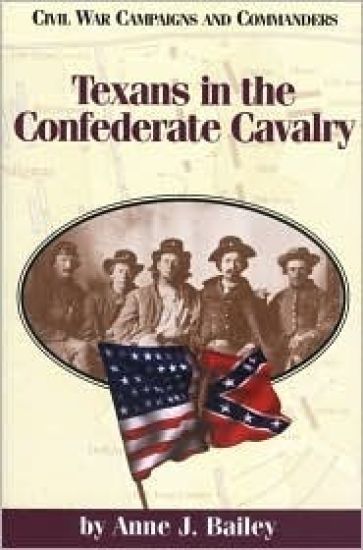
Texans in the Confederate Cavalry

Texans in the Confederate Cavalry

Anne J. Bailey; Grady McWhiney

McWhiney Foundation Press
1998
nidottu
Texas Rangers had patrolled on horseback since the early days of the Republic. Texas military heritage, born in a revolution from Mexico in the 1830s and maturing in the Mexican-American War of the 1840s, shaped all who lived there. Now, years later, a handful of these veterans and a generation raised in this heritage would make a colorful and heroic contribution to the Civil War as unique and independent "horse soldiers." This is the picturesque story of their battles and skirmishes where the often outnumbered cavalry, through bravado or sheer madness, frequently helped turn the tide of battle . . . from Colonel Parsons' assault on the Federal Navy during the Red River Campaign of 1864 to Terry's Texas Rangers with General Wheeler's horsemen tirelessly badgering Sherman on his "March to the Sea," it's all here. A lively and picturesque narration by a respected historian.
A Deep Steady Thunder

A Deep Steady Thunder

Steven E. Woodworth; Grady McWhiney

McWhiney Foundation Press
1998
nidottu
In September 1863, Union Gen. William S. Rosecrans drives into Georgia flanking Confederate Gen. Braxton Bragg out of Chattanooga. Bragg, heavily reinforced, turns on Rosecrans and nearly traps him before he can fall back. The two great armies finally meet at Chickamauga. Through woods and small clearings, a confused but vicious battle rages as each army gropes and grapples at the other trying to find the enemy's flanks. At nightfall, Rosecrans holds his ground and continues to slide his army northward to Chattanooga. The following morning, however, Bragg launches an attack that catches Rosecrans in the midst of a clumsy readjustment of his lines. Half the Union Army is crushed and sent streaming back to Chattanooga. The other half, led by the redoubtable George H. Thomas, stands firm, weathers furious day-long assaults, and salvages honor and survival for the beaten Union Army. A brief, fast-moving, colorful account of one of the biggest and bloodiest battles of the Civil War by a widely published historian.
Cottonclads!

Cottonclads!

Donald Frazier; Grady McWhiney

McWhiney Foundation Press
1998
nidottu
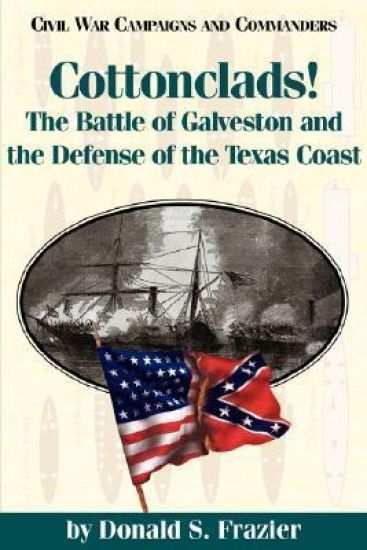
1862. Admiral David Farragut orders enclaves to be established in Texas as part of the Federal blockade. This involves attempts against Corpus Christi, Sabine Pass, Galveston, and Port Lavaca. By the end of the year Federal troops reduce the defenses of Sabine Pass and occupy Galveston, the state's principal port. However, the gains prove tenuous. While Federal sailors await Union infantry reinforcements, the Confederates, under Gen. John B. Magruder, seize the initiative. They organize a makeshift fleet of "cottonclads"--lightly armed and armored, but good platforms for sharpshooters--and boldly attack the Union fleet whenever it lies close to shore. Meanwhile, Confederate troops bombard from land. Ultimately, this counterattack results in the destruction or capture of four Union warships and three supply vessels and temporarily lifts the blockade. A lively account of innovative and daring tactics against superior forces by a dynamic historian.
The Emergence of Total War

The Emergence of Total War

Daniel E. Sutherland; Grady McWhiney

McWhiney Foundation Press
1998
nidottu
Summer 1862. The Confederacy has suffered several important defeats in the Western Theater and faces a serious threat to Richmond in the East. Federal politicians and citizenry, perplexed that fighting has continued into a second year, want an end to the war. Abraham Lincoln asks his battlefield commanders to develop a winning strategy in the East, a strategy that will not spare resources, terrain, nor the well being of private citizens--a strategy that would come to be known as "total war." The plan, implemented in 1862, proves a failure, mostly because of the man charged with carrying it out: Gen. John Pope. Pope's defeat is the story of the Second Manassas campaign. While Pope's demise gives new life to the Confederacy and emboldens Robert E. Lee to invade Maryland, Lincoln remains convinced that a strategy of total war represents the North's best chance for victory. In 1864-1865, Generals Ulysses S. Grant and William T. Sherman will prove him right. A vivid account of how Civil War campaigns foreshadowed total war.
Cracker Culture

Cracker Culture

Grady McWhiney

The University of Alabama Press
1989
nidottu
Cracker Culture is a provocative study of social life in the Old South that probes the origin of cultural differences between the South and the North throughout American history. Among Scotch-Irish settlers the term 'Cracker' initially designated a person who boasted, but in American usage the word has come to designate poor whites. McWhiney uses the term to define culture rather than to signify an economic condition. Although all poor whites were Crackers, not all Crackers were poor whites; both, however, were Southerners. The author insists that Southerners and Northerners were never alike. American colonists who settled south and west of Pennsylvania during the 17th and 18th centuries were mainly from the 'Celtic fringe' of the British Isles. The culture that these people retained in the New World accounts in considerable measure for the difference between them and the Yankees of New England, most of whom originated in the lowlands of the southeastern half of the island of Britain. From their solid base in the southern backcountry, Celts and their 'Cracker' descendants swept westward throughout the antebellum period until they had established themselves and their practices across the Old South. Basic among those practices that determined their traditional folkways, values, norms, and attitudes was the herding of livestock on the open range, in contrast to the mixed agriculture that was the norm both in southeastern Britain and in New England. The Celts brought to the Old South leisurely ways that fostered idleness and gaiety. Like their Celtic ancestors, Southerners were characteristically violent; they scorned pacifism; they considered fights and duels honorable and consistently ignored laws designed to control their actions. In addition, family and kinship were much more important in Celtic Britain and the antebellum South than in England and the Northern United States. Fundamental differences between Southerners and Northerners shaped the course of antebellum American history; their conflict in the 1860s was not so much brother against brother as culture against culture.
Cracker Culture

Cracker Culture

Grady McWhiney

THE UNIVERSITY OF ALABAMA PRESS
1988
sidottu
Cracker Culture is a provocative study of social life in the Old South that probes the origin of cultural differences between the South and the North throughout American history.
Attack and Die

Attack and Die

Grady McWhiney; Perry D. Jamieson

The University of Alabama Press
1984
nidottu
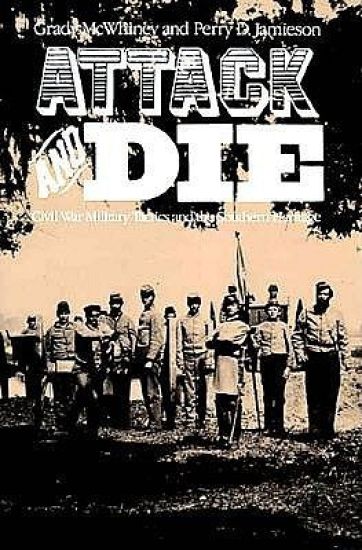
"In the first twenty-seven months of combat 175,000 Southern soldiers died. This number was more than the entire Confederate military force in the summer of 1861, and it far exceeded the strength of any army that Lee ever commanded. More than 80,000 Southerners fell in just five battles. At Gettysburg three out of every ten Confederates present were hit; one brigade lost 65 percent of its men and 70 percent of its field officers in a single charge. A North Carolina regiment started the action with some 800 men; only 216 survived unhurt. Another unit lost two-thirds of its men as well as its commander in a brief assault." Why did the Confederacy lose so many men? The authors contend that the Confederates bled themselves nearly to death in the first three years of the war by making costly attacks more often than the Federals. Offensive tactics, which had been used successfully by Americans in the Mexican War, were much less effective in the 1860s because an improved weapon - the rifle - had given increased strength to defenders. This book describes tactical theory in the 1850s and suggests how each related to Civil War tactics. It also considers the development of tactics in all three arms of the service during the Civil War. In examining the Civil War the book separates Southern from Northern tactical practice and discusses Confederate military history in the context of Southern social history. Although the Southerners could have offset their numerical disadvantage by remaining on the defensive and forcing the Federals to attack, they failed to do so. The authors argue that the Southerners' consistent favoring of offensive warfare was attributable, in large measure, to their Celtic heritage: they fought with the same courageous dash and reckless abandon that had characterized their Celtic forebears since ancient times. The Southerners of the Civil War generation were prisoners of their social and cultural history: they attacked courageously and were killed - on battlefields so totally defended by the Federals that "not even a chicken could get through."
Plain Folk of the Old South

Plain Folk of the Old South

Frank Lawrence Owsley; Grady McWhiney

Louisiana State University Press
1982
nidottu
First published in 1949, Frank Lawrence Owsley's Plain Folk of the Old South refuted the popular myth that the antebellum South contained only three classes, planters, poor whites, and slaves. Owsley draws on a wide range of source materials, firsthand accounts such as diaries and the published observations of travelers and journalists; church records; and county records, including wills, deeds, tax lists, and grand-jury reports, to accurately reconstruct the prewar South's large and significant ""yeoman farmer"" middle class. He follows the history of this group, beginning with their migration from the Atlantic states into the frontier South, charts their property holdings and economic standing, and tells of the rich texture of their lives: the singing schools and corn shuckings, their courtship rituals and revival meetings, barn raisings and logrollings, and contests of marksmanship and horsemanship such as ""snuffing the candle,"" ""driving the nail,"" and the ""gander pull.