Kirjojen hintavertailu. Mukana 12 595 353 kirjaa ja 12 kauppaa.

Kirjailija

Graeme Salaman

Kirjat ja teokset yhdessä paikassa: 7 kirjaa, julkaisuja vuosilta 1974-2016, suosituimpien joukossa A Better Way of Doing Business?. Vertaile teosten hintoja ja tarkista saatavuus suomalaisista kirjakaupoista.

7 kirjaa

Kirjojen julkaisuhaarukka 1974-2016.

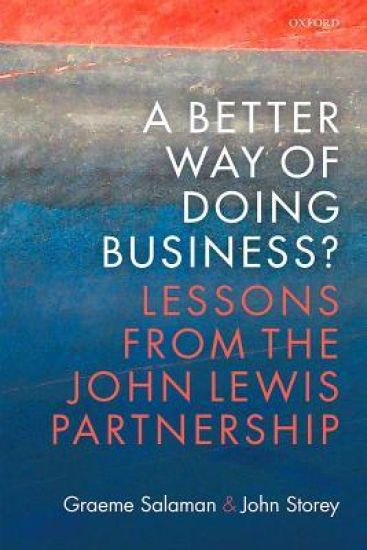
A Better Way of Doing Business?

A Better Way of Doing Business?

Graeme Salaman; John Storey

Oxford University Press
2016
sidottu
This book offers a thoroughly researched and accessibly written account of the John Lewis Partnership. It describes what the JLP is, how it works, and what other businesses can learn from it. The US/UK model of the firm, with its emphasis on shareholder value and its openness to the market in the buying and selling of businesses, is prone to a number of problematic consequences for employees, suppliers, and sometimes share-holders. The JLP represents a contrast to this model - one that has implications beyond the small niche of mutually-owned firms. The JLP has lessons for organizations that are unlikely to move towards the Partnership's distinctive shared ownership. This book identifies these lessons. The key questions addressed include: how does the JLP work in practice? What is the link between co-ownership, the JLP employment model, and the performance of the businesses? What is the role of management in the success of John Lewis and Waitrose? Are mutuality, co-ownership and business performance at odds? What is the significance of democracy within the JLP? And probably most significantly: what are the implications, for policy-makers and for economic agents of the JLP? This book is based on detailed knowledge of the JLP and its constituent business gathered by the authors over a fifteen year period. Their conclusion: that the JLP is more complex, even more impressive, and more interesting than its admirers realise.
Managers of Innovation

Managers of Innovation

John Storey; Graeme Salaman

Wiley-Blackwell (an imprint of John Wiley Sons Ltd)
2004
nidottu
Innovation is increasingly identified as the critical factor in ensuring economic competitiveness. Departments of state and quasi-governmental organizations in many countries including, Austria, Australia, Canada, France, Germany, The Netherlands, Sweden and the UK, have issued reports and calls to action; but implementation will continue to be problematic unless the points made in this book are taken into account. Drawing on 350 in-depth interviews with senior managers, this book presents an original theory about the characteristics of managers in “good innovative organizations” and “poor innovative organizations”. It pays close attention to the attitudes, understandings, assumptions and interpretations of managers, who are often the ultimate decision-makers when it comes to innovation. The text is supported by real-life, internationally-known cases such as Hewlett-Packard, Zeneca and the BBC, as well as voluntary sector cases such as Oxfam. It is also enriched by substantial and highly revealing quotations from senior managers themselves.
Managers of Innovation

Managers of Innovation

John Storey; Graeme Salaman

Wiley-Blackwell (an imprint of John Wiley Sons Ltd)
2004
sidottu
Innovation is increasingly identified as the critical factor in ensuring economic competitiveness. Departments of state and quasi-governmental organizations in many countries including, Austria, Australia, Canada, France, Germany, The Netherlands, Sweden and the UK, have issued reports and calls to action; but implementation will continue to be problematic unless the points made in this book are taken into account. Drawing on 350 in-depth interviews with senior managers, this book presents an original theory about the characteristics of managers in “good innovative organizations” and “poor innovative organizations”. It pays close attention to the attitudes, understandings, assumptions and interpretations of managers, who are often the ultimate decision-makers when it comes to innovation. The text is supported by real-life, internationally-known cases such as Hewlett-Packard, Zeneca and the BBC, as well as voluntary sector cases such as Oxfam. It is also enriched by substantial and highly revealing quotations from senior managers themselves.
Strategy and Capability

Strategy and Capability

Graeme Salaman; David Asch

Blackwell Publishers
2003
nidottu
This book helps managers and students of management to makes sense of the competing advice on how to change organisations in order to improve their effectiveness. Helps managers to understand how their organisations’ performance could be improved. Presents an overview of the advice on organisational improvement facing managers. Classifies and evaluates various different approaches. Highlights the relationships between strategy and capability.
Strategy and Capability

Strategy and Capability

Graeme Salaman; David Asch

JOHN WILEY AND SONS LTD
2003
sidottu
This book helps managers and students of management to makes sense of the competing advice on how to change organisations in order to improve their effectiveness. Helps managers to understand how their organisations’ performance could be improved. Presents an overview of the advice on organisational improvement facing managers. Classifies and evaluates various different approaches. Highlights the relationships between strategy and capability.
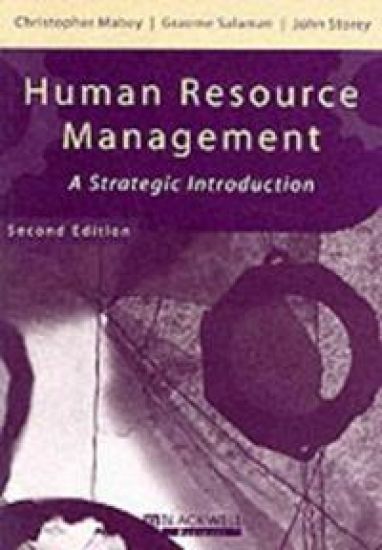
Human Resource Management

Human Resource Management

Christopher Mabey; Graeme Salaman; John Storey

JOHN WILEY AND SONS LTD
1998
nidottu
Building on the success of the first edition, Christopher Mabey and Graeme Salaman are joined by John Storey in producing an even more comprehensive and thoroughly revised textbook.
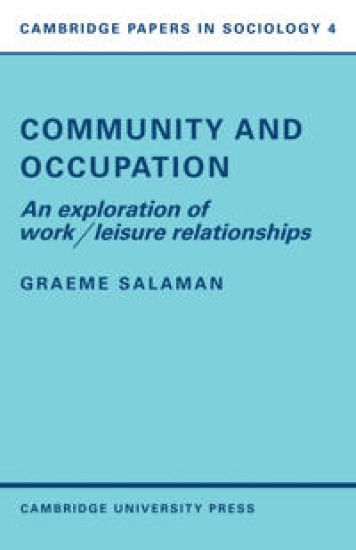
Community and Occupation

Community and Occupation

Graeme Salaman

Cambridge University Press
1974
pokkari
This book is concerned with the relationship between a man's work and his leisure time, in its broadest sense. At the opposite extreme to the 'instrumental' attitude, where the worker keeps his work and leisure time completely separate, is the close involvement in work and the correspondingly close relationship between working and non-working identities characteristic of 'occupational communities'. This 1974 book attempts to define the concept. After a survey of the theoretical background, Dr. Salaman presents a model of what an occupational community is and the reasons for its existence. The following chapters consist of empirical discussions on some specific examples. There is a detailed comparison between Cambridge railwaymen and architects. Dr Salaman draws the conclusion that occupational communities may be of two sorts - one based on the occupation as a whole, the other on a particular local workplace - and this distinction has considerable implications for the sociology of work.