

Kirjailija
Graham B. McBride
Kirjat ja teokset yhdessä paikassa: 3 kirjaa, julkaisuja vuosilta 1990-2018, suosituimpien joukossa Industrial Water Treatment. Vertaile teosten hintoja ja tarkista saatavuus suomalaisista kirjakaupoista.
3 kirjaa
Kirjojen julkaisuhaarukka 1990-2018.
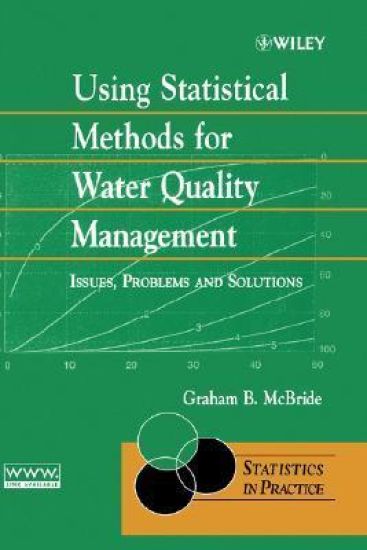
Using Statistical Methods for Water Quality Management
Graham B. McBride
John Wiley Sons Inc
2005
sidottu
STATISTICS IN PRACTICE A practical exploration of alternative approaches to analyzing water-related environmental issues Written by an experienced environmentalist and recognized expert in the field, this text is designed to help water resource managers and scientists to formulate, implement, and interpret more effective methods of water quality management. After presenting the basic foundation for using statistical methods in water resource management, including the use of appropriate hypothesis test procedures and some rapid calculation procedures, the author offers a range of practical problems and solutions on environmental topics that often arise, but are not generally covered. These include: * Formulating water quality standards * Determining compliance with standards * MPNs and microbiology * Water-related, human health risk modeling * Trends, impacts, concordance, and detection limits In order to promote awareness of alternative approaches to analyzing data, both frequentist and Bayesian, statistical methods are contrasted in terms of their applicability to various environmental issues. Each chapter ends with a number of set problems for which full answers are provided. The book also encourages discussion between technical staff and management before embarking on statistical studies.

Design of Water Quality Monitoring Systems
Robert C. Ward; Jim C. Loftis; Graham B. McBride
John Wiley Sons Inc
1990
sidottu
Design of Water Quality Monitoring Systems Design of Water Quality Monitoring Systems presents a state-of-the-art approach to designing a water quality monitoring system that gets consistently valid results. It seeks to provide a strong scientific basis for monitoring that will enable readers to establish cost-effective environmental programs. The book begins by reviewing the evolution of water quality monitoring as an information system, and then defines water quality monitoring as a system, following the flow of information through six major components: sample collection, laboratory analysis, data handling, data analysis, reporting, and information utilization. The importance of statistics in obtaining useful information is discussed next, followed by the presentation of an overall approach to designing a total water quality information system. This sets the stage for a thorough examination of the quantification of information expectations, data analysis, network design, and the writing of the final design report. Several case studies describe the efforts of various organizations and individuals to design water quality monitoring systems using many of the concepts discussed here. A helpful summary and final system design checklist are also provided. Design of Water Quality Monitoring Systems will be an essential working tool for a broad range of managers, environmental scientists, chemists, toxicologists, regulators, and public officials involved in monitoring water quality. The volume will also be of great interest to professionals in government, industry, and academia concerned with establishing sound environmental programs.