Kirjojen hintavertailu. Mukana 12 390 323 kirjaa ja 12 kauppaa.

Kirjailija

Graham Button

Kirjat ja teokset yhdessä paikassa: 9 kirjaa, julkaisuja vuosilta 1995-2025, suosituimpien joukossa Culture and Society from within. Vertaile teosten hintoja ja tarkista saatavuus suomalaisista kirjakaupoista.

9 kirjaa

Kirjojen julkaisuhaarukka 1995-2025.

Harvey Sacks and Ethnomethodology

Harvey Sacks and Ethnomethodology

Graham Button

TAYLOR FRANCIS LTD
2025
sidottu
Ethnomethodology and Conversation Analysis have made major inroads into the disciplines that make up the social sciences. Although commonly run together under the title of EMCA, what their relationship is to one another remains as elusive as the relationship between their respective founders, Harold Garfinkel and Harvey Sacks.This book clarifies the nature of these relationships, demonstrating that Harvey Sacks’ studies of the sequential organisation of conversation are the cardinal example of what Garfinkel described as an ethnomethodological alternate to traditional social science. However, over the decades that have passed since Garfinkel developed ethnomethodology, several confusions have arisen as to what he meant. The author argues that these have resulted in a blunting of Garfinkel’s original intentions which compromise the adequacy of ethnomethodological description. In response, this book shows how Sacks’ considerations of adequacy can ground ethnomethodology as a “natural observational science” that redirects it towards developing further coherent and precisely circumscribed bodies of work to those of Sacks’ own coherent and precisely circumscribed studies.It will appeal to both new and existing scholars of ethnomethodology and conversation analysis, as well as those with interests in social theory, methodology, and those who have taken up the relevance of conversation analysis for their research and are interested in the ethnomethodological heritage of conversation analysis.

Ethnomethodology, Conversation Analysis and Constructive Analysis

Ethnomethodology, Conversation Analysis and Constructive Analysis

Graham Button; Michael Lynch; Wes Sharrock

TAYLOR FRANCIS LTD
2022
nidottu
This book revisits the arguments by which Harvey Sacks and Harold Garfinkel opposed the widespread attempt in the social sciences to construct disciplinary theories and methods in place of common-sense knowledge of human action, and proposed instead an alternative that would investigate the organised methods of natural language use and common-sense reasoning that constitute social orders – arguments that led to the establishment and proliferation of ethnomethodology and conversation analysis. As the very "constructive analysis" that they opposed has begun to be incorporated into influential lines of research in ethnomethodology and conversation analysis, the authors return to the founding insights of the field and reiterate the importance of Garfinkel and Sacks’ original and controversial proposals for an "alternate" sociology of practical action and practical reasoning. Showing how constructive analysis has become entrenched in ethnomethodology and conversation analysis and arguing for a need to "re-boot" these approaches, this volume constitutes a call for a renewal of the radical alternative proposed by Garfinkel and Sacks.
Ethnomethodology, Conversation Analysis and Constructive Analysis

Ethnomethodology, Conversation Analysis and Constructive Analysis

Graham Button; Michael Lynch; Wes Sharrock

TAYLOR FRANCIS LTD
2022
sidottu
This book revisits the arguments by which Harvey Sacks and Harold Garfinkel opposed the widespread attempt in the social sciences to construct disciplinary theories and methods in place of common-sense knowledge of human action, and proposed instead an alternative that would investigate the organised methods of natural language use and common-sense reasoning that constitute social orders – arguments that led to the establishment and proliferation of ethnomethodology and conversation analysis. As the very "constructive analysis" that they opposed has begun to be incorporated into influential lines of research in ethnomethodology and conversation analysis, the authors return to the founding insights of the field and reiterate the importance of Garfinkel and Sacks’ original and controversial proposals for an "alternate" sociology of practical action and practical reasoning. Showing how constructive analysis has become entrenched in ethnomethodology and conversation analysis and arguing for a need to "re-boot" these approaches, this volume constitutes a call for a renewal of the radical alternative proposed by Garfinkel and Sacks.
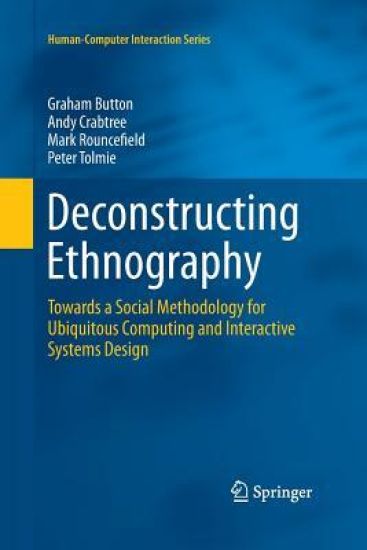
Deconstructing Ethnography

Deconstructing Ethnography

Graham Button; Andy Crabtree; Mark Rouncefield; Peter Tolmie

Springer International Publishing AG
2016
nidottu
This book aims to deconstruct ethnography to alert systems designers, and other stakeholders, to the issues presented by new approaches that move beyond the studies of ‘work’ and ‘work practice’ within the social sciences (in particular anthropology and sociology). The theoretical and methodological apparatus of the social sciences distort the social and cultural world as lived in and understood by ordinary members, whose common-sense understandings shape the actual milieu into which systems are placed and used.In Deconstructing Ethnography the authors show how ‘new’ calls are returning systems design to ‘old’ and problematic ways of understanding the social. They argue that systems design can be appropriately grounded in the social through the ordinary methods that members use to order their actions and interactions.This work is written for post-graduate students and researchers alike, as well as design practitioners who have an interest in bringing the social to bear on design in a systematic rather than a piecemeal way. This is not a ‘how to’ book, but instead elaborates the foundations upon which the social can be systematically built into the design of ubiquitous and interactive systems.
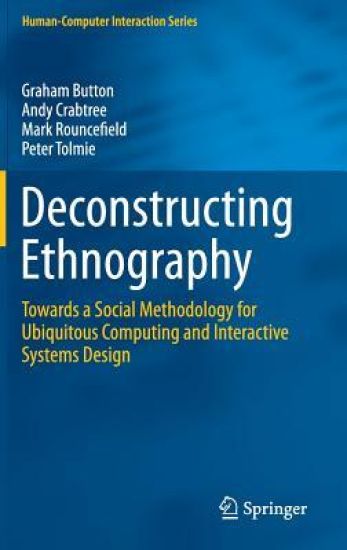
Deconstructing Ethnography

Deconstructing Ethnography

Graham Button; Andy Crabtree; Mark Rouncefield; Peter Tolmie

Springer International Publishing AG
2015
sidottu
This book aims to deconstruct ethnography to alert systems designers, and other stakeholders, to the issues presented by new approaches that move beyond the studies of ‘work’ and ‘work practice’ within the social sciences (in particular anthropology and sociology). The theoretical and methodological apparatus of the social sciences distort the social and cultural world as lived in and understood by ordinary members, whose common-sense understandings shape the actual milieu into which systems are placed and used.In Deconstructing Ethnography the authors show how ‘new’ calls are returning systems design to ‘old’ and problematic ways of understanding the social. They argue that systems design can be appropriately grounded in the social through the ordinary methods that members use to order their actions and interactions.This work is written for post-graduate students and researchers alike, as well as design practitioners who have an interest in bringing the social to bear on design in a systematic rather than a piecemeal way. This is not a ‘how to’ book, but instead elaborates the foundations upon which the social can be systematically built into the design of ubiquitous and interactive systems.
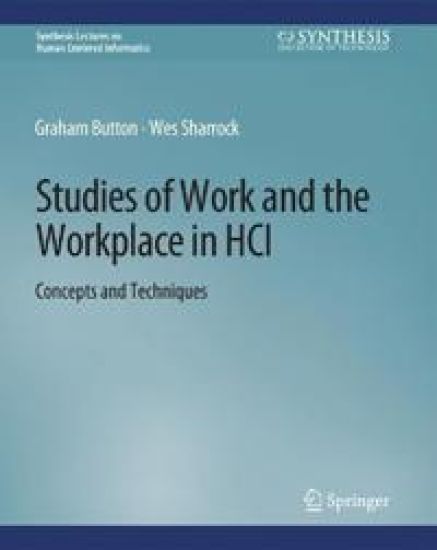
Studies of Work and the Workplace in HCI

Studies of Work and the Workplace in HCI

Graham Button; Wes Sharrock

Springer International Publishing AG
2009
nidottu
This book has two purposes. First, to introduce the study of work and the workplace as a method for informing the design of computer systems to be used at work. We primarily focus on the predominant way in which the organization of work has been approached within the field of human-computer interaction (HCI), which is from the perspective of ethnomethodology. We locate studies of work in HCI within its intellectual antecedents, and describe paradigmatic examples and case studies. Second, we hope to provide those who are intending to conduct the type of fieldwork that studies of work and the workplace draw off with suggestions as to how they can go about their own work of developing observations about the settings they encounter. These suggestions take the form of a set of maxims that we have found useful while conducting the studies we have been involved in. We draw from our own fieldwork notes in order to illustrate these maxims. In addition we also offer some homilies about how to make observations; again, these are ones we have found useful in our own work. Table of Contents: Motivation / Overview: A Paradigmatic Case / Scientific Foundations / Detailed Description / Case Study / How to Conduct Ethnomethodological Studies of Work / Making Observations / Current Status
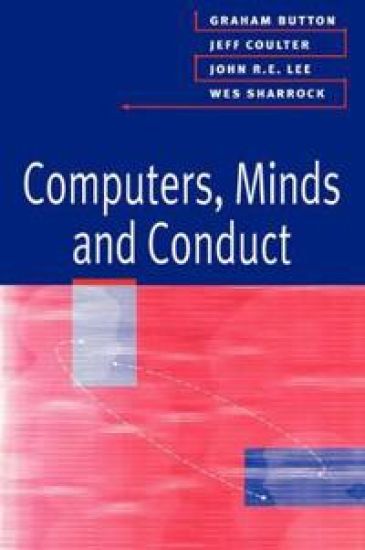
Computers, Minds and Conduct

Computers, Minds and Conduct

Graham Button; Jeff Coulter; John Lee; Wes Sharrock

Polity Press
1995
nidottu
This book provides a sustained and penetrating critique of a wide range of views in modern cognitive science and philosophy of the mind, from Turing's famous test for intelligence in machines to recent work in computational linguistic theory. While discussing many of the key arguments and topics, the authors also develop a distinctive analytic approach. Drawing on the methods of conceptual analysis first elaborated by Wittgenstein and Ryle, the authors seek to show that these methods still have a great deal to offer in the field of the cognitive theory and the philosophy of mind, providing a powerful alternative to many of the positions put forward in the contemporary literature. Amoung the many issues discussed in the book are the following: the Cartesian roots of modern conceptions of mind; Searle's 'Chinese Room' thought experiment; Fodor's 'language of thought' hypothesis; the place of 'folk psychology' in cognitivist thought; and the question of whether any machine may be said to 'think' or 'understand' in the ordinary senses of these words. Wide ranging, up-to-date and forcefully argued, this book represents a major intervention in contemporary debates about the status of cognitive science an the nature of mind. It will be of particular interest to students and scholars in philosophy, psychology, linguistics and computing sciences.