Kirjojen hintavertailu. Mukana 12 319 557 kirjaa ja 12 kauppaa.

Kirjailija

Graham Huggan

Kirjat ja teokset yhdessä paikassa: 16 kirjaa, julkaisuja vuosilta 2000-2025, suosituimpien joukossa The Postcolonial Exotic. Vertaile teosten hintoja ja tarkista saatavuus suomalaisista kirjakaupoista.

16 kirjaa

Kirjojen julkaisuhaarukka 2000-2025.

Modern British Nature Writing, 1789–2020

Modern British Nature Writing, 1789–2020

Will Abberley; Christina Alt; David Higgins; Graham Huggan; Pippa Marland

Cambridge University Press
2025
pokkari
Why do we speak so much of nature today when there is so little of it left? Prompted by this question, this study offers the first full-length exploration of modern British nature writing, from the late eighteenth century to the present. Focusing on non-fictional prose writing, the book supplies new readings of classic texts by Romantic, Victorian and Contemporary authors, situating these within the context of an enduringly popular genre. Nature writing is still widely considered fundamentally celebratory or escapist, yet it is also very much in tune with the conflicts of a natural world under threat. The book's five authors connect these conflicts to the triple historical crisis of the environment; of representation; and of modern dissociated sensibility. This book offers an informed critical approach to modern British nature writing for specialist readers, as well as a valuable guide for general readers concerned by an increasingly diminished natural world.
Modern British Nature Writing, 1789–2020

Modern British Nature Writing, 1789–2020

Will Abberley; Christina Alt; David Higgins; Graham Huggan; Pippa Marland

Cambridge University Press
2022
sidottu
Why do we speak so much of nature today when there is so little of it left? Prompted by this question, this study offers the first full-length exploration of modern British nature writing, from the late eighteenth century to the present. Focusing on non-fictional prose writing, the book supplies new readings of classic texts by Romantic, Victorian and Contemporary authors, situating these within the context of an enduringly popular genre. Nature writing is still widely considered fundamentally celebratory or escapist, yet it is also very much in tune with the conflicts of a natural world under threat. The book's five authors connect these conflicts to the triple historical crisis of the environment; of representation; and of modern dissociated sensibility. This book offers an informed critical approach to modern British nature writing for specialist readers, as well as a valuable guide for general readers concerned by an increasingly diminished natural world.
Colonialism, Culture, Whales

Colonialism, Culture, Whales

Graham Huggan

Bloomsbury Academic
2020
nidottu
This book is available as open access through the Bloomsbury Open Access programme and is available on www.bloomsburycollections.com.Colonialism, Culture, Whales: The Cetacean Quartet explores how our attitudes to whales, whale hunting, and whale watching expose colonial attitudes to the natural world in modern Western culture. Foraging across the disciplines and moving between ideas and methods drawn from postcolonial criticism, animal studies, and environmental humanities, the book critically examines the colonial histories of whaling, their legacies in contemporary tourism from whale-watching excursions to the performing orcas at SeaWorld, and cultural representations of anxieties about extinction in recent literature, television, and film. Extensively researched and engagingly written, the four essays that comprise The Cetacean Quartet should appeal to scholars in a number of different fields as well as to general readers interested in finding out more about our enduring, guilt-ridden fascination with one of the world's most iconic living creatures, the whale.
Colonialism, Culture, Whales

Colonialism, Culture, Whales

Graham Huggan

Bloomsbury Academic
2018
sidottu
This book is available as open access through the Bloomsbury Open Access programme and is available on www.bloomsburycollections.com.Colonialism, Culture, Whales: The Cetacean Quartet explores how our attitudes to whales, whale hunting, and whale watching expose colonial attitudes to the natural world in modern Western culture. Foraging across the disciplines and moving between ideas and methods drawn from postcolonial criticism, animal studies, and environmental humanities, the book critically examines the colonial histories of whaling, their legacies in contemporary tourism from whale-watching excursions to the performing orcas at SeaWorld, and cultural representations of anxieties about extinction in recent literature, television, and film. Extensively researched and engagingly written, the four essays that comprise The Cetacean Quartet should appeal to scholars in a number of different fields as well as to general readers interested in finding out more about our enduring, guilt-ridden fascination with one of the world's most iconic living creatures, the whale.
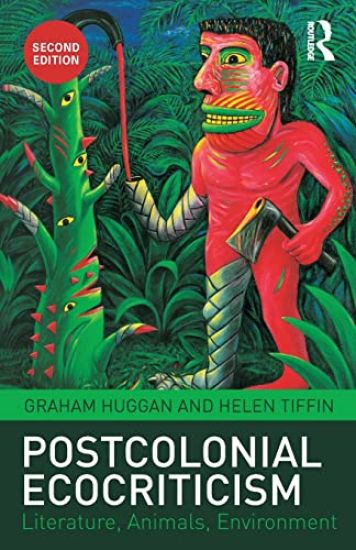
Postcolonial Ecocriticism

Postcolonial Ecocriticism

Graham Huggan; Helen Tiffin

Routledge
2015
sidottu
This second edition of Postcolonial Ecocriticism, a book foundational for its field, has been updated to consider recent developments in the area such as environmental humanities and animal studies. Graham Huggan and Helen Tiffin examine transverse relations between humans, animals and the environment across a wide range of postcolonial literary texts and also address key issues such as global warming, food security, human over-population in the context of animal extinction, queer ecology, and the connections between postcolonial and disability theory. Considering the postcolonial first from an environmental and then a zoocritical perspective, the book looks at:Narratives of development in postcolonial writingEntitlement, belonging and the pastoralColonial 'asset stripping' and the Christian missionThe politics of eating and the representation of cannibalismAnimality and spiritualitySentimentality and anthropomorphismThe changing place of humans and animals in a 'posthuman' world. With a new preface written specifically for this edition and an annotated list of suggestions for further reading, Postcolonial Ecocriticism offers a comprehensive and fully up-to-date introduction to a rapidly expanding field.
Postcolonial Ecocriticism

Postcolonial Ecocriticism

Graham Huggan; Helen Tiffin

Routledge
2015
nidottu
This second edition of Postcolonial Ecocriticism, a book foundational for its field, has been updated to consider recent developments in the area such as environmental humanities and animal studies. Graham Huggan and Helen Tiffin examine transverse relations between humans, animals and the environment across a wide range of postcolonial literary texts and also address key issues such as global warming, food security, human over-population in the context of animal extinction, queer ecology, and the connections between postcolonial and disability theory. Considering the postcolonial first from an environmental and then a zoocritical perspective, the book looks at:Narratives of development in postcolonial writingEntitlement, belonging and the pastoralColonial 'asset stripping' and the Christian missionThe politics of eating and the representation of cannibalismAnimality and spiritualitySentimentality and anthropomorphismThe changing place of humans and animals in a 'posthuman' world. With a new preface written specifically for this edition and an annotated list of suggestions for further reading, Postcolonial Ecocriticism offers a comprehensive and fully up-to-date introduction to a rapidly expanding field.
Nature's Saviours

Nature's Saviours

Graham Huggan

Routledge
2013
sidottu
Today's celebrity conservationists, many of whom made their reputations through television and other visual media, play a major role in drawing public attention to an increasingly threatened world. This book, one of the first to address this contribution, focuses on five key figures: the English naturalist David Attenborough, the French marine adventurer Jacques-Yves Cousteau, the American primatologist Dian Fossey, the Canadian scientist-broadcaster-activist David Suzuki, and the Australian 'crocodile hunter' Steve Irwin. Some of the issues the author addresses include: What is the changing relationship between western conservation and celebrity? How has the spread of television helped shape and mediate this relationship? To what extent can celebrity conservation be seen as part of a global system in which conservation, like celebrity, is big business? The book critically examines the heroic status accorded to the five figures mentioned above, taking in the various discourses – around nature, science, nation, gender – through which they and their work have been presented to us. In doing so, it fills in the cultural, historical and ideological background behind contemporary celebrity conservationism as a popular expression of a chronically endangered world.
Nature's Saviours

Nature's Saviours

Graham Huggan

Routledge
2013
nidottu
Today's celebrity conservationists, many of whom made their reputations through television and other visual media, play a major role in drawing public attention to an increasingly threatened world. This book, one of the first to address this contribution, focuses on five key figures: the English naturalist David Attenborough, the French marine adventurer Jacques-Yves Cousteau, the American primatologist Dian Fossey, the Canadian scientist-broadcaster-activist David Suzuki, and the Australian 'crocodile hunter' Steve Irwin. Some of the issues the author addresses include: What is the changing relationship between western conservation and celebrity? How has the spread of television helped shape and mediate this relationship? To what extent can celebrity conservation be seen as part of a global system in which conservation, like celebrity, is big business? The book critically examines the heroic status accorded to the five figures mentioned above, taking in the various discourses – around nature, science, nation, gender – through which they and their work have been presented to us. In doing so, it fills in the cultural, historical and ideological background behind contemporary celebrity conservationism as a popular expression of a chronically endangered world.
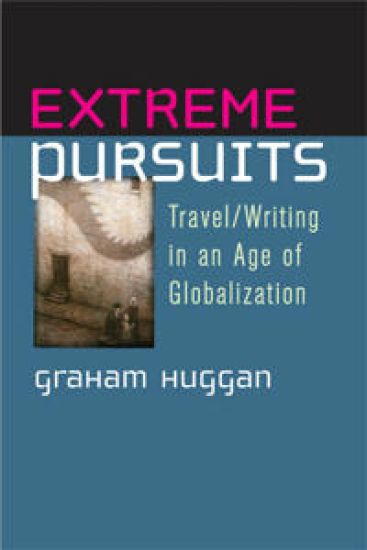
Extreme Pursuits

Extreme Pursuits

Graham Huggan

The University of Michigan Press
2009
nidottu
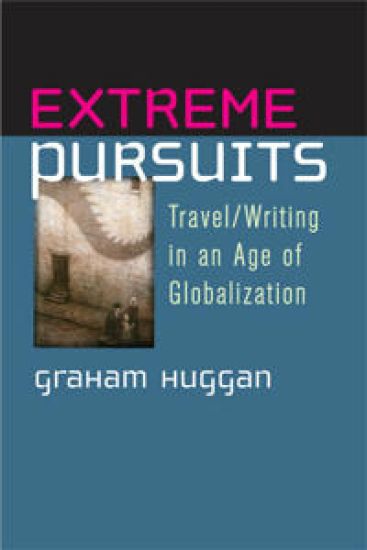
Recent figures suggest that there will be 1.6 billion arrivals at world airports by the year 2020. Extreme Pursuits looks at the new conditions of global travel and the unease, even paranoia, that underlies them---at the opportunities they offer for alternative identities and their oscillation between remembered and anticipated states. Graham Huggan offers a provocative account of what is happening to travel at a time characterized by extremes of social and political instability in which adrenaline-filled travelers appear correspondingly determined to take risks. It includes discussions of the links between tourism and terrorism, of contemporary modes of disaster tourism, and of the writing that derives from these; but it also confirms the existence of more responsible forms of travel/writing that demonstrate awareness of a chronically endangered world. Extreme Pursuits is the first study of its kind to link travel writing explicitly with structural changes in the global tourist industry. The book makes clear that travel writing can no longer take refuge in the classic distinctions (traveler versus tourist, foreigner versus native) on which it previously depended. Such distinctions---which were dubious in the first place---no longer make sense in an increasingly globalized world. Huggan argues accordingly that the category "travel writing" must include experimental ethnography and prose fiction; that it should concern itself with other kinds of travel practices, such as those related to Holocaust deportation and migrant labor; and that it should encompass representations of travelers and "traveling cultures" that appear in popular media, especially TV and film.Graham Huggan is Professor of Commonwealth and Postcolonial Literatures at the University of Leeds. He is the coauthor, with Patrick Holland, of Tourists with Typewriters: Critical Reflections on Contemporary Travel Writing (University of Michigan Press) and coauthor, with Helen Tiffin, of Postcolonial Ecocriticism (Routledge).Illustration: "Shadow Wall," 2006 © Shaun Tan.
Extreme Pursuits

Extreme Pursuits

Graham Huggan

The University of Michigan Press
2009
sidottu
Recent figures suggest that there will be 1.6 billion arrivals at world airports by the year 2020. Extreme Pursuits looks at the new conditions of global travel and the unease, even paranoia, that underlies them---at the opportunities they offer for alternative identities and their oscillation between remembered and anticipated states. Graham Huggan offers a provocative account of what is happening to travel at a time characterized by extremes of social and political instability in which adrenaline-filled travelers appear correspondingly determined to take risks. It includes discussions of the links between tourism and terrorism, of contemporary modes of disaster tourism, and of the writing that derives from these; but it also confirms the existence of more responsible forms of travel/writing that demonstrate awareness of a chronically endangered world. Extreme Pursuits is the first study of its kind to link travel writing explicitly with structural changes in the global tourist industry. The book makes clear that travel writing can no longer take refuge in the classic distinctions (traveler versus tourist, foreigner versus native) on which it previously depended. Such distinctions---which were dubious in the first place---no longer make sense in an increasingly globalized world. Huggan argues accordingly that the category "travel writing" must include experimental ethnography and prose fiction; that it should concern itself with other kinds of travel practices, such as those related to Holocaust deportation and migrant labor; and that it should encompass representations of travelers and "traveling cultures" that appear in popular media, especially TV and film.Graham Huggan is Professor of Commonwealth and Postcolonial Literatures at the University of Leeds. He is the coauthor, with Patrick Holland, of Tourists with Typewriters: Critical Reflections on Contemporary Travel Writing (University of Michigan Press) and coauthor, with Helen Tiffin, of Postcolonial Ecocriticism (Routledge).Illustration: "Shadow Wall," 2006 © Shaun Tan.
Interdisciplinary Measures

Interdisciplinary Measures

Graham Huggan

Liverpool University Press
2008
nidottu
Interdisciplinary Measures makes the case for a cross-disciplinary, but literature-centred, approach to postcolonial studies. Despite the anxieties that interdisciplinarity brings with it, a combination of different, discontinuously structured disciplinary knowledges is arguably best suited to address the tangled concerns of both the globalised present and the colonial past. The book looks specifically at the intersections between literary criticism, history, anthropology, geography and environmental studies, while arguing more specifically for a postcolonialism across the disciplines in the service of informed (cross-) cultural critique. Bringing together a wide range of literary material from Africa, Australia, Canada, the Caribbean, New Zealand and South Asia, the book also considers the different, but sometimes related, cultural contexts within which the key debates in postcolonial studies – e.g. those around globalisation, North-South relations and the new imperialism – are currently taking place. These debates suggest the need for a multi-sited, multilinguistic and, not least, multidisciplinary appraoch to postcolonial studies that consolidates its status as a comparative field.
Australian Literature

Australian Literature

Graham Huggan

Oxford University Press
2007
nidottu
The Oxford Studies in Postcolonial Literatures series offers stimulating and accessible introductions to definitive topics and key genres and regions within the rapidly diversifying field of postcolonial literary studies in English. In a provocative contribution to the series, Graham Huggan presents fresh readings of an outstanding, sometimes deeply unsettling national literature whose writers and readers just as unmistakably belong to the wider world. Australian literature is not the unique province of Australian readers and critics; nor is its exclusive task to provide an internal commentary on changing national concerns. Huggan's book adopts a transnational approach, motivated by postcolonial interests, in which contemporary ideas taken from postcolonial criticism and critical race theory are productively combined and imaginatively transformed. Rejecting the fashionable view that Australia is not, and never will be, postcolonial, Huggan argues on the contrary that Australian literature, like other settler literatures, requires close attention to postcolonial methods and concerns. A postcolonial approach to Australian literature, he suggests, is more than just a case for a more inclusive nationalism; it also involves a general acknowledgement of the nation's changed relationship to an increasingly globalized world. As such, the book helps to deprovincialize Australian literary studies. Australian Literature also contributes to debates about the continuing history of racism in Australia-a history in which the nation's literature has played a constitutive role, as both product and producer of racial tensions and anxieties, nowhere more visible than in the discourse it has produced about race, both within and beyond the national context.
Australian Literature

Australian Literature

Graham Huggan

Oxford University Press
2007
sidottu
The Oxford Studies in Postcolonial Literatures series offers stimulating and accessible introductions to definitive topics and key genres and regions within the rapidly diversifying field of postcolonial literary studies in English. In a provocative contribution to the series, Graham Huggan presents fresh readings of an outstanding, sometimes deeply unsettling national literature whose writers and readers just as unmistakably belong to the wider world. Australian literature is not the unique province of Australian readers and critics; nor is its exclusive task to provide an internal commentary on changing national concerns. Huggan's book adopts a transnational approach, motivated by postcolonial interests, in which contemporary ideas taken from postcolonial criticism and critical race theory are productively combined and imaginatively transformed. Rejecting the fashionable view that Australia is not, and never will be, postcolonial, Huggan argues on the contrary that Australian literature, like other settler literatures, requires close attention to postcolonial methods and concerns. A postcolonial approach to Australian literature, he suggests, is more than just a case for a more inclusive nationalism; it also involves a general acknowledgement of the nation's changed relationship to an increasingly globalized world. As such, the book helps to deprovincialize Australian literary studies. Australian Literature also contributes to debates about the continuing history of racism in Australia-a history in which the nation's literature has played a constitutive role, as both product and producer of racial tensions and anxieties, nowhere more visible than in the discourse it has produced about race, both within and beyond the national context.
The Postcolonial Exotic

The Postcolonial Exotic

Graham Huggan

Routledge
2001
nidottu
Travel writing, it has been said, helped produce the rest of the world for a Western audience. Could the same be said more recently of postcolonial writing? In The Postcolonial Exotic, Graham Huggan examines some of the processes by which value is attributed to postcolonial works within their cultural field. Using varied methods of analysis, Huggan discusses both the exoticist discourses that run through postcolonial studies, and the means by which postcolonial products are marketed and domesticated for Western consumption. Global in scope, the book takes in everything from: * the latest 'Indo-chic' to the history of the Heinemann African Writers series * from the celebrity stakes of the Booker Prize to those of the US academic star-system *from Canadian multicultural anthologies to Australian 'tourist novels'. This timely and challenging volume points to the urgent need for a more carefully grounded understanding of the processes of production, dissemination and consumption that have surrounded the rapid development of the postcolonial field.
The Postcolonial Exotic

The Postcolonial Exotic

Graham Huggan

Routledge
2001
sidottu
Travel writing, it has been said, helped produce the rest of the world for a Western audience. Could the same be said more recently of postcolonial writing? In The Postcolonial Exotic, Graham Huggan examines some of the processes by which value is attributed to postcolonial works within their cultural field. Using varied methods of analysis, Huggan discusses both the exoticist discourses that run through postcolonial studies, and the means by which postcolonial products are marketed and domesticated for Western consumption. Global in scope, the book takes in everything from: * the latest 'Indo-chic' to the history of the Heinemann African Writers series * from the celebrity stakes of the Booker Prize to those of the US academic star-system *from Canadian multicultural anthologies to Australian 'tourist novels'. This timely and challenging volume points to the urgent need for a more carefully grounded understanding of the processes of production, dissemination and consumption that have surrounded the rapid development of the postcolonial field.
Tourists with Typewriters

Tourists with Typewriters

Patrick Holland; Graham Huggan

The University of Michigan Press
2000
nidottu
The first extensive survey of contemporary travel writing, Tourists with Typewriters offers a series of challenging and provocative critical insights into a wide range of travel narratives written in English after the Second World War. The book focuses in particular on contemporary travel writers such as Jan Morris, Peter Matthiessen, V. S. Naipaul, Barry Lopez, Mary Morris, Paul Theroux, Peter Mayle, and the late Bruce Chatwin. It examines some of the reasons for travel writing's enduring popularity, and for its particular appeal to readers--many of them also travelers--in the present. The book maps new terrain in a growing area of critical study. Although critical of travel writing's complacency and its often unacknowledged ethnocentrism, the book recognizes its importance as both a literary and cultural form. While travel writing at its worst emerges as a crude expression of economic advantage, at its best it becomes a subtle instrument of cultural self-perception, a barometer for changing views of "other" (i.e., foreign, non-Western) cultures, and a trigger for the information circuits that tap us into the wider world. Tourists with Typewriters gauges both the best and worst in contemporary travel writing, capturing the excitement of this most volatile--and at times infuriating--of literary genres. The book will appeal to general readers interested in a closer examination of travel writing and to academic readers in disciplines such as literary/cultural studies, geography, history, anthropology, and tourism studies."An eminently readable and informative study. It breathes tolerance and intelligence. It is critically perceptive and very au courant. It raises issues (coloniality, postmodernity, gender. . . ) and discusses books that readers of many different stripes will want to find out about." --Ross Chambers, University of MichiganPatrick Holland, Associate Professor of English, University of Guelph, was born in New Zealand and educated in England, Australia, and Canada. Graham Huggan, Professor of English, University of Munich, was born in Hong Kong and educated in England and in British Columbia.