Kirjojen hintavertailu. Mukana 12 211 568 kirjaa ja 12 kauppaa.

Kirjailija

Graham Loomes

Kirjat ja teokset yhdessä paikassa: 4 kirjaa, julkaisuja vuosilta 2002-2020, suosituimpien joukossa Economic Valuation with Stated Preference Techniques. Vertaile teosten hintoja ja tarkista saatavuus suomalaisista kirjakaupoista.

4 kirjaa

Kirjojen julkaisuhaarukka 2002-2020.

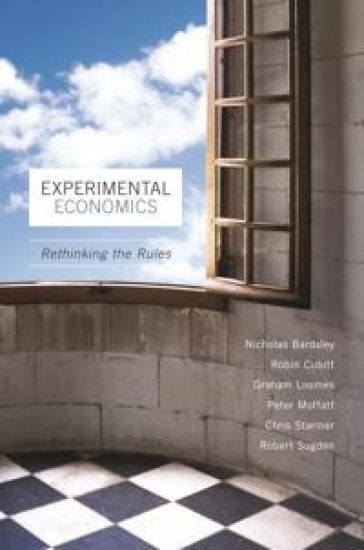
Experimental Economics

Experimental Economics

Nicholas Bardsley; Robin Cubitt; Graham Loomes; Peter Moffatt; Chris Starmer; Robert Sugden

Princeton University Press
2020
pokkari
Since the 1980s, there has been explosive growth in the use of experimental methods in economics, leading to exciting developments in economic theory and policy. Despite this, the status of experimental economics remains controversial. In Experimental Economics, the authors draw on their experience and expertise in experimental economics, economic theory, the methodology of economics, philosophy of science, and the econometrics of experimental data to offer a balanced and integrated look at the nature and reliability of claims based on experimental research. The authors explore the history of experiments in economics, provide examples of different types of experiments, and show that the growing use of experimental methods is transforming economics into a genuinely empirical science. They explain that progress is being held back by an uncritical acceptance of folk wisdom regarding how experiments should be conducted, a failure to acknowledge that different objectives call for different approaches to experimental design, and a misplaced assumption that principles of good practice in theoretical modeling can be transferred directly to experimental design. Experimental Economics debates how such limitations might be overcome, and will interest practicing experimental economists, nonexperimental economists wanting to interpret experimental research, and philosophers of science concerned with the status of knowledge claims in economics.
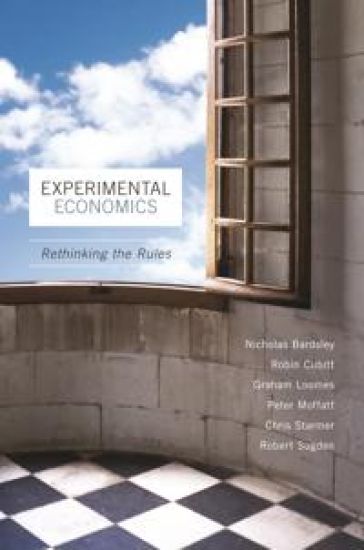
Experimental Economics

Experimental Economics

Nicholas Bardsley; Robin Cubitt; Graham Loomes; Peter Moffatt; Chris Starmer; Robert Sugden

Princeton University Press
2009
sidottu
Since the 1980s, there has been explosive growth in the use of experimental methods in economics, leading to exciting developments in economic theory and policy. Despite this, the status of experimental economics remains controversial. In Experimental Economics, the authors draw on their experience and expertise in experimental economics, economic theory, the methodology of economics, philosophy of science, and the econometrics of experimental data to offer a balanced and integrated look at the nature and reliability of claims based on experimental research. The authors explore the history of experiments in economics, provide examples of different types of experiments, and show that the growing use of experimental methods is transforming economics into a genuinely empirical science. They explain that progress is being held back by an uncritical acceptance of folk wisdom regarding how experiments should be conducted, a failure to acknowledge that different objectives call for different approaches to experimental design, and a misplaced assumption that principles of good practice in theoretical modeling can be transferred directly to experimental design. Experimental Economics debates how such limitations might be overcome, and will interest practicing experimental economists, nonexperimental economists wanting to interpret experimental research, and philosophers of science concerned with the status of knowledge claims in economics.
Economic Valuation with Stated Preference Techniques

Economic Valuation with Stated Preference Techniques

Ian J. Bateman; Richard T. Carson; Brett Day; Michael Hanemann; Nick Hanley; Tannis Hett; Michael Jones-Lee; Graham Loomes

Edward Elgar Publishing Ltd
2004
nidottu
This manual offers a detailed, up-to-date explanation of how to carry out economic valuation using stated preference techniques. It is relevant for the application of these techniques to all non-market goods and services including air and water quality; provision of public open space; health care that is not sold through private markets; risk reduction policies and investments not provided privately; provision of information as with the recorded heritage, the protection of cultural assets and so on. The resulting valuations can be used for a number of purposes including, but not limited to, demonstrating the importance of a good or service; cost-benefit analysis; setting priorities for environmental policy; design of economic instruments; green national/corporate accounting, and natural resource damage assessment. Compiled by the leading experts in the field, this manual starts by explaining the concepts. It shows how to choose the most appropriate technique and how to design the questionnaires. Detailed advice on econometric analysis is provided, as well as explanation of the pitfalls that need to be avoided.
Economic Valuation with Stated Preference Techniques

Economic Valuation with Stated Preference Techniques

Ian J. Bateman; Richard T. Carson; Brett Day; Michael Hanemann; Nick Hanley; Tannis Hett; Michael Jones-Lee; Graham Loomes

Edward Elgar Publishing Ltd
2002
sidottu
This manual offers a detailed, up-to-date explanation of how to carry out economic valuation using stated preference techniques. It is relevant for the application of these techniques to all non-market goods and services including air and water quality; provision of public open space; health care that is not sold through private markets; risk reduction policies and investments not provided privately; provision of information as with the recorded heritage, the protection of cultural assets and so on. The resulting valuations can be used for a number of purposes including, but not limited to, demonstrating the importance of a good or service; cost-benefit analysis; setting priorities for environmental policy; design of economic instruments; green national/corporate accounting, and natural resource damage assessment. Compiled by the leading experts in the field, this manual starts by explaining the concepts. It shows how to choose the most appropriate technique and how to design the questionnaires. Detailed advice on econometric analysis is provided, as well as explanation of the pitfalls that need to be avoided.