Kirjojen hintavertailu. Mukana 12 152 606 kirjaa ja 12 kauppaa.

Kirjailija

Graham M. Smith

Kirjat ja teokset yhdessä paikassa: 5 kirjaa, julkaisuja vuosilta 2007-2011, suosituimpien joukossa Mixed Effects Models and Extensions in Ecology with R. Vertaile teosten hintoja ja tarkista saatavuus suomalaisista kirjakaupoista.

5 kirjaa

Kirjojen julkaisuhaarukka 2007-2011.

Friendship and the Political

Friendship and the Political

Graham M. Smith

Imprint Academic
2011
pokkari
This book reappraises the idea of "friendship" in contemporary political thought. Friendship was a central notion for the Ancients, being regarded as a political ideal to rank alongside justice. The author explores the possibilities for theorising friendship in modern times through an examination of three seminal thinkers: Kierkegaard, Nietzsche and Schmitt. He shows that friendship is a vital descriptive, analytic and normative idea in contemporary political thought, identifying and valuing the horizontal moral and affective affinities that bind political communities. Reappraised in this way, friendship is shown to play an important role in redeveloping the contours of current debates around liberalism, communitarianism, community, social cohesion, civil society, justice, power, and ultimately our understanding of the political itself.
Mixed Effects Models and Extensions in Ecology with R

Mixed Effects Models and Extensions in Ecology with R

Alain Zuur; Elena N. Ieno; Neil Walker; Anatoly A. Saveliev; Graham M. Smith

Springer-Verlag New York Inc.
2011
nidottu
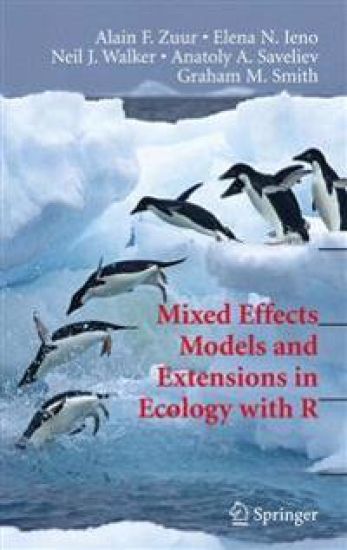
Building on the successful Analysing Ecological Data (2007) by Zuur, Ieno and Smith, the authors now provide an expanded introduction to using regression and its extensions in analysing ecological data. As with the earlier book, real data sets from postgraduate ecological studies or research projects are used throughout. The first part of the book is a largely non-mathematical introduction to linear mixed effects modelling, GLM and GAM, zero inflated models, GEE, GLMM and GAMM. The second part provides ten case studies that range from koalas to deep sea research. These chapters provide an invaluable insight into analysing complex ecological datasets, including comparisons of different approaches to the same problem. By matching ecological questions and data structure to a case study, these chapters provide an excellent starting point to analysing your own data. Data and R code from all chapters are available from www.highstat.com.
Analyzing Ecological Data

Analyzing Ecological Data

Alain Zuur; Elena N. Ieno; Graham M. Smith

Springer-Verlag New York Inc.
2011
nidottu
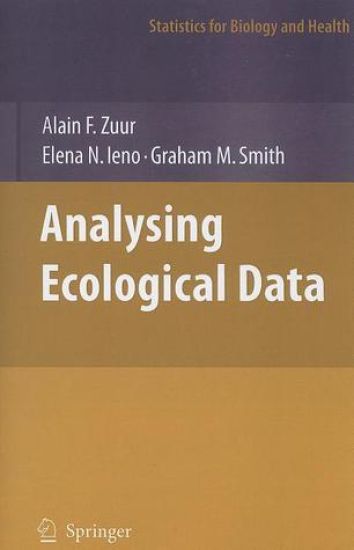
'Which test should I apply?' During the many years of working with ecologists, biologists and other environmental scientists, this is probably the question that the authors of this book hear the most often. The answer is always the same and along the lines of 'What are your underlying questions?', 'What do you want to show?'. The answers to these questions provide the starting point for a detailed discussion on the ecological background and purpose of the study. This then gives the basis for deciding on the most appropriate analytical approach. Therefore, a better start­ ing point for an ecologist is to avoid the phrase 'test' and think in terms of 'analy­ sis'. A test refers to something simple and unified that gives a clear answer in the form of a p-value: something rarely appropriate for ecological data. In practice, one has to apply a data exploration, check assumptions, validate the models, per­ haps apply a series of methods, and most importantly, interpret the results in terms of the underlying ecology and the ecological questions being investigated. Ecology is a quantitative science trying to answer difficult questions about the complex world we live in. Most ecologists are aware of these complexities, but few are fully equipped with the statistical sophistication and understanding to deal with them.
Mixed Effects Models and Extensions in Ecology with R

Mixed Effects Models and Extensions in Ecology with R

Alain Zuur; Elena N. Ieno; Neil Walker; Anatoly A. Saveliev; Graham M. Smith

Springer-Verlag New York Inc.
2009
sidottu
Building on the successful Analysing Ecological Data (2007) by Zuur, Ieno and Smith, the authors now provide an expanded introduction to using regression and its extensions in analysing ecological data. As with the earlier book, real data sets from postgraduate ecological studies or research projects are used throughout. The first part of the book is a largely non-mathematical introduction to linear mixed effects modelling, GLM and GAM, zero inflated models, GEE, GLMM and GAMM. The second part provides ten case studies that range from koalas to deep sea research. These chapters provide an invaluable insight into analysing complex ecological datasets, including comparisons of different approaches to the same problem. By matching ecological questions and data structure to a case study, these chapters provide an excellent starting point to analysing your own data. Data and R code from all chapters are available from www.highstat.com.
Analyzing Ecological Data

Analyzing Ecological Data

Alain Zuur; Elena N. Ieno; Graham M. Smith

Springer-Verlag New York Inc.
2007
sidottu
'Which test should I apply?' During the many years of working with ecologists, biologists and other environmental scientists, this is probably the question that the authors of this book hear the most often. The answer is always the same and along the lines of 'What are your underlying questions?', 'What do you want to show?'. The answers to these questions provide the starting point for a detailed discussion on the ecological background and purpose of the study. This then gives the basis for deciding on the most appropriate analytical approach. Therefore, a better start­ ing point for an ecologist is to avoid the phrase 'test' and think in terms of 'analy­ sis'. A test refers to something simple and unified that gives a clear answer in the form of a p-value: something rarely appropriate for ecological data. In practice, one has to apply a data exploration, check assumptions, validate the models, per­ haps apply a series of methods, and most importantly, interpret the results in terms of the underlying ecology and the ecological questions being investigated. Ecology is a quantitative science trying to answer difficult questions about the complex world we live in. Most ecologists are aware of these complexities, but few are fully equipped with the statistical sophistication and understanding to deal with them.