Kirjailija
Graham Smith
Kirjat ja teokset yhdessä paikassa: 49 kirjaa, julkaisuja vuosilta 1985-2026, suosituimpien joukossa Suffolk Airfields in the Second World War. Vertaile teosten hintoja ja tarkista saatavuus suomalaisista kirjakaupoista.
49 kirjaa
Kirjojen julkaisuhaarukka 1985-2026.
'A crucial, riveting polemic in support of one of the most precious things humanity has built - democracy itself' OWEN JONES'Graham Smith shows what fools our rotten constitution makes of us, with a monarch as emblem of a country beset by nepotism, backhanders, chumocracy and inherited privilege. Read and rebel!' POLLY TOYNBEEWe're constantly told the same things about the monarchy:But the monarchy is good for tourism..It isn't! Evidence points to some royal weddings actually having a negative impact on inbound tourism.But the monarchy makes a big difference to charity..Of the approx. 1,200 charities with a royal patron, 74% had no contact with their patron during the preceding year.But everyone loves the monarchy..A January 2023 poll showed support for the monarchy is down 55 percent.It's wrong in principle and it doesn't work in practice. It doesn't have to be this way.They say Britain should be proud to have the mother of parliaments, to be a shining beacon of democracy and an example to other nations. But there's an elephant in the room.At the heart of power is a single family. They weren't elected but they live off the public purse. They aren't accountable to anyone, and yet between them they are privy to more government secrets than many cabinet ministers. Divinely appointed using a special hat, the head of the family is your superior, you his subject. Apparently he is guardian of our constitution - but we're also told he wouldn't dream of interfering in politics.If you accept the monarchy, you must accept the moral compromise that comes with it, from its erosion of the principle of equality to the secret interference in our laws. But the good news is that we don't have to accept it. True democracy is within our reach.

"Can you hear a dog barking?" Blake asked."That's not a dog barking I think the barking owls have come back to the farm for the summer," Blake's father said.
Can we design institutions that increase and deepen citizen participation in the political decision making process? At a time when there is growing disillusionment with the institutions of advanced industrial democracies, there is also increasing interest in new ways of involving citizens in the political decisions that affect their lives. This book draws together evidence from a variety of democratic innovations from around the world, including participatory budgeting in Brazil, Citizens' Assemblies on Electoral Reform in Canada, direct legislation in California and Switzerland and emerging experiments in e-democracy. The book offers a rare systematic analysis of this diverse range of democratic innovations, drawing lessons for the future development of both democratic theory and practice.
Contemporary democracies are frequently criticized for failing to respond adequately to environmental problems and our political institutions are often charged with misrepresenting environmental values in decision-making processes. In this innovative volume, Graham Smith argues that the enhancement and institutionalisation of democratic deliberation will improve reflection on the wide range of environmental values that citizens hold. Drawing on theories of deliberative democracy, Smith argues that institutions need to be restructured in order to promote democratic dialogue and reflection on the plurality of environmental values. Deliberative Democracy and the Environment makes an important contribution to our understanding of the relationship between democratic and green political theory. Drawing on evidence from Europe and the United States, it systematically engages with questions of institutional design.
The collapse of the Soviet Union has engendered one of the most momentous and critical regional transformations of our tiomes through the formation and development of the post-Soviet states. This book explores the politics of post-Soviet transition and the problems which will continue to face these states well into the twenty-first century, as they struggle towards democracy, market reform, ethnic co-existance and integration into a new geoplolitical post-Cold War world order.Richly illustrated with examples drawn from Russian and other post-Soviet primary sources, the author focuses on three broad themes of transition. Firstly, the progression from colonialism to post-colonialism and the consquences of such changes on national identity and the redefinition of national homeland. Secondly, the movement away from totalitarian rule and the factors which both facilitate and challenge the prospects of a democratic future. Thirdly, the process of securing a successful place in the global capitalist economy.
Nation-building in the Post-Soviet Borderlands
Graham Smith; Vivien Law; Andrew Wilson; Annette Bohr; Edward Allworth
Cambridge University Press
1998
pokkari
This book examines how national and ethnic identities are being reforged in the post-Soviet borderland states. The first chapter provides a conceptual and theoretical context for examining national identities, drawing in particular upon post-colonial theory. The rest of the book is divided into three parts. In Part I, the authors examine how national histories of the borderland states are being rewritten especially in relation to new nationalising historiographies, around myths of origin, homeland, and descent. Part II explores the ethnopolitics of group boundary construction and how such a politics has led to nationalising policies of both exclusion and inclusion. Part III examines the relationship between nation-building and language, especially with regard to how competing conceptions of national identity have informed the thinking of both political decision-takers and nationalising intellectuals, and the consequences for ethnic minorities. Such perspectives on nation-building are illustrated with substantive studies drawn from the Baltic states, Ukraine, and Belarus, Transcaucasia, and Central Asia.
Nation-building in the Post-Soviet Borderlands
Graham Smith; Vivien Law; Andrew Wilson; Annette Bohr; Edward Allworth
Cambridge University Press
1998
sidottu
This book examines how national and ethnic identities are being reforged in the post-Soviet borderland states. The first chapter provides a conceptual and theoretical context for examining national identities, drawing in particular upon post-colonial theory. The rest of the book is divided into three parts. In Part I, the authors examine how national histories of the borderland states are being rewritten especially in relation to new nationalising historiographies, around myths of origin, homeland, and descent. Part II explores the ethnopolitics of group boundary construction and how such a politics has led to nationalising policies of both exclusion and inclusion. Part III examines the relationship between nation-building and language, especially with regard to how competing conceptions of national identity have informed the thinking of both political decision-takers and nationalising intellectuals, and the consequences for ethnic minorities. Such perspectives on nation-building are illustrated with substantive studies drawn from the Baltic states, Ukraine, and Belarus, Transcaucasia, and Central Asia.
This illustrated, action-packed book contains a full account of the part played by Suffolk's airfields during the Second World War. The history of each airfield is described, with details of the planes and the pilots who flew them, and the local civilians who worked alongside them. The subject is brought vividly to life with detailed accounts, alongside photos of the airmen themselves and their aircraft. The build-up of the RAF air offensive after 1940, and the arrival of the huge USAAF Eighth Air Force in 1942, meant that by early 1945 in Suffolk alone, there were some 1300 aircraft flying from 32 airfields. This book details the history of these airfields - RAF or USAAF - and highlights the major wartime operations and the many and varied aircraft that comprised the operational squadrons. Numbered among them are the Blenheim, Wellington, Stirling, Lancaster, Liberator, Flying Fortress, Spitfire, Hurricane, Thunderbolt, Mustang and the Sunderland Flying Boat. These, and the young airmen who flew them, made an immense contribution to the final defeat of the Third Reich, as Allied bombers and fighters flew increasingly larger raids across the North Sea and into the dangerous, smoke-filled skies of occupied Europe. This is their incredible story.
This book provides a comprehensive and detailed examination of the successes and failures of federalism in a diverse range of multi-ethnic polities and societies.It offers excellent coverage of the experiences of a wide range of contemporary states with specially commissioned contributions from established authorities.An introductory chapter introduces the reader to the nature of federations, the political philosophies that underpin federalism, the characteristics of federal formations, and highlights some of the theories as to why this system of government has failed in some cases to provide ethno-regional stability. A concluding chapter draws upon the findings and examines the prospects for federalism in the light of the acceleration towards greater economic interdependency and local political fragmentation, in the post-Cold War world.
This meticulously researched, illustrated book contains a full account of the part played by Norfolk's airfields during World War II. The book describes the history of each airfield - RAF or USAAF - and highlights the major wartime operations and the many and varied aircraft that comprised the operational squadrons. Numbered among these are the Blenheim, Boston, Spitfire, Hurricane, Wellington, Stirling, Lancaster, Liberator and Flying Fortress. The subject is brought vividly to life with evocative accounts, alongside photos of the airmen themselves and their aircraft. An American pilot serving in Norfolk during the Second World War once commented, 'I guess if you just switch off and glide, you're more likely to have gotten on an airfield than in any other place.' Norfolk's geography meant that it became home to no less than 37 airfields by the end of the war. These, and the airmen who flew from them, made an immense contribution both to the defence of Britain and later, more significantly, to the air war in Europe, as the allied air forces flew increasingly large concentrations of bombers into the smoke-filled skies above Germany. The effects of the war on the daily lives of the people of Norfolk and the dangers they endured, including the 'Baedeker' raids on Norwich in April 1942, are also detailed. Graham Smith's action-packed book will appeal equally to aviation enthusiasts and to anyone with an interest in Norfolk's wartime history.
An exclusive, definitive visual and narrative account of the New Romantic movement from a photographer who was there. While many musical styles have been labeled 'post-punk,' the New Romantic movement transcended the 'no future' ethos of the late 1970s like no other. In the dimly lit bars of Soho, a group of extravagant youths emerged, dressed in flamboyant and striking attire - ushering in a cultural moment that would define a generation. Photographer Graham Smith was at its core, capturing over 500 extraordinary images that reveal this vibrant, groundbreaking scene in unparalleled detail. This book offers an intimate, behind-the-scenes perspective on a movement that visually shaped a decade and left a lasting influence on music and fashion. Featuring exclusive forewords boy George, Gary Kemp, and the late Steve Strange, this is the definitive photographic and narrative record of one of the most creative, bohemian, and influential movements of the late twentieth century.
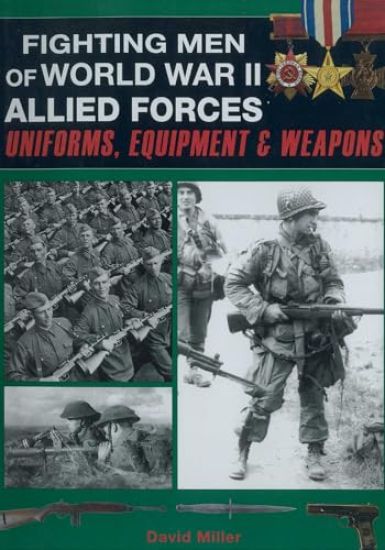
Fighting Men of World War II - Allied Forces
David Miller; Graham Smith
Skyhorse Publishing
2025
pokkari
Fighting Men of World War II: Allied Forces is the second part of a two-volume set (Axis Forces is also available) which sets out to examine in detail the weapons and equipment of the average soldier of the United States, Great Britain and its Dominions and Commonwealth, the Soviet Union, and the other nations like France and Poland who fought on despite being overrun in the early stages of the conflict. In these pages we examine a broad range of general equipment that was used every day, including mess tins, water bottles, medical kits, radios, binoculars, goggles, entrenching tools and wire cutters. We give detailed specifications of weapons such as: pistols and revolvers, rifles, bayonets, fighting knives, hand grenades, flamethrowers, mortars and anti-tank weapons. The clothing sections include headgear, from the M1 helmet system to the Tam o’ Shanter and the Russian pilotka. We examine footwear as diverse as polished officers’ shoes, cavalry boots, paratroopers’ jump boots and felt overboots. Uniform tunics, shirts, trousers, and greatcoats all receive attention, as do all-weather gear, gloves, ponchos, camouflage smocks and load-carrying vests. Numerous variations are shown, as are rank badges and other insignia. Personal items too are included. We show cigarettes and lighters, letters and postcards home, magazines, gramophones, identity tags, mending kits and eating utensils. Almost all of the items shown have not been featured in book form before and have been specially chosen from museums and private collections to form a unique reference source for the general reader, budding collector, military enthusiast, re-enactor, and modeller. The fighting man is placed within the context of his unit organization, while carefully researched archive photos show him with his weapons and equipment in action. The text, by seasoned military expert David Miller, is the result of painstaking research, backed up by his own military experience in the British Army, which has given him the necessary credentials to understand what the average fighting man’s needs and day-to-day preoccupations actually were. David has been assisted by editor Graham Smith, and the two of them have pulled together all these diverse elements to form one of the most definitive works of its kind.
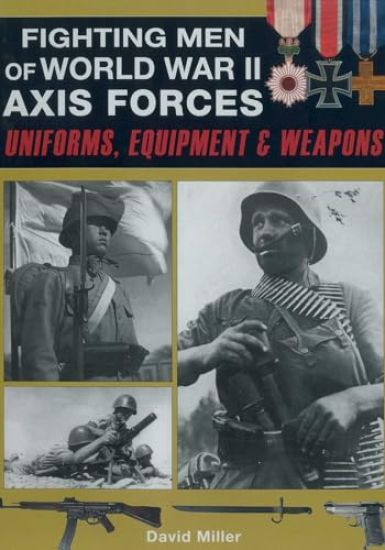
Fighting Men of World War II - Axis Forces
David Miller; Graham Smith
Skyhorse Publishing
2025
pokkari
Fighting Men of World War II: Axis Forces is the first part of a two-volume set (Allied Forces is also available) which sets out to examine in detail the weapons and equipment of the average soldier of Germany, Japan, Italy, and the other nations like Finland, Bulgaria, Hungary and Romania, comprised the Axis forces. In these pages we examine a broad range of general equipment that was used every day, including binoculars, goggles, radios, water bottles, fuel cans, medical kits, skis, wire cutters and detonators. We give detailed specifications of weapons such as pistols and revolvers, rifles, bayonets, fighting knives, hand grenades, landmines, flamethrowers, mortars and light artillery. The clothing sections include headgear, from the feathered hats of the Italian Bersaglieri sharpshooters to the redoubtable Stahlheim of the German troops. We examine footwear as diverse as polished officers’ shoes, cavalry boots, paratroopers’ jump boots and Japanese Tabi canvas shoes. Uniform tunics, shirts, trousers and greatcoats all receive attention, as do all-weather gear, gloves, ponchos and shelter sections, such as the German Zeltbahn. Camouflage variations are shown, as are rank badges together with unit badges and medals. Personal items too are included. We show cigarettes and lighters, letters and postcards home, campstools, fans, identity tags, mending kits and eating utensils. Almost all the items shown have not been featured in book form before and have been specially chosen from museums and private collections to form a unique reference source for the general reader, budding collector, military enthusiast, re-enactor, and modeller. The fighting man is placed within the context of his unit organization, while carefully researched archive photos show him with his weapons and equipment in action. The text, by seasoned military expert David Miller, is the result of painstaking research, backed up by his own military experience in the British Army, which has given him the necessary credentials to understand what the average fighting man’s needs and day-to-day preoccupations actually were. David has been assisted by editor Graham Smith, and the two of them have pulled together all these diverse elements to form one of the most definitive works of its kind.
Citizens' assemblies bring the shared wisdom of ordinary people into political decision making on the climate and ecological crisis. They are increasingly being used at local, national and even global levels. But with what impact? Can they take us beyond the shortcomings of electoral and partisan politics? Can they make a real difference? This book explains why climate assemblies have captured the imagination of governments and activists alike, exploring the ways they can have a meaningful impact on climate politics. This book charts the development of climate assemblies across Europe and beyond. It explores what ordinary people want, highlighting the ways in which assembly recommendations take us beyond current government policies and offer new visions and directions for change. It shows that not all assemblies are the same and that the context and design of climate assemblies have differed quite profoundly - as have their impacts on policy and public discourse. The book also lays out the key elements needed for climate assemblies to have sustained impact, providing essential insights for anyone wanting to run or advocate for them, and concludes with reflections on what we can expect from assemblies as they evolve. The transition to net zero and climate resilient societies requires deep social and economic transformations that will have significant impacts on citizens' choices and behaviours. Such a transition needs to engage the public directly and this book shows how climate assemblies can achieve this, allowing us to address the issues we all face together.
'A crucial, riveting polemic in support of one of the most precious things humanity has built - democracy itself' OWEN JONES'Graham Smith shows what fools our rotten constitution makes of us, with a monarch as emblem of a country beset by nepotism, backhanders, chumocracy and inherited privilege. Read and rebel!' POLLY TOYNBEEWe're constantly told the same things about the monarchy:But the monarchy is good for tourism..It isn't! Evidence points to some royal weddings actually having a negative impact on inbound tourism.But the monarchy makes a big difference to charity..Of the approx. 1,200 charities with a royal patron, 74% had no contact with their patron during the preceding year.But everyone loves the monarchy..A January 2023 poll showed support for the monarchy is down 55 percent.It's wrong in principle and it doesn't work in practice. It doesn't have to be this way.They say Britain should be proud to have the mother of parliaments, to be a shining beacon of democracy and an example to other nations. But there's an elephant in the room.At the heart of power is a single family. They weren't elected but they live off the public purse. They aren't accountable to anyone, and yet between them they are privy to more government secrets than many cabinet ministers. Divinely appointed using a special hat, the head of the family is your superior, you his subject. Apparently he is guardian of our constitution - but we're also told he wouldn't dream of interfering in politics.If you accept the monarchy, you must accept the moral compromise that comes with it, from its erosion of the principle of equality to the secret interference in our laws. But the good news is that we don't have to accept it. True democracy is within our reach.

This book, the first of a two volume study, provides an historical account of complaints against Metropolitan police officers between formation of the force in 1829 and codification of remedies for misconduct under the Police Act 1964. A complainant centred standpoint is developed to counteract the marginalization of the interests of victims, which is held to demonstrate that the drive for effective and efficient law enforcement has overshadowed the public interest in holding officers to account for misconduct. After officer accountability before the criminal courts diminished in the nineteenth century, missed opportunities to reform complaints procedures following commissions of inquiry in 1906-08, 1928 and 1960-62 are discussed. The second volume of the study, Combating Impunity: Complaints Against Metropolitan Police, 1964-2021, will examine the part played by complainants and civil society organisations in combating police impunity in the citizen oversight era.