Kirjojen hintavertailu. Mukana 12 390 323 kirjaa ja 12 kauppaa.

Kirjailija

Greg Hearn

Kirjat ja teokset yhdessä paikassa: 3 kirjaa, julkaisuja vuosilta 2003-2023, suosituimpien joukossa Public Policy in Knowledge-Based Economies. Vertaile teosten hintoja ja tarkista saatavuus suomalaisista kirjakaupoista.

3 kirjaa

Kirjojen julkaisuhaarukka 2003-2023.

Community, Culture, Commerce

Community, Culture, Commerce

Jock McQueenie; Marcus Foth; Greg Hearn

SPRINGER VERLAG, SINGAPORE
2023
sidottu
As digital environments become increasingly individualised, instant, ubiquitous, and disintermediated, this book demonstrates the continuing relevance of intermediaries at the intersection of design, creativity, community engagement, and corporate social responsibility. The authors examine intermediaries as enablers of mutual benefit and offer a proactive, interventionist, and holistic approach to intermediation practice that steps beyond design thinking. By means of case studies that employ the 3C project design methodology—Community, Culture, Commerce—the authors provide an accessible introduction to intermediation at the nexus of theory and practice and signpost new opportunities for researchers and practitioners in the post-COVID environment.
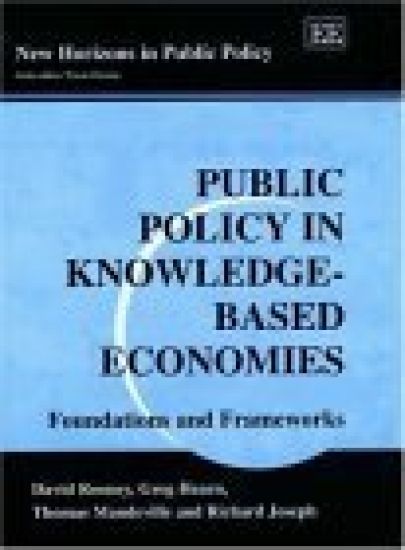
Public Policy in Knowledge-Based Economies

Public Policy in Knowledge-Based Economies

David Rooney; Greg Hearn; Thomas Mandeville; Richard Joseph

Edward Elgar Publishing Ltd
2003
sidottu
Knowledge is a product of human social systems and, therefore, the foundations of the knowledge-based economy are social and cultural. Communication is central to knowledge creation and diffusion, and Public Policy in Knowledge-Based Economies highlights specific social and cultural conditions that can enhance the communication, use and creation of knowledge in a society. The purpose of this book is to illustrate how these social and cultural conditions are identified and analysed through new conceptual frameworks. Such frameworks are necessary to penetrate the surface features of knowledge-based economies - science and technology - and disclose what drives such economies. The authors employ a trans-disciplinary approach to explore the nature of knowledge systems or environments and examine questions regarding the measurement of knowledge. Lessons are drawn from a variety of perspectives, including the history of information policy, philosophy, economic history, sociology, psychology, information economics, complex systems theory, organisational knowledge theory and political science.This book will provide policymakers, analysts and academics with the fundamental tools needed for the development of policy in this little understood and emerging area.