

Kirjailija
Gregg Bordowitz
Kirjat ja teokset yhdessä paikassa: 4 kirjaa, julkaisuja vuosilta 2006-2021, suosituimpien joukossa Felix Gonzalez-Torres. Vertaile teosten hintoja ja tarkista saatavuus suomalaisista kirjakaupoista.
4 kirjaa
Kirjojen julkaisuhaarukka 2006-2021.

One of the most significant artists to emerge in the late 1980s and early 1990s, Felix Gonzalez-Torres' (1957-96) reduced formal vocabulary, conceptual rigor and evocative use of everyday materials resonates with meaning that is at once specific and mutable, rigorous and generous, poetic and political.Featuring several key bodies of work from throughout the artist's career, this publication showcases a series of distinct installations at David Zwirner in New York in 2017. Together, in their radical openness to interventions of site, audience and context, the works on view challenge perceived notions of what constitutes an exhibition space, a public, an artwork itself. Despite the resolute abstraction of much of his work, Gonzalez-Torres worked with familiar materials, from his iconic candy spill works to his evocative light string pieces, to mirrors, clocks and curtains. His work activates the architecture of the various spaces, the physicality of the viewer, the past and present, continuously maintaining its relevance.Opening with details of the exhibition and images of visitors in the spaces, the publication walks the reader through each piece. New texts by Gregg Bordowitz and David Breslin explore the works included while contextualizing Gonzalez-Torres' contribution to art history.
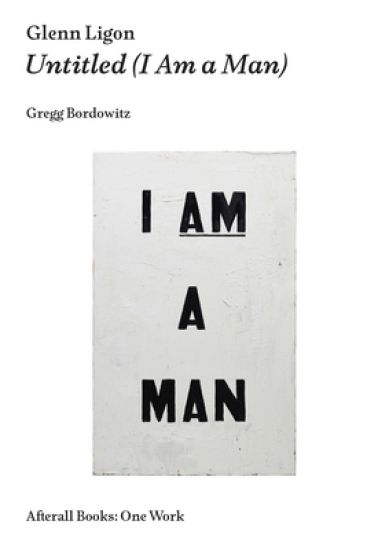
An illustrated examination of Glenn Ligon's iconic Untitled (I Am a Man) (1988)-a quotation, an appropriated text turned into an artifact.The iconic work Untitled (I Am a Man) (1988) by the important contemporary American artist Glenn Ligon is a quotation, an appropriated text turned into an artifact. The National Gallery of Art in Washington presents the work as a "representation-a signifier-of the actual signs carried by 1,300 striking African American sanitation workers in Memphis, made famous by Ernest Withers' 1968 photographs." In this illustrated study of the work, Gregg Bordowitz takes the National Gallery's presentation as his starting point, considering the museum's juxtaposition of Untitled (I Am a Man) and the ca. 1935 sculpture, Schoolteacher, by William Edmondson, and the relation of the two terms, "markers" and "signs."After closely examining the canvas itself, its textures, brushwork, and structure, Bordowitz presents a theoretical framework that draws on the work of American philosopher Charles Sanders Peirce and his theory of Firstness, Secondness, and Thirdness. He makes a case for Thirdness as a function, operation, or law of meaning-making, not limited by the gender, age, ethnicity, race, class, or personal history of the viewer. Bordowitz goes on to examine Ligon's work in terms of the representation of self, race, and gender, focusing on three series: Profile Series (1990-91), Narratives, and Runaways (both 1993). He cites such historical figures as Sojourner Truth and her famous 1851 speech, "Ain't I a Woman?" as well as influences ranging from Bo Diddley's 1955 song, "I'm a Man" to the cultural theories of Stuart Hall.
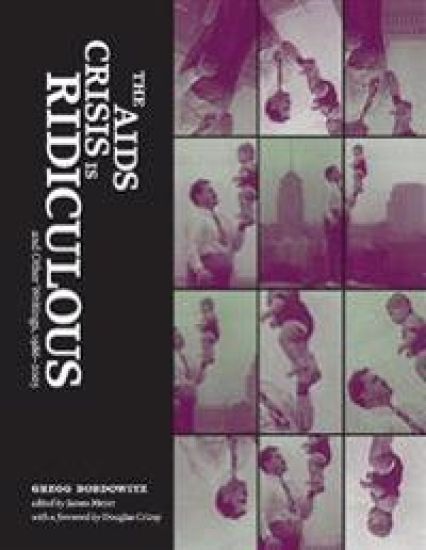
The AIDS Crisis Is Ridiculous and Other Writings, 1986–2003
Gregg Bordowitz; Douglas Crimp
MIT Press
2006
pokkari
The first collection of writings by a noted artist and activist whose work has focused on the AIDS epidemic.The HIV epidemic animates this collection of essays by a noted artist, writer, and activist. "So total was the burden of illness-mine and others'-that the only viable response, other than to cease making art entirely, was to adjust to the gravity of the predicament by using the crisis as a lens," writes Gregg Bordowitz, a film- and video-maker whose best-known works, Fast Trip Long Drop (1993) and Habit (2001), address AIDS globally and personally. In The AIDS Crisis Is Ridiculous-the title essay is inspired by Charles Ludlam, founder of the Ridiculous Theater Company-Bordowitz follows in the tradition of artist-writers Robert Smithson and Yvonne Rainer by making writing an integral part of an artistic practice.Bordowitz has left his earliest writings for the most part unchanged-to preserve, he says, "both the youthful exuberance and the palpable sense of fear" created by the early days of the AIDS crisis. After these early essays, the writing becomes more experimental, sometimes mixing fiction and fact; included here is a selection of Bordowitz's columns from the journal Documents, "New York Was Yesterday." Finally, in his newest essays he reformulates early themes, and, in "My Postmodernism" (written for Artforum's fortieth anniversary issue) and "More Operative Assumptions" (written especially for this book), he reexamines the underlying ideas of his practice and sums up his theoretical concerns.In his mature work, Bordowitz seeks to join the subjective-the experience of having a disease-and the objective-the fact of the disease as a global problem. He believes that this conjunction is necessary for understanding and fighting the crisis. "If it can be written," he says, "then it can be realized."