Kirjojen hintavertailu. Mukana 12 595 353 kirjaa ja 12 kauppaa.

Kirjailija

Gregor Kennedy

Kirjat ja teokset yhdessä paikassa: 4 kirjaa, julkaisuja vuosilta 2011-2022, suosituimpien joukossa Blended Synchronous Learning. Vertaile teosten hintoja ja tarkista saatavuus suomalaisista kirjakaupoista.

4 kirjaa

Kirjojen julkaisuhaarukka 2011-2022.

Teaching for Quality Learning at University 5e

Teaching for Quality Learning at University 5e

John Biggs; Catherine Tang; Gregor Kennedy

OPEN UNIVERSITY PRESS
2022
nidottu
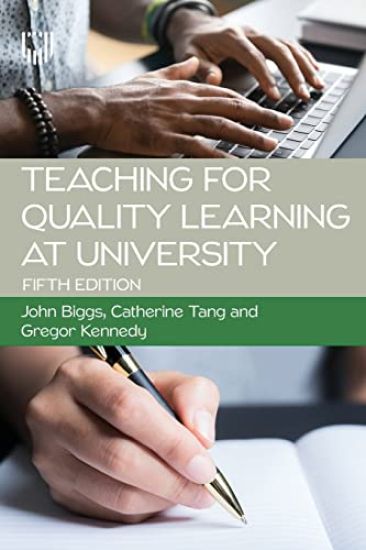
“Biggs and Tang, now with Kennedy, have ensured this new edition remains an international leader for university teaching for the next decade.”Denise Chalmers AM, Emeritus Professor, University of Western Australia, Australia“This book, a fifth edition, can truly be called a “classic” on the topic of teaching, learning and curriculum design in higher education.”Michael Prosser, Honorary Professorial Fellow, Centre for the Study of Higher Education, University of Melbourne, Australia“You should be inspired to increase the quality of your teaching, your learning, and your learning about teaching.”John R. Kirby, Professor Emeritus of Educational Psychology, Queen’s University, CanadaThe concept of constructive alignment has supported generations of students and teachers within higher education. It is a ‘backward design’ method of teaching where the student outcomes are identified first and the teacher then designs teaching activities to enable students to achieve those outcomes, assessing how well they have been achieved. Each chapter outlines how to design the learning outcomes, teaching and assessments for success in learning. This updated edition of Teaching for Quality Learning at University: • Provides a comprehensive, research-based theory of teaching for teacher reflection • Outlines how educational technology can be used in constructively aligned teaching • Helps staff developers to provide support for staff and departments in line with institutional policies • Offers a framework for quality assurance and quality enhancement across a whole institution Teaching for Quality Learning at University continues to be used as a framework for designing higher education teaching systems globally and is essential reading for those in the field. John Biggs has held Chairs in Education in Canada, Australia, and Hong Kong. He has published extensively on student learning and the implications of his research for teaching. He developed his concept of constructive alignment at the University of Hong Kong, first outlined in Teaching for Quality Learning at University in 1999. Catherine Tang has over 15 years of teaching experience in tertiary education and is the former Head of the Centre for Learning, Teaching and Supervision at the Education University of Hong Kong (the then Hong Kong Institute of Education) and the Educational Development Centre at the Hong Kong Polytechnic University. Gregor Kennedy is the Deputy Vice-Chancellor (Academic) at the University of Melbourne, Australia and a Professor of Higher Education in the Melbourne Centre for the Study of Higher Education.
Evaluating e-Learning

Evaluating e-Learning

Rob Phillips; Carmel McNaught; Gregor Kennedy

Routledge
2011
nidottu
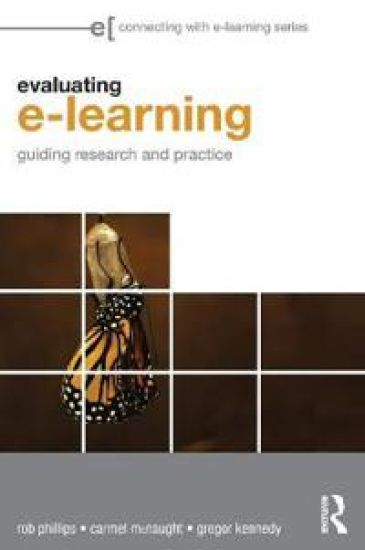
How can novice e-learning researchers and postgraduate learners develop rigorous plans to study the effectiveness of technology-enhanced learning environments? How can practitioners gather and portray evidence of the impact of e-learning? How can the average educator who teaches online, without experience in evaluating emerging technologies, build on what is successful and modify what is not? By unpacking the e-learning lifecycle and focusing on learning, not technology, Evaluating e-Learning attempts to resolve some of the complexity inherent in evaluating the effectiveness of e-learning. The book presents practical advice in the form of an evaluation framework and a scaffolded approach to an e-learning research study, using divide-and-conquer techniques to reduce complexity in both design and delivery. It adapts and builds on familiar research methodology to offer a robust and accessible approach that can ensure effective evaluation of a wide range of innovative initiatives, including those covered in other books in the Connecting with e-Learning series. Readers will find this jargon-free guide is a must-have resource that provides the proper tools for evaluating e-learning practices with ease.
Evaluating e-Learning

Evaluating e-Learning

Rob Phillips; Carmel McNaught; Gregor Kennedy

Routledge
2011
sidottu
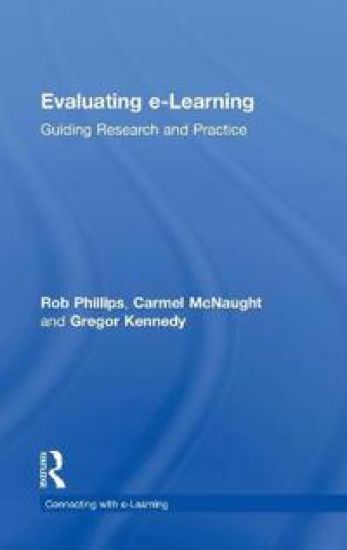
How can novice e-learning researchers and postgraduate learners develop rigorous plans to study the effectiveness of technology-enhanced learning environments? How can practitioners gather and portray evidence of the impact of e-learning? How can the average educator who teaches online, without experience in evaluating emerging technologies, build on what is successful and modify what is not? By unpacking the e-learning lifecycle and focusing on learning, not technology, Evaluating e-Learning attempts to resolve some of the complexity inherent in evaluating the effectiveness of e-learning. The book presents practical advice in the form of an evaluation framework and a scaffolded approach to an e-learning research study, using divide-and-conquer techniques to reduce complexity in both design and delivery. It adapts and builds on familiar research methodology to offer a robust and accessible approach that can ensure effective evaluation of a wide range of innovative initiatives, including those covered in other books in the Connecting with e-Learning series. Readers will find this jargon-free guide is a must-have resource that provides the proper tools for evaluating e-learning practices with ease.