Kirjojen hintavertailu. Mukana 12 657 676 kirjaa ja 12 kauppaa.
Kirjailija
Gregory F. Treverton
Kirjat ja teokset yhdessä paikassa: 23 kirjaa, julkaisuja vuosilta 1994-2019, suosituimpien joukossa Intelligence for an Age of Terror. Vertaile teosten hintoja ja tarkista saatavuus suomalaisista kirjakaupoista.
"This comprehensive overview, presenting the views of eminent scholars and practitioners, explores in useful detail the new Latin America's changing relationships with the United States, Europe, Japan, and other regions. It is excellent and most timely".--Enrique V. Iglesias, President, Inter-American Development Bank. Lightning Print On Demand Tit
Gregory Treverton reviews the significant episodes in Europe's history after World War II, emphasizing America's preoccupation with Europe and the decisive effect of U.S. foreign policy on European security and economic arrangements during the postwar years. Originally published in 1992. The Princeton Legacy Library uses the latest print-on-demand technology to again make available previously out-of-print books from the distinguished backlist of Princeton University Press. These editions preserve the original texts of these important books while presenting them in durable paperback and hardcover editions. The goal of the Princeton Legacy Library is to vastly increase access to the rich scholarly heritage found in the thousands of books published by Princeton University Press since its founding in 1905.
The Intelligence Community does not lag far behind the private sector in using collaborative tools; indeed, it has developed an impressive array. However, the most used tools, like instant messaging (IM), are employed primarily within agencies for peer-to-peer communication and hence are neither widely collaborative nor especially novel: they are different ways of accomplishing familiar functions. The array of collaborative tools across agencies—ranging from IM to blogs to a wiki called Intellipedia—is impressive but used mostly by enthusiasts. This report identifies lessons learned from looking at the use of internal collaborative tools across the Intelligence Community, especially across the four biggest agencies: Central Intelligence Agency, Defense Intelligence Agency, National Security Agency, and National Geospatial Intelligence Agency.
Intelligence is currently facing increasingly challenging cross-pressures from both a need for accurate and timely assessments of potential or imminent security threats and the unpredictability of many of these emerging threats. We are living in a social environment of growing security and intelligence challenges, yet the traditional, narrow intelligence process is becoming increasingly insufficient for coping with diffuse, complex, and rapidly-transforming threats. The essence of intelligence is no longer the collection, analysis, and dissemination of secret information, but has become instead the management of uncertainty in areas critical for overriding security goals---not only for nations, but also for the international community as a whole. For its part, scientific research on major societal risks like climate change is facing a similar cross-pressure from demand on the one hand and incomplete data and developing theoretical concepts on the other. For both of these knowledge-producing domains, the common denominator is the paramount challenges of framing and communicating uncertainty and of managing the pitfalls of politicization National Intelligence and Science is one of the first attempts to analyze these converging domains and the implications of their convergence, in terms of both more scientific approaches to intelligence problems and intelligence approaches to scientific problems. Science and intelligence constitute, as the book spells out, two remarkably similar and interlinked domains of knowledge production, yet ones that remain traditionally separated by a deep political, cultural, and epistemological divide. Looking ahead, the two twentieth-century monoliths---the scientific and the intelligence estates---are becoming simply outdated in their traditional form. The risk society is closing the divide, though in a direction not foreseen by the proponents of turning intelligence analysis into a science, or the new production of scientific knowledge.
Gregory Treverton reviews the significant episodes in Europe's history after World War II, emphasizing America's preoccupation with Europe and the decisive effect of U.S. foreign policy on European security and economic arrangements during the postwar years. Originally published in 1992. The Princeton Legacy Library uses the latest print-on-demand technology to again make available previously out-of-print books from the distinguished backlist of Princeton University Press. These editions preserve the original texts of these important books while presenting them in durable paperback and hardcover editions. The goal of the Princeton Legacy Library is to vastly increase access to the rich scholarly heritage found in the thousands of books published by Princeton University Press since its founding in 1905.
Some police forces believe that 20 years from now they will operate much as they do today, but advances in technology and operating concepts are driving significant changes in day-to-day police operations. This book explores potential visions of the future of policing, based on the drivers of jurisdiction, technology, and threat, and includes concrete steps for implementation. This analysis is based on a review of policing methods and theories from the 19th century to the present day. Recommendations include educating personnel and leaders to build internal support for change, transitioning to shared technical platforms, and leveraging winning technologies. Because criminals will also use new technology that becomes available, the key to the future of policing will not be the technology itself; it will be the ways in which police forces adapt the technology to their needs.
During the Cold War, U.S. intelligence was concerned primarily with states; non-state actors like terrorists were secondary. Now the priorities are reversed and the challenge is enormous. States had an address, and they were hierarchical and bureaucratic. They thus came with some 'story'. Terrorists do not. States were 'over there', but terrorists are there and here. They thus put pressure on intelligence at home, not just abroad. The strength of this book is that it underscores the extent of the change and ranges broadly across data collection and analysis, foreign and domestic, as well as presenting the issues of value that arise as new targets require collecting more information at home.
It is often challenging to determine whether security cooperation activities conducted by the Defense Department have contributed to U.S. objectives. This monograph, based on themes that emerged from a May 2008 assessment workshop held at RAND, lays out a framework for security program assessment and stresses the need for injecting a greater level of objectivity into the assessment process.
During the Cold War, U.S. intelligence was concerned primarily with states; non-state actors like terrorists were secondary. Now the priorities are reversed and the challenge is enormous. States had an address, and they were hierarchical and bureaucratic. They thus came with some 'story'. Terrorists do not. States were 'over there', but terrorists are there and here. They thus put pressure on intelligence at home, not just abroad. The strength of this book is that it underscores the extent of the change and ranges broadly across data collection and analysis, foreign and domestic, as well as presenting the issues of value that arise as new targets require collecting more information at home.
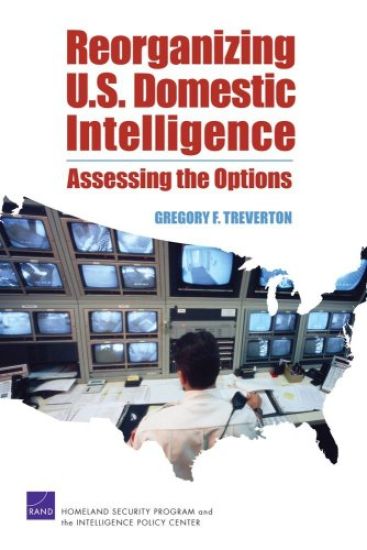
One of the questions in the fight against terrorism is whether the United States needs a counterterrorism domestic intelligence agency separate from law enforcement. Drawing on an analysis of current counterterrorism efforts, an examination the domestic intelligence agencies in six other democracies, and interviews with intelligence and law enforcement experts, this volume lays out the relevant considerations for creating such an agency.This volume examines counterterrorism-focused domestic intelligence in the United States and discusses the pros and cons of creating a new, dedicated domestic intelligence agency, on the model of several comparable democracies.
Insecurity in the 21st century appears to come less from the collisions of powerful states than from the debris of imploding ones. This paper aims to improve the understanding and treatment of failed states by focusing on critical challenges at the intersections between security, economics, and politics and on the guiding goal of lifting local populations from the status of victims of failure to agents of recovery.
This report assesses intelligence analysis across the main U.S. intelligence agencies and makes a number of recommendations, some of which parallel initiatives that have begun in the wake of the December 2004 legislation, for instance, create a Deputy Director of National Intelligence as a focal point for analysis, establish a National Intelligence University, build a Long Term Analysis Unit at the National Intelligence Council, and form an Open Source Center for making more creative use of open-source materials.
In June 2005, the RAND Corporation and the Office of the Director of National Intelligence convened a one-day workshop to discuss how theories underlie U.S. intelligence work and might lead to a better understanding and practice of intelligence.
Examines how state and local law enforcement agencies conducted and supported counterterrorism intelligence activities after 9/11. The report analyzes data from a 2002 survey of law enforcement preparedness in the context of intelligence, shows how eight local law enforcement agencies handle intelligence operations, and suggests ways that the job of gathering and analyzing intelligence might best be shared among federal, state, and local agencies.
The CIA's Global Futures Partnership and the RAND Corporation convened a series of four one-day workshops to examine how to better integrate alternative analysis into the analytic process. The basic assumption of the workshops was that "transnational" issues, such as terrorism, present a different set of analytic challenges than more traditional intelligence topics targeted primarily on nation states. This document contains the reports from those four workshops.
John E. Peters; James Dickens; Derek Eaton; Christine Fair; Nina Hachigian; Theodore W. Karasik; Rollie Lal; Rachel Swanger; Gregory F. Treverton; Charles Wolf
Highlights key factors in South Asia imperiling U.S. interests, and suggests how and where the U.S. military might play an expanded, influential role. It suggests steps the military might take to better advance and defend U.S. interests in the area. This monograph highlights key factors in South Asia imperiling U.S. interests, and suggests how and where the U.S. military might play an expanded, influential role. It suggests seven steps the military might take to better advance and defend U.S. interests in South Asia, the Middle East, and Asia at large. Washington should intensify involvement in South Asia and become more influential with the governments there. Given the area's potential for violence, it should also shape part of the U.S. military to meet potential crises.
People with complex, hard-to-train skills, such as information technology specialists, linguists or scientists are difficult for the military to attract and retain. This report examines five new ideas for attracting such people into the Reserve Component.
Is the United States producing the leaders it will need in the 21st century? No issue is more critical for America's role in the world than its capacity to develop among its people the intellectual and professional expertise that will be required for leadership in international affairs. The authors of this study interviewed representatives of internationally oriented organizations, queried experts who could provide insights on this topic, and reviewed recent literature on U.S. leadership in international affairs.