Kirjojen hintavertailu. Mukana 12 390 323 kirjaa ja 12 kauppaa.

Kirjailija

Gregory Plett

Kirjat ja teokset yhdessä paikassa: 3 kirjaa, julkaisuja vuosilta 2015-2024, suosituimpien joukossa Battery Management Systems, Volume II: Equivalent-Circuit Methods. Vertaile teosten hintoja ja tarkista saatavuus suomalaisista kirjakaupoista.

3 kirjaa

Kirjojen julkaisuhaarukka 2015-2024.

Battery Management Systems, Volume III: Physics-Based Methods

Battery Management Systems, Volume III: Physics-Based Methods

Gregory Plett; M. Scott Trimboli

Artech House Publishers
2024
sidottu
This book -- the third and final volume in a series describing battery-management systems – shows you how to use physics-based models of battery cells in a computationally efficient way for optimal battery-pack management and control to maximize battery-pack performance and extend life. It covers the foundations of electrochemical model-based battery management system while introducing and teaching the state of the art in physics-based methods for battery management. Building upon the content in volumes I and II, the book helps you identify parameter values for physics-based models of a commercial lithium-ion battery cell without requiring cell teardown; shows you how to estimate the internal electrochemical state of all cells in a battery pack in a computationally efficient way during operation using these physics-based models; demonstrates the use the models plus state estimates in a battery management system to optimize fast-charge of battery packs to minimize charge time while also maximizing battery service life; and takes you step-by-step through the use models to optimize the instantaneous power that can be demanded from the battery pack while also maximizing battery service life. The book also demonstrates how to overcome the primary roadblocks to implementing physics-based method for battery management: the computational-complexity roadblock, the parameter-identification roadblock, and the control-optimization roadblock. It also uncovers the fundamental flaw in all present “state of art” methods and shows you why all BMS based on equivalent-circuit models must be designed with over-conservative assumptions. This is a strong resource for battery engineers, chemists, researchers, and educators who are interested in advanced battery management systems and strategies based on the best available understanding of how battery cells operate.
Battery Management Systems, Volume II: Equivalent-Circuit Methods
This second volume discusses state-of-the-art applications of equivalent-circuit models as they pertain to solving problems in battery management and control. Readers are provided information on how to use models from Volume I to control battery packs, along with discussion of fundamental flaws in current approaches. In addition, Volume II introduces the ideas of physics-based optimal battery controls and explains why they can be superior to the state-of-the-art equivalent-circuit controls.
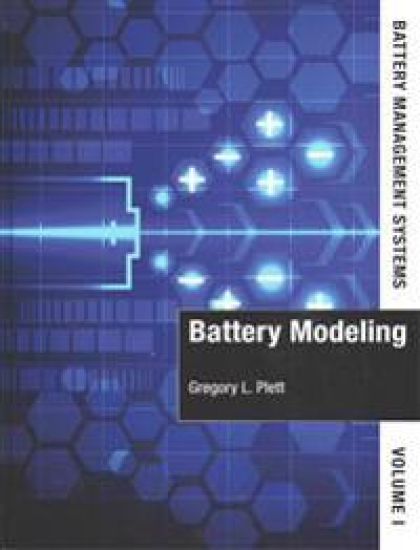
Battery Management Systems, Volume I: Battery Modeling

Battery Management Systems, Volume I: Battery Modeling

Gregory Plett

Artech House Publishers
2015
sidottu
Large-scale battery packs are needed in hybrid and electric vehicles, utilities grid backup and storage, and frequency-regulation applications. In order to maximize battery-pack safety, longevity, and performance, it is important to understand how battery cells work. This first of its kind new resource focuses on developing a mathematical understanding of how electrochemical (battery) cells work, both internally and externally.This comprehensive resource derives physics-based micro-scale model equations, then continuum-scale model equations, and finally reduced-order model equations. This book describes the commonly used equivalent-circuit type battery model and develops equations for superior physics-based models of lithium-ion cells at different length scales.This book presents a breakthrough technology called the "discrete-time realization algorithm" that automatically converts physics-based models into high-fidelity approximate reduced-order models.