Kirjailija
Gregory S. Kealey
Kirjat ja teokset yhdessä paikassa: 10 kirjaa, julkaisuja vuosilta 1995-2024, suosituimpien joukossa Debating Dissent. Vertaile teosten hintoja ja tarkista saatavuus suomalaisista kirjakaupoista.
Mukana myös kirjoitusasut: Gregory S Kealey
10 kirjaa
Kirjojen julkaisuhaarukka 1995-2024.
In 1941, the RCMP recruited Frank Hadesbeck, a Spanish Civil War veteran, as a paid informant to infiltrate the Communist Party. For decades, he informed not only upon communists, but also upon hundreds of other people who held progressive views. Hadesbeck's "Watch Out" lists on behalf of the Security Service included labour activists, medical doctors, lawyers, university professors and students, journalists, Indigenous and progressive farm leaders, members of the clergy, and anyone involved in the peace and human rights movements. Defying every warning given to him by his handlers, Hadesbeck kept secret notes. Using these notes, author Dennis Gruending recounts how the RCMP spied upon thousands of Canadians. Hadesbeck's life and career are in the past, but RCMP surveillance continues in new guises. As Canada's petroleum industry doubles down on its extraction plans in the oil sands and elsewhere, the RCMP and other state agencies provide support, routinely branding Indigenous land defenders and their allies in the environmental movement as potential terrorists. They share information and tactics with petroleum industry "stakeholders" in what has been described as a "surveillance web" intended to suppress dissent. A Communist for the RCMP provides an inside account of Hadesbeck's career and illustrates how the RCMP uses surveillance of activists to enforce the status quo.
Award winning author Gregory S. Kealey’s study of Canada’s security and intelligence community before the end of World War II depicts a nation caught up in the Red Scare in the aftermath of the Bolshevik Revolution and tangled up with the imperial interests of first the United Kingdom and then the United States. Spying on Canadians brings together over twenty five years of research and writing about political policing in Canada. Through itse use of the Dominion Police and later the RCMP, Canada repressed the labour movement and the political left in defense of capital. The collection focuses on three themes; the nineteenth-century roots of political policing in Canada, the development of a national security system in the twentieth-century, and the ongoing challenges associated with research in this area owing to state secrecy and the inadequacies of access to information legislation. This timely collection alerts all Canadians to the need for the vigilant defence of civil liberties and human rights in the face of the ever increasing intrusion of the state into our private lives in the name of countersubversion and counterterrorism.
Debating Dissent
Lara A. Campbell; Dominique Clement; Gregory S. Kealey
University of Toronto Press
2012
sidottu
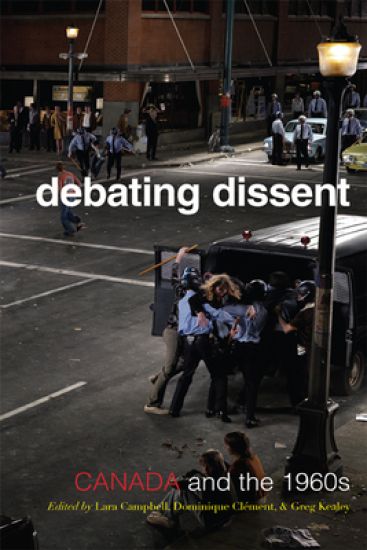
Although the 1960s are overwhelmingly associated with student radicalism and the New Left, most Canadians witnessed the decade’s political, economic, and cultural turmoil from a different perspective. Debating Dissent dispels the myths and stereotypes associated with the 1960s by examining what this era’s transformations meant to diverse groups of Canadians – and not only protestors, youth, or the white middle-class. With critical contributions from new and senior scholars, Debating Dissent integrates traditional conceptions of the 1960s as a ‘time apart’ within the broader framework of the ‘long-sixties’ and post-1945 Canada, and places Canada within a local, national, an international context. Cutting-edge essays in social, intellectual, and political history reflect a range of historical interpretation and explore such diverse topics as narcotics, the environment, education, workers, Aboriginal and Black activism, nationalism, Quebec, women, and bilingualism. Touching on the decade’s biggest issues, from changing cultural norms to the role of the state, Debating Dissent critically examines ideas of generational change and the sixties.
Debating Dissent
Lara A. Campbell; Dominique Clement; Gregory S. Kealey
University of Toronto Press
2012
pokkari
Although the 1960s are overwhelmingly associated with student radicalism and the New Left, most Canadians witnessed the decade’s political, economic, and cultural turmoil from a different perspective. Debating Dissent dispels the myths and stereotypes associated with the 1960s by examining what this era’s transformations meant to diverse groups of Canadians – and not only protestors, youth, or the white middle-class. With critical contributions from new and senior scholars, Debating Dissent integrates traditional conceptions of the 1960s as a ‘time apart’ within the broader framework of the ‘long-sixties’ and post-1945 Canada, and places Canada within a local, national, an international context. Cutting-edge essays in social, intellectual, and political history reflect a range of historical interpretation and explore such diverse topics as narcotics, the environment, education, workers, Aboriginal and Black activism, nationalism, Quebec, women, and bilingualism. Touching on the decade’s biggest issues, from changing cultural norms to the role of the state, Debating Dissent critically examines ideas of generational change and the sixties.
Secret Service
Reginald Whitaker; Gregory S. Kealey; Andrew Parnaby
University of Toronto Press
2012
sidottu
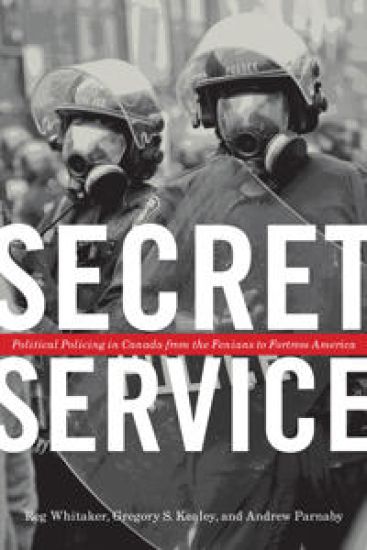
Secret Service provides the first comprehensive history of political policing in Canada – from its beginnings in the mid-nineteenth century, through two world wars and the Cold War to the more recent 'war on terror.' This book reveals the extent, focus, and politics of government-sponsored surveillance and intelligence-gathering operations. Drawing on previously classified government records, the authors reveal that for over 150 years, Canada has run spy operations largely hidden from public or parliamentary scrutiny – complete with undercover agents, secret sources, agent provocateurs, coded communications, elaborate files, and all the usual apparatus of deception and betrayal so familiar to fans of spy fiction. As they argue, what makes Canada unique among Western countries is its insistent focus of its surveillance inwards, and usually against Canadian citizens. Secret Service highlights the many tensions that arise when undercover police and their covert methods are deployed too freely in a liberal democratic society. It will prove invaluable to readers attuned to contemporary debates about policing, national security, and civil rights in a post-9/11 world.
Secret Service
Reginald Whitaker; Gregory S. Kealey; Andrew Parnaby
University of Toronto Press
2012
pokkari
Secret Service provides the first comprehensive history of political policing in Canada – from its beginnings in the mid-nineteenth century, through two world wars and the Cold War to the more recent 'war on terror.' This book reveals the extent, focus, and politics of government-sponsored surveillance and intelligence-gathering operations. Drawing on previously classified government records, the authors reveal that for over 150 years, Canada has run spy operations largely hidden from public or parliamentary scrutiny – complete with undercover agents, secret sources, agent provocateurs, coded communications, elaborate files, and all the usual apparatus of deception and betrayal so familiar to fans of spy fiction. As they argue, what makes Canada unique among Western countries is its insistent focus of its surveillance inwards, and usually against Canadian citizens. Secret Service highlights the many tensions that arise when undercover police and their covert methods are deployed too freely in a liberal democratic society. It will prove invaluable to readers attuned to contemporary debates about policing, national security, and civil rights in a post-9/11 world.
Dreaming of What Might Be
Gregory S. Kealey; Bryan D. Palmer
Cambridge University Press
2004
pokkari
As Canada's most industrialised province, Ontario served as the regional centre of the Noble and Holy Order of the Knights of Labor, an organisation which embodied a late nineteenth-century working-class vision of an alternative to the developing industrial-capitalist society. The Order opposed the exploitation of labor, and cultivated working-class unity by providing an institutional and cultural rallying point for North American workers. By 1886 thousands of industrial workers had enrolled within the ranks of Ontario's local and district assemblies. This book examines the rise and fall of the Order, providing case studies of its experience in Toronto and Hamilton and chronicling its impact across the province.
Kealey provides an overview of the study of workers in Canada as well as in-depth examinations of two of the field's leading scholars, political economist Clare Pentland and Marxist historian Stanley Brehaut Ryerson. He analyses the development of Canadian labour history in particular and social history in general, and provides detailed empirical studies of the Orange Order in Toronto, printers and their unions, the Knights of Labor, and the Canadian labour revolt of 1919. The collection concludes with three synthetic views of Canadian working-class history focusing on the labour movement, the role of strikes, and attempts by the state to manage class conflict. Workers and Canadian History will be of great interest to students and scholars of Canadian history, labour history, Marxist and socialist theory and history, and political science.