Kirjojen hintavertailu. Mukana 12 595 353 kirjaa ja 12 kauppaa.

Kirjailija

Guangquan Zhang

Kirjat ja teokset yhdessä paikassa: 6 kirjaa, julkaisuja vuosilta 2009-2016, suosituimpien joukossa Multi-Level Decision Making. Vertaile teosten hintoja ja tarkista saatavuus suomalaisista kirjakaupoista.

6 kirjaa

Kirjojen julkaisuhaarukka 2009-2016.

Multi-Level Decision Making

Multi-Level Decision Making

Guangquan Zhang; Jie Lu; Ya Gao

Springer-Verlag Berlin and Heidelberg GmbH Co. K
2016
nidottu
This monograph presents new developments in multi-level decision-making theory, technique and method in both modeling and solution issues. It especially presents how a decision support system can support managers in reaching a solution to a multi-level decision problem in practice. This monograph combines decision theories, methods, algorithms and applications effectively. It discusses in detail the models and solution algorithms of each issue of bi-level and tri-level decision-making, such as multi-leaders, multi-followers, multi-objectives, rule-set-based, and fuzzy parameters.Potential readers include organizational managers and practicing professionals, who can use the methods and software provided to solve their real decision problems; PhD students and researchers in the areas of bi-level and multi-level decision-making and decision support systems; students at an advanced undergraduate, master’s level in information systems, business administration, or the application of computer science.

Multi-Level Decision Making

Multi-Level Decision Making

Guangquan Zhang; Jie Lu; Ya Gao

Springer-Verlag Berlin and Heidelberg GmbH Co. K
2015
sidottu
This monograph presents new developments in multi-level decision-making theory, technique and method in both modeling and solution issues. It especially presents how a decision support system can support managers in reaching a solution to a multi-level decision problem in practice. This monograph combines decision theories, methods, algorithms and applications effectively. It discusses in detail the models and solution algorithms of each issue of bi-level and tri-level decision-making, such as multi-leaders, multi-followers, multi-objectives, rule-set-based, and fuzzy parameters.Potential readers include organizational managers and practicing professionals, who can use the methods and software provided to solve their real decision problems; PhD students and researchers in the areas of bi-level and multi-level decision-making and decision support systems; students at an advanced undergraduate, master’s level in information systems, business administration, or the application of computer science.

Handbook on Decision Making

Handbook on Decision Making

Jie Lu; Lakhmi C Jain; Guangquan Zhang

Springer-Verlag Berlin and Heidelberg GmbH Co. K
2016
nidottu
This book presents innovative theories, methodologies, and techniques in the field of risk management and decision making. It introduces new research developments and provides a comprehensive image of their potential applications to readers interested in the area. The collection includes: computational intelligence applications in decision making, multi-criteria decision making under risk, risk modelling,forecasting and evaluation, public security and community safety, risk management in supply chain and other business decision making, political risk management and disaster response systems.The book is directed to academic and applied researchers working on risk management, decision making, and management information systems.
Cognition-Driven Decision Support for Business Intelligence

Cognition-Driven Decision Support for Business Intelligence

Li Niu; Jie Lu; Guangquan Zhang

Springer-Verlag Berlin and Heidelberg GmbH Co. K
2012
nidottu
Cognition-driven decision support system (DSS) has been recognized as a paradigm in the research and development of business intelligence (BI). Cognitive decision support aims to help managers in their decision making from human cognitive aspects, such as thinking, sensing, understanding and predicting, and fully reuse their experience. Among these cognitive aspects, decision makers’ situation awareness (SA) and mental models are considered to be two important prerequisites for decision making, particularly in ill-structured and dynamic decision situations with uncertainties, time pressure and high personal stake. In today’s business domain, decision making is becoming increasingly complex. To make a successful decision, managers’ SA about their business environments becomes a critical factor. This book presents theoretical models as well practical techniques of cognitiondriven DSS. It first introduces some important concepts of cognition orientation in decision making process and some techniques in related research areas including DSS, data warehouse and BI, offering readers a preliminary for moving forward in this book. It then proposes a cognition-driven decision process (CDDP) model which incorporates SA and experience (mental models) as its central components. The goal of the CDDP model is to facilitate cognitive decision support to managers on the basis of BI systems. It also presents relevant techniques developed to support the implementation of the CDDP model in a BI environment. Key issues addressed of a typical business decision cycle in the CDDP model include: natural language interface for a manager’s SA input, extraction of SA semantics, construction of data warehouse queries based on the manger’s SA and experience, situation information retrieval from data warehouse, how the manager perceives situation information and update SA, how the manager’s SA leads to a final decision. Finally, a cognition-driven DSS, FACETS, and twoillustrative applications of this system are discussed.
Handbook on Decision Making

Handbook on Decision Making

Jie Lu; Lakhmi C Jain; Guangquan Zhang

Springer-Verlag Berlin and Heidelberg GmbH Co. K
2012
sidottu
This book presents innovative theories, methodologies, and techniques in the field of risk management and decision making. It introduces new research developments and provides a comprehensive image of their potential applications to readers interested in the area. The collection includes: computational intelligence applications in decision making, multi-criteria decision making under risk, risk modelling,forecasting and evaluation, public security and community safety, risk management in supply chain and other business decision making, political risk management and disaster response systems.The book is directed to academic and applied researchers working on risk management, decision making, and management information systems.
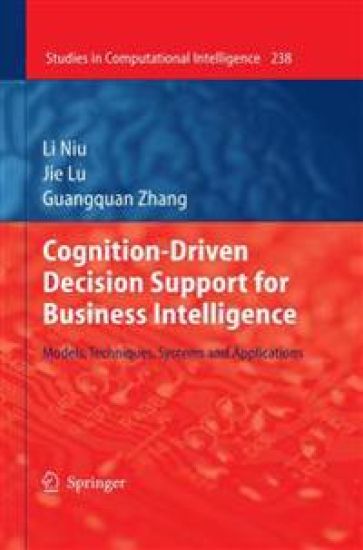
Cognition-Driven Decision Support for Business Intelligence

Cognition-Driven Decision Support for Business Intelligence

Li Niu; Jie Lu; Guangquan Zhang

Springer-Verlag Berlin and Heidelberg GmbH Co. K
2009
sidottu
Cognition-driven decision support system (DSS) has been recognized as a paradigm in the research and development of business intelligence (BI). Cognitive decision support aims to help managers in their decision making from human cognitive aspects, such as thinking, sensing, understanding and predicting, and fully reuse their experience. Among these cognitive aspects, decision makers’ situation awareness (SA) and mental models are considered to be two important prerequisites for decision making, particularly in ill-structured and dynamic decision situations with uncertainties, time pressure and high personal stake. In today’s business domain, decision making is becoming increasingly complex. To make a successful decision, managers’ SA about their business environments becomes a critical factor. This book presents theoretical models as well practical techniques of cognitiondriven DSS. It first introduces some important concepts of cognition orientation in decision making process and some techniques in related research areas including DSS, data warehouse and BI, offering readers a preliminary for moving forward in this book. It then proposes a cognition-driven decision process (CDDP) model which incorporates SA and experience (mental models) as its central components. The goal of the CDDP model is to facilitate cognitive decision support to managers on the basis of BI systems. It also presents relevant techniques developed to support the implementation of the CDDP model in a BI environment. Key issues addressed of a typical business decision cycle in the CDDP model include: natural language interface for a manager’s SA input, extraction of SA semantics, construction of data warehouse queries based on the manger’s SA and experience, situation information retrieval from data warehouse, how the manager perceives situation information and update SA, how the manager’s SA leads to a final decision. Finally, a cognition-driven DSS, FACETS, and twoillustrative applications of this system are discussed.