Kirjojen hintavertailu. Mukana 12 595 353 kirjaa ja 12 kauppaa.

Kirjailija

Gunnar Stiesch

Kirjat ja teokset yhdessä paikassa: 3 kirjaa, julkaisuja vuosilta 2003-2010, suosituimpien joukossa Modeling Engine Spray and Combustion Processes. Vertaile teosten hintoja ja tarkista saatavuus suomalaisista kirjakaupoista.

3 kirjaa

Kirjojen julkaisuhaarukka 2003-2010.

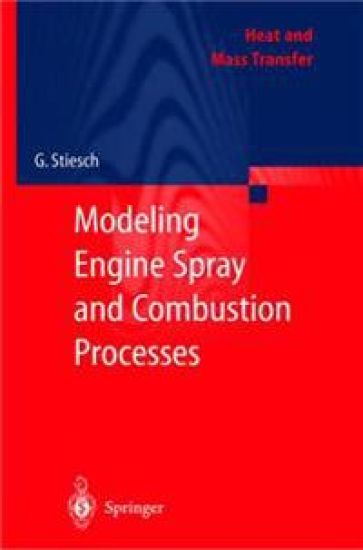
Modeling Engine Spray and Combustion Processes

Modeling Engine Spray and Combustion Processes

Gunnar Stiesch

Springer-Verlag Berlin and Heidelberg GmbH Co. K
2010
nidottu
The utilization of mathematical models to numerically describe the performance of internal combustion engines is of great significance in the development of new and improved engines. Today, such simulation models can already be viewed as standard tools, and their importance is likely to increase further as available com­ puter power is expected to increase and the predictive quality of the models is constantly enhanced. This book describes and discusses the most widely used mathematical models for in-cylinder spray and combustion processes, which are the most important subprocesses affecting engine fuel consumption and pollutant emissions. The relevant thermodynamic, fluid dynamic and chemical principles are summarized, and then the application of these principles to the in-cylinder processes is ex­ plained. Different modeling approaches for the each subprocesses are compared and discussed with respect to the governing model assumptions and simplifica­ tions. Conclusions are drawn as to which model approach is appropriate for a specific type of problem in the development process of an engine. Hence, this book may serve both as a graduate level textbook for combustion engineering stu­ dents and as a reference for professionals employed in the field of combustion en­ gine modeling. The research necessary for this book was carried out during my employment as a postdoctoral scientist at the Institute of Technical Combustion (ITV) at the Uni­ versity of Hannover, Germany and at the Engine Research Center (ERC) at the University of Wisconsin-Madison, USA.
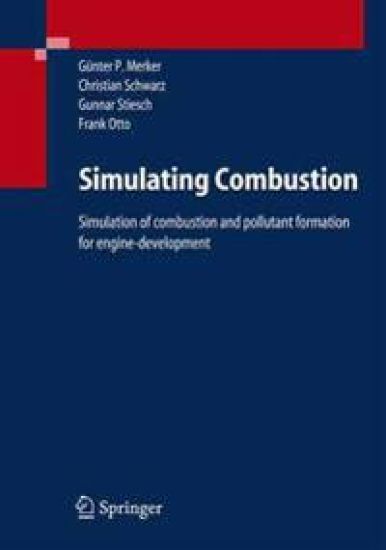
Simulating Combustion

Simulating Combustion

Günter P. Merker; Christian Schwarz; Gunnar Stiesch; Frank Otto

Springer-Verlag Berlin and Heidelberg GmbH Co. K
2005
nidottu
The numerical simulation of combustion processes in internal combustion engines, including also the formation of pollutants, has become increasingly important in the recent years, and today the simulation of those processes has already become an indispensable tool when - veloping new combustion concepts. While pure thermodynamic models are well-established tools that are in use for the simulation of the transient behavior of complex systems for a long time, the phenomenological models have become more important in the recent years and have also been implemented in these simulation programs. In contrast to this, the thr- dimensional simulation of in-cylinder combustion, i. e. the detailed, integrated and continuous simulation of the process chain injection, mixture formation, ignition, heat release due to combustion and formation of pollutants, has been significantly improved, but there is still a number of challenging problems to solve, regarding for example the exact description of s- processes like the structure of turbulence during combustion as well as the appropriate choice of the numerical grid. While chapter 2 includes a short introduction of functionality and operating modes of internal combustion engines, the basics of kinetic reactions are presented in chapter 3. In chapter 4 the physical and chemical processes taking place in the combustion chamber are described. Ch- ter 5 is about phenomenological multi-zone models, and in chapter 6 the formation of poll- ants is described.
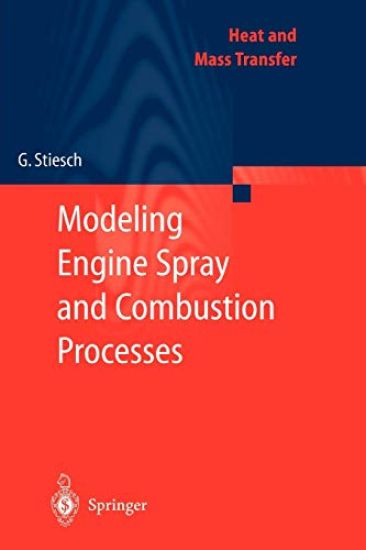
Modeling Engine Spray and Combustion Processes

Modeling Engine Spray and Combustion Processes

Gunnar Stiesch

Springer-Verlag Berlin and Heidelberg GmbH Co. K
2003
sidottu
The utilization of mathematical models to numerically describe the performance of internal combustion engines is of great significance in the development of new and improved engines. Today, such simulation models can already be viewed as standard tools, and their importance is likely to increase further as available com­ puter power is expected to increase and the predictive quality of the models is constantly enhanced. This book describes and discusses the most widely used mathematical models for in-cylinder spray and combustion processes, which are the most important subprocesses affecting engine fuel consumption and pollutant emissions. The relevant thermodynamic, fluid dynamic and chemical principles are summarized, and then the application of these principles to the in-cylinder processes is ex­ plained. Different modeling approaches for the each subprocesses are compared and discussed with respect to the governing model assumptions and simplifica­ tions. Conclusions are drawn as to which model approach is appropriate for a specific type of problem in the development process of an engine. Hence, this book may serve both as a graduate level textbook for combustion engineering stu­ dents and as a reference for professionals employed in the field of combustion en­ gine modeling. The research necessary for this book was carried out during my employment as a postdoctoral scientist at the Institute of Technical Combustion (ITV) at the Uni­ versity of Hannover, Germany and at the Engine Research Center (ERC) at the University of Wisconsin-Madison, USA.