Kirjojen hintavertailu. Mukana 12 197 182 kirjaa ja 12 kauppaa.

Kirjailija

Gunter H Meyer

Kirjat ja teokset yhdessä paikassa: 4 kirjaa, julkaisuja vuosilta 2005-2019, suosituimpien joukossa Time-discrete Method Of Lines For Options And Bonds, The: A Pde Approach. Vertaile teosten hintoja ja tarkista saatavuus suomalaisista kirjakaupoista.

Mukana myös kirjoitusasut: Gunter H. Meyer

4 kirjaa

Kirjojen julkaisuhaarukka 2005-2019.

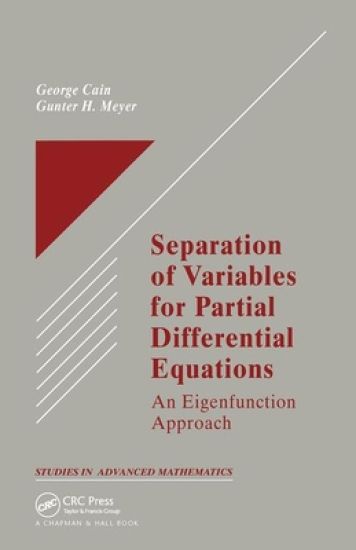
Separation of Variables for Partial Differential Equations
Separation of Variables for Partial Differential Equations: An Eigenfunction Approach includes many realistic applications beyond the usual model problems. The book concentrates on the method of separation of variables for partial differential equations, which remains an integral part of the training in applied mathematics. Beyond the usual model problems, the presentation includes a number of realistic applications that illustrate the power and usefulness of the ideas behind these techniques. This complete, self-contained book includes numerous exercises and error estimates, as well as a rigorous approximation and computational tool.
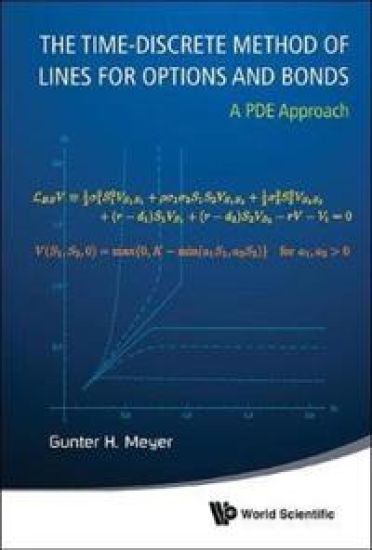
Time-discrete Method Of Lines For Options And Bonds, The: A Pde Approach

Time-discrete Method Of Lines For Options And Bonds, The: A Pde Approach

Gunter H Meyer

WSPC co-published with Now Publisher
2015
sidottu
Few financial mathematical books have discussed mathematically acceptable boundary conditions for the degenerate diffusion equations in finance. In The Time-Discrete Method of Lines for Options and Bonds, Gunter H Meyer examines PDE models for financial derivatives and shows where the Fichera theory requires the pricing equation at degenerate boundary points, and what modifications of it lead to acceptable tangential boundary conditions at non-degenerate points on computational boundaries when no financial data are available.Extensive numerical simulations are carried out with the method of lines to examine the influence of the finite computational domain and of the chosen boundary conditions on option and bond prices in one and two dimensions, reflecting multiple assets, stochastic volatility, jump diffusion and uncertain parameters. Special emphasis is given to early exercise boundaries, prices and their derivatives near expiration. Detailed graphs and tables are included which may serve as benchmark data for solutions found with competing numerical methods.
Numerical Solution Of The American Option Pricing Problem, The: Finite Difference And Transform Approaches

Numerical Solution Of The American Option Pricing Problem, The: Finite Difference And Transform Approaches

Carl Chiarella; Boda Kang; Gunter H Meyer

World Scientific Publishing Co Pte Ltd
2014
sidottu
The early exercise opportunity of an American option makes it challenging to price and an array of approaches have been proposed in the vast literature on this topic. In The Numerical Solution of the American Option Pricing Problem, Carl Chiarella, Boda Kang and Gunter Meyer focus on two numerical approaches that have proved useful for finding all prices, hedge ratios and early exercise boundaries of an American option. One is a finite difference approach which is based on the numerical solution of the partial differential equations with the free boundary problem arising in American option pricing, including the method of lines, the component wise splitting and the finite difference with PSOR. The other approach is the integral transform approach which includes Fourier or Fourier Cosine transforms. Written in a concise and systematic manner, Chiarella, Kang and Meyer explain and demonstrate the advantages and limitations of each of them based on their and their co-workers' experiences with these approaches over the years.
Separation of Variables for Partial Differential Equations

Separation of Variables for Partial Differential Equations

George Cain; Gunter H. Meyer

Chapman Hall/CRC
2005
sidottu
Separation of Variables for Partial Differential Equations: An Eigenfunction Approach includes many realistic applications beyond the usual model problems. The book concentrates on the method of separation of variables for partial differential equations, which remains an integral part of the training in applied mathematics. Beyond the usual model problems, the presentation includes a number of realistic applications that illustrate the power and usefulness of the ideas behind these techniques. This complete, self-contained book includes numerous exercises and error estimates, as well as a rigorous approximation and computational tool.