Kirjojen hintavertailu. Mukana 12 305 063 kirjaa ja 12 kauppaa.
Kirjailija
Gustavus Hindman Miller
Kirjat ja teokset yhdessä paikassa: 19 kirjaa, julkaisuja vuosilta 2004-2025, suosituimpien joukossa Dreams. Vertaile teosten hintoja ja tarkista saatavuus suomalaisista kirjakaupoista.
Ten thousand dreams interpreted or what's in a dream is an extensive guide exploring the significance and meanings of dreams through historical, philosophical, and psychological lenses. The book presents dreams as powerful reflections of the subconscious mind, emotions, and spiritual state, often containing insights into the future. It draws on the beliefs of ancient thinkers and literary figures who regarded dreams as prophetic or spiritually revealing. The work distinguishes between different types of dreams-subjective, physical, and spiritual-and emphasizes the role of inner consciousness and intuition in understanding them. It includes various anecdotes and historical examples illustrating how dreams have revealed crucial truths or warnings to individuals. The book promotes the idea that dreams can communicate messages from a higher self or spiritual source beyond ordinary rational thought. It stresses the importance of balancing material and spiritual awareness to achieve a harmonious state of being. Ultimately, the guide encourages readers to pay close attention to their dreams, offering tools to interpret them for personal growth and insight into life's mysteries.
Reproduction of the original. The publishing house Megali specialises in reproducing historical works in large print to make reading easier for people with impaired vision.
Reproduction of the original. The publishing house Megali specialises in reproducing historical works in large print to make reading easier for people with impaired vision.
The Dictionary of Dreams provides the necessary tools to interpret almost every dream object and its hidden meaning to better understand what your subconscious is telling you. Now in a pocket-size edition for easy, on-the-go instruction. Dreams can be fun and adventurous, but also frightening and distorted, and still again, they can be an endless combination of both. From spitting teeth out (a sign of aging), to creepy, crawly spiders (a sign that one feels like an outsider), dreams can mean much more to us once we learn how to decipher their hidden meanings. Whether positive or negative, The Dictionary of Dreams gives you all the tools, symbols, and their true meanings to translate our cryptic nightly images. Starting with selections from classic texts like Interpretation of Dreams by Sigmund Freud, the father of psychoanalysis, and 10,000 Dreams Interpreted by Gustavus Hindman Miller, one of the first authors to complete a thorough study of all the symbols that appear in our dreamscape, this updated edition features revisions (such as the addition of cell phones, computers, televisions, and more) of Miller’s original interpretations to bring the book up to speed with our modern life.
This classic work, considered to be the all-time greatest dictionary of dreams and their symbolism ever compiled, has astounded readers since it was first published over a century ago. Compiled painstakingly by author Gustavus Hindman Miller, 10,000 Dreams Interpreted is the Bible of dream interpretation, and is an invaluable resource in the search for understanding and meaning in our nightly sojourns. Wheteher you read it as a mystical manual, or a Freudian study of the subconscious, 10,000 Dreams Interpreted is THE key to unlocking the mystery of those baffling and unsettling mental movies that manifest themselves during the REM phase of our slumbering hours. Unlock the meaning behind your dreams, and find the solution to fears, phobias, and the mysteries of life.
Ten Thousand Dreams Interpreted. or, What's in a Dream. A Scientific and Practical Exposition. By Gustavus Hindman Miller. Dreams, in Freud's view, are all forms of "wish fulfillment" - attempts by the unconscious to resolve a conflict of some sort, whether something recent or something from the recesses of the past (later in Beyond the Pleasure Principle, Freud would discuss dreams which do not appear to be wish-fulfillment). Because however, the information in the unconscious is in an unruly and often disturbing form, a "censor" in the preconscious will not allow it to pass unaltered into the conscious. During dreams, the preconscious is more lax in this duty than in waking hours, but is still attentive: as such, the unconscious must distort and warp the meaning of its information to make it through the censorship. As such, images in dreams are often not what they appear to be, according to Freud, and need deeper interpretation if they are to inform on the structures of the unconscious. Freud used to mention the dreams as "The Royal Road to the Unconscious". He proposed the 'phenomenon of condensation'; the idea that one simple symbol or image presented in a person's dream may have multiple meanings. For this very reason, Freud tried to focus on details during psychoanalysis and asked his patients about things they could even think trivial (i.e. while a patient was describing an experience in their dream, Freud could ask him/her: "was there any sign upon the walls? What was it?"). As Freud was focusing upon the biologic drives of the individual (a fact that alienated him from several colleagues of his like Breuer, Jung and Adler), he stated that when we observe a hollow object in our dreams, like a box or a cave, this is a symbol of a womb, while an elongated object is a symbol for penis. Due to these statements, Freud attracted much criticism from those who believed him a "sexist" or "misanthrope", as he was alleged to have overemphasised the role of instinct, as though he believed people were "wild beasts".
The Dictionary of Dreams provides the necessary tools to interpret almost every dream object and its hidden meaning to better understand what your subconscious is telling you. Dreams can be fun and adventurous, but also frightening and distorted, and still again, they can be an endless combination of both. From spitting teeth out (a sign of aging), to creepy, crawly spiders (a sign that one feels like an outsider), dreams can mean much more to us once we learn how to decipher their hidden meanings. Whether positive or negative, The Dictionary of Dreams gives you all the tools, symbols, and their true meanings to translate our cryptic nightly images. Starting with selections from classic texts like Interpretation of Dreams by Sigmund Freud, the father of psychoanalysis, and 10,000 Dreams Interpreted by Gustavus Hindman Miller, one of the first authors to complete a thorough study of all the symbols that appear in our dream-scape, this updated edition features revisions (such as the addition of cell phones, computers, televisions, and more) of Miller’s original interpretations to bring the book up to speed with our modern life. Elegantly designed and beautifully illustrated, the Complete Illustrated Encyclopedia series offers comprehensive, display-worthy references on a range of intriguing topics, including birthday astrology, techniques for harnessing the power of dreams, flower meanings, and the stories behind signs and symbols.
The Bible, as well as other great books of historical and revealed religion, shows traces of a general and substantial belief in dreams.Plato, Goethe, Shakespeare and Napoleon assigned to certain dreams prophetic value. Joseph saw eleven stars of the Zodiac bow to himself, the twelfth star.The famine of Egypt was revealed by a vision of fat and lean cattle. The parents of Christ were warned of the cruel edict of Herod, and fled with the Divine Child into Egypt.Pilate's wife, through the influence of a dream, advised her husband to have nothing to do with the conviction of Christ. But the gross materialism of the day laughed at dreams, as it echoed the voice and verdict of the multitude, Crucify the Spirit, but let the flesh live.'' Barabbas, the robber, was set at liberty.The ultimatum of all human decrees and wisdom is to gratify the passions of the flesh at the expense of the spirit. The prophets and those who have stood nearest the fountain of universal knowledge used dreams with more frequency than any other mode of divination.Profane, as well as sacred, history is threaded with incidents of dream prophecy. Ancient history relates that Gennadius was convinced of the immortality of his soul by conversing with an apparition in his dream.Through the dream of Cecilia Metella, the wife of a Consul, the Roman Senate was induced to order the temple of Juno Sospita rebuilt.The Emperor Marcian dreamed he saw the bow of the Hunnish conqueror break on the same night that Attila died.Plutarch relates how Augustus, while ill, through the dream of a friend, was persuaded to leave his tent, which a few hours after was captured by the enemy, and the bed whereon he had lain was pierced with the enemies' swords.If Julius Caesar had been less incredulous about dreams he would have listened to the warning which Calpurnia, his wife, received in a dream.Croesus saw his son killed in a dream.Petrarch saw his beloved Laura, in a dream, on the day she died, after which he wrote his beautiful poem, The Triumph of Death.''Cicero relates the story of two traveling Arcadians who went to different lodgings-one to an inn, and the other to a private house. During the night the latter dreamed that his friend was begging for help. The dreamer awoke; but, thinking the matter unworthy of notice, went to sleep again. The second time he dreamed his friend appeared, saying it would be too late, for he had already been murdered and his body hid in a cart, under manure. The cart was afterward sought for and the body found. Cicero also wrote, If the gods love men they will certainly disclose their purposes to them in sleep.''Chrysippus wrote a volume on dreams as divine portent. He refers to the skilled interpretations of dreams as a true divination; but adds that, like all other arts in which men have to proceed on conjecture and on artificial rules, it is not infallible.Plato concurred in the general idea prevailing in his day, that there were divine manifestations to the soul in sleep. Condorcet thought and wrote with greater fluency in his dreams than in waking life.Tartini, a distinguished violinist, composed his Devil's Sonata'' under the inspiration of a dream. Coleridge, through dream influence, composed his Kubla Khan.''The writers of Greek and Latin classics relate many instances of dream experiences. Homer accorded to some dreams divine origin. During the third and fourth centuries, the supernatural origin of dreams was so generally accepted that the fathers, relying upon the classics and the Bible as authority, made this belief a doctrine of the Christian Church.Synesius placed dreaming above all methods of divining the future; he thought it the surest, and open to the poor and rich alike.Aristotle wrote: There is a divination concerning some things in dreams not incredible.''
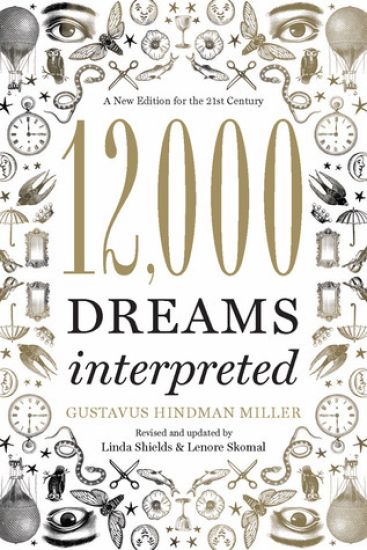
Nearly a century ago, Gustavus Hindman Miller published his groundbreaking masterwork, "10,000 Dreams Interpreted" (9781402751844), the most compelling and thorough study of all the symbols that appear in our dreamscape. Miller offered an enlightening introduction to dream history and types and organised his symbols into eminently logical categories. Now, popular psychic and medium Linda Shields has updated this classic, with revisions and additions to more than 2000 of his original interpretations as well as 2000 entirely new entries. This brings the book up to speed with our modern life, including objects unknown in Miller's time, such as mobile phones, computers, televisions and more. This title offers an exciting, enriching and elegantly packaged revision that's a must-have for anyone who dreams!