Kirjojen hintavertailu. Mukana 12 123 093 kirjaa ja 12 kauppaa.

Kirjailija

Guy Davenport

Kirjat ja teokset yhdessä paikassa: 24 kirjaa, julkaisuja vuosilta 1993-2025, suosituimpien joukossa Guy Davenport and James Laughlin: Selected Letters. Vertaile teosten hintoja ja tarkista saatavuus suomalaisista kirjakaupoista.

24 kirjaa

Kirjojen julkaisuhaarukka 1993-2025.

Guy Davenport and James Laughlin: Selected Letters

Guy Davenport and James Laughlin: Selected Letters

Guy Davenport; James Laughlin

WW Norton Co
2007
sidottu
This volume features selections from the New Directions founder's correspondence with Guy Davenport, the polymath artist and author of The Geography of the Imagination. More than simply detailing an author/publisher relationship, these letters depict two fine minds educating and supporting each other in the service of literature.
Marmalade

Marmalade

Guy Davenport; William Benton

STATION HILL PRESS
2025
nidottu
From the perspectives of an accomplished contemporary artist, William Benton's MARMALADE takes the words of the French poet Mallarme (note pun) into an American idiom that both explodes and tightens poetic mysteries and mischief. Some 50 years from its first publication, complemented with the original watercolors of James McGarrill, this classic of autonomic and visionary translation remains testament to our human and "faunean" imagination unbridled. As the poet Guy Davenport writes in his introduction, "And if one dreamed, and was too feral to sort dream from flesh, and took up a flute and began to see how dream and reality are flower and leaf on the one stem, and a French poet Mallarme] in a plaid shawl who loved old gardens and mirrors and Greek poetry wrote what he thought the faun thought, and an American poet Benton] has a bright impulse to speak for Mallarm speaking for the faun? Turn the page and read on."
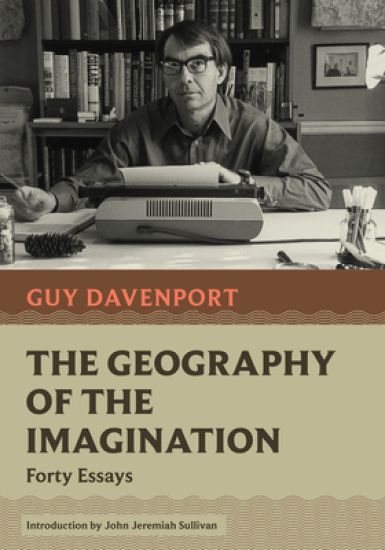
The Geography of the Imagination

The Geography of the Imagination

Guy Davenport

DAVID R. GODINE PUBLISHER INC
2024
pokkari
“One of the most sinuous stylists and searching minds of the twentieth century.”—Washington Post Forty essays on history, art, and literature to lift your mind and spirit. Guy Davenport provides links between music and sculpture, modernist poets and classic philosophers, the past and present—and pretty much everything in between. Not only had Davenport seemingly read (and often translated from the original languages) everything ever written, he also had the ability, expressed with unalloyed enthusiasm, to draw connections between how cultural synapses make, define, and reflect our civilization.Davenport serves as the reader’s guide through history and literature, pointing out the values and avenues of thought that have shaped our ideas and our thinking. In these forty essays we find fresh thinking on Greek culture, Whitman, Spinoza, Wittgenstein, Melville, Tolkien, Ezra Pound, Wallace Stevens, Charles Olson, Marianne Moore, Eudora Welty, Louis Zukovsky, and many others. Each essay is a tour of the history of ideas and imagination, written with wit and startling erudition. This Nonpareil edition includes a new introduction by John Jeremiah Sullivan.
A Balthus Notebook

A Balthus Notebook

Guy Davenport; Judith Thurman

David Zwirner
2020
nidottu
In his 1989 book on Balthus—the storied and controversial artist who worked in Paris throughout the twentieth century—Guy Davenport gives one of the most nuanced, literary, and compelling readings of the work of this master. Reading it today highlights the change in perspectives on sexuality and nudity in art in the past thirty years.Written over several years in his notebooks, Davenport’s distinct reflections on Balthus’s paintings try to explain why his work is so radical, and why it has so often come under scrutiny for its depiction of girls and women. Davenport throws the lens back on the viewer and asks: is it us or Balthus who reads sexuality into these paintings? For Davenport, the answer is clear: Balthus may indeed show us periods in adolescent development that are uncomfortable to view, but the eroticization exists primarily on the part of the viewer. Arguing that Balthus’s figures are erotic only if we make them so, and that their innocence is more present than anything pornographic in them, Davenport posits that the paintings hold up a mirror to our own perversities and force us, difficultly, to confront them. He writes, “The nearer an artist works to the erotic politics of his own culture, the more he gets its concerned attention. Gauguin’s naked Polynesian girls, brown and remote, escape the scandal of Balthus’s, although a Martian observer would not see the distinction.” Davenport’s critique helps us understand Balthus in our times—something we need more than ever as we crucially confront sexual politics in visual art.
The Sayings Of Jesus

The Sayings Of Jesus

Guy Davenport; Benjamin Urrutia

Counterpoint
2019
nidottu
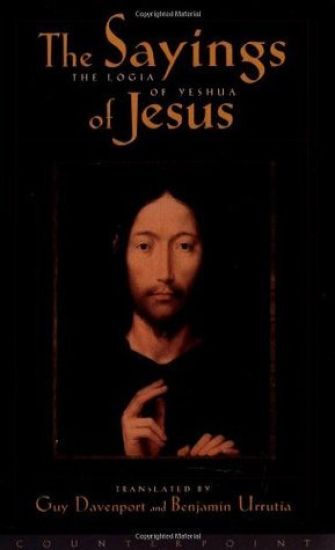
Jesus was a street preacher who taught through story and aphorism. Antedating the Gospels, these 105 sayings were recorded by his followers during and shortly after his lifetime. Through the immediacy of direct quotation, Guy Davenport and Benjamin Urrutia's bold translation shakes our preconceptions, reintroducing us to the West's greatest teacher, whose powerful words ring anew.
Questioning Minds

Questioning Minds

Edward M. Burns; Guy Davenport; Hugh Kenner

Counterpoint
2018
sidottu
"The most intellectually exhilarating work published in 2018 . . . A lasting treasure." -Michael Dirda, The Washington PostHugh Kenner (1923-2003) and Guy Davenport (1927-2005) first met in September 1953 when each gave a paper on Ezra Pound at Columbia University. They met again in the fall of 1957, and their correspondence begins with Kenner's letter of March 7, 1958. In the next forty-four years, they exchanged over one thousand letters. An extraordinary document of a literary friendship that lasted half a century, the letters represent one of the great and-with the dawn of the age of text and Twitter-one of the last major epistolary exchanges of its kind. Students and lovers of modernism will find, in the letters, matchless engagements with Eliot, Joyce, Beckett, Basil Bunting, Charles Tomlinson, R. Buckminster Fuller, Stan Brakhage, Jonathan Williams, and the American modernists William Carlos Williams, Marianne Moore, and Louis Zukofsky. The correspondence ends with Kenner's letter of August 9, 2002, lamenting how they had drifted apart.The extensive notes and cross-referencing of archival sources in Questioning Minds are a major contribution to the study of literary modernism. The letters contained within explore how new works were conceived and developed by both writers. They record faithfully, and with candor, the urgency that each brought to his intellectual and creative pursuits. Here is a singular opportunity to follow the development of their unique fictions and essays.
Gadfly: December, 1959

Gadfly: December, 1959

Ezra Pound; Austen Warren; Guy Davenport

Literary Licensing, LLC
2011
sidottu
Gadfly: December, 1959 is a book written by the renowned American poet and critic, Ezra Pound. The book is a collection of essays, letters, and poems that were written by Pound during his confinement at St. Elizabeths Hospital in Washington, D.C. Pound was incarcerated at the hospital for over a decade due to his controversial political views and alleged support for fascism during World War II.The book offers a unique insight into Pound's thoughts and ideas during this period of confinement. The essays and letters cover a wide range of topics, including politics, economics, literature, and philosophy. Pound's writing is characterized by his trademark wit, erudition, and provocative style.The book also includes a selection of Pound's poems, which are considered some of the most innovative and influential works of modernist poetry. Pound's poetry is known for its complex imagery, unconventional syntax, and use of literary allusions and references.Overall, Gadfly: December, 1959 is a fascinating and thought-provoking book that offers a glimpse into the mind of one of the most important and controversial figures in modern literature.Contains The First Appearance Of Ezra Pound's Ars Vivendi, And Contributions By Austen Warren, Jean Helion, Guy Davenport, Olivier Bernier And Others.This scarce antiquarian book is a facsimile reprint of the old original and may contain some imperfections such as library marks and notations. Because we believe this work is culturally important, we have made it available as part of our commitment for protecting, preserving, and promoting the world's literature in affordable, high quality, modern editions, that are true to their original work.
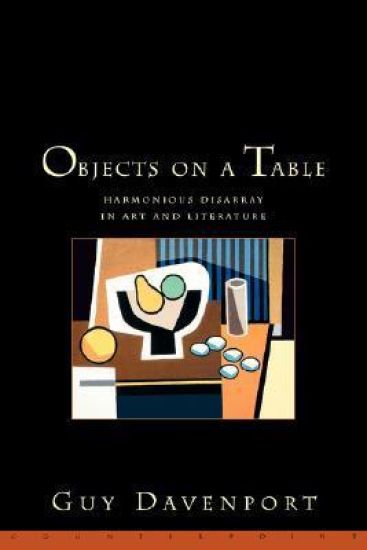
Objects On A Table

Objects On A Table

Guy Davenport

Counterpoint
1999
nidottu
Davenports meditations on the still life dip into the full history of this art formfrom Neolithic cave paintings to the Dutch masters, from Czanne and Van Gogh to photography and the collage.. In a series of four meditations on still-life painting, Guy Davenport blends art history with literary criticism, taking a close look at the iconic and symbolic function of objects and the multiple ways they are represented in culture. Focusing on a genre that is supposedly static, these essays reveal the dynamic forces that motivate and shape the still life, explaining why and how painters have employed this genre to such vital effect. In a series of four meditations on still-life painting, Guy Davenport blends art history with literary criticism, taking a close look at the iconic and symbolic function of objects and the multiple ways they are represented in culture. As always in Davenports eclectic and provocative work, specific themes or images that appear simple on the surface--apple and pear, a bust of Sherlock Holmes--resonate across human history to yield a rich interplay of meaning and story.Whether ancient or modern--an image found within an Egyptian tomb or a painting by van Gogh, a verse from the Book of Amos or a passage from Joyce--the works that Davenport discusses are parsed and analyzed for the clues within silent objects (the fruit basket, the postage stamp, the clock) with brilliant erudition. Feats of maverick detective work, Davenports readings of art never fail to surprise and inform.Focusing on a genre that is ostensibly static, these meditations reveal the dynamic forces that motivate and shape the use of still life, explaining why and how painters have employed this form to such vital effect. As Davenport says here, Culture is like a magnetic field, a patterned energy shaping history. It is invisible, even unsuspected, until a receiver sensitive enough to pick up its messages can give it a voice. When Ezra Pound said that poets are the antennae of the race, he meant radio antennae, not insects only. Readers, whether they are newcomers or devoted fans of Davenports extraordinary work, will discover that Objects on a Table broadcasts the energy of cultural patterns in a way that will awaken them to the music within.
The Logia Of Yeshua

The Logia Of Yeshua

Guy Davenport

Counterpoint
1998
nidottu
Jesus was a street preacher who taught through story and aphorism. Antedating the Gospels, these 105 sayings were recorded by his followers during and shortly after his lifetime. Through the immediacy of direct quotation, Davenport and Urrutias bold translation shakes our preconceptions, reintroducing us to the living teacher whose powerful words ring anew.
The Geography of the Imagination

The Geography of the Imagination

Guy Davenport

David R. Godine Publisher
1997
pokkari
In the 40 essays that constitute this collection, Guy Davenport, one of America's major literary critics, elucidates a range of literary history, encompassing literature, art, philosophy and music, from the ancients to the grand old men of modernism.
The Hunter Gracchus

The Hunter Gracchus

Guy Davenport

Counterpoint
1997
nidottu
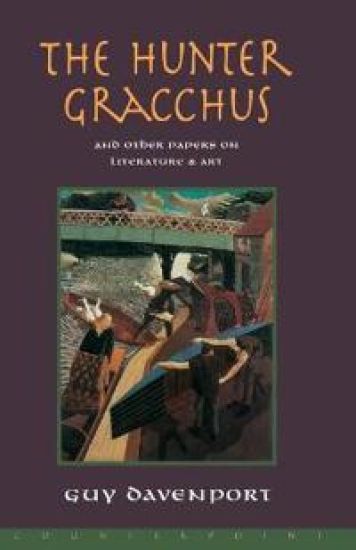
Open the pages of The Hunter Gracchus and step into the remarkable mind of Guy Davenport, one of this countrys most provocative writers. Moving effortlessly from snake handling to Wallace Stevens, these essays take delight in an immense range of topics, including art and architecture, religion, and literature. Open the pages of The Hunter Gracchus and step into the remarkable mind of Guy Davenport, one of this countrys most brilliant and provocative writers. Hardly the typical essay collection, The Hunter Gracchus is better described as a collage of ideas, commentary, and criticism from an eclectic stylist whose sentences ring with clarity and originality.Moving effortlessly from snake handling to Wallace Stevens, these essays take delight in an immense range of topics, including art and architecture, religion and literature--all approached from Davenports deeply personal point of view. In one essay, Davenport recalls a lunch with Thomas Merton at the Ramada Inn, where Merton, already the worlds most famous Trappist monk, drank several martinis and held forth on the architecture of Buddhist temples.In another, Davenport finds in postwar modernism a catalogue of our lost innocence. In the stunning title essay, he maps out the world of a posthumously published story by Franz Kafka.Davenport has the singular and joyous ability to read into human artifacts--Picassos Guernica , a pattern of bricks, a Shaker design for easy-to-clean revolving windows. His kinetic prose unfolds surprising connections of influence, transporting readers from the world of the intellectual to the world of the extraordinary.The way I write about texts and works of art, Davenport says in his introductory note, has been shaped by forty years of explaining them to students in a classroom. I am not writing for scholars or fellow critics, but for people who like to read, to look at pictures, and to know things.
Twelve Stories

Twelve Stories

Guy Davenport

Counterpoint
1997
nidottu
Since the publication of Tatlin! in 1974, Guy Davenport has established himself as one of the most original and stimulating writers of fiction today. Twelve Stories draws the best work from Davenports early collections: Tatlin! , Apples and Pears , and The Drummer of the Eleventh North Devonshire Fusiliers . Chosen by the author, these stories are nowhere else in print.Guy Davenports short stories are journeys through history and the imagination. Radically original and surprising, comic and sensuous, Davenports virtuoso talent charms us into a world both familiar and strange. Whether in the timelessness of deep woods or fleeing the bloody dreamscape of battle, Davenports characters embody lifes contradictions.
The Cardiff Team: Ten Stories

The Cardiff Team: Ten Stories

Guy Davenport

New Directions Publishing Corporation
1996
sidottu
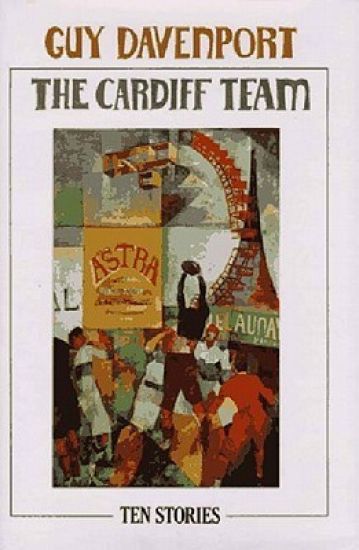
Guy Davenport’s story collection A Table of Green Fields (New Directions, 1993) was praised for its amazing artistry and “stratospheric” literary intelligence (Kirkus Reviews). As The Washington Post noted, “It draws one in with its austere, beautifully formal sentences, its rich pattern of memory.” In Davenport’s follow-up collection, The Cardiff Team, the stories continue in this vein, their texts a wondrous collage of persons, events, and ideas from cultural history. The central theme is that of tribeless people joining, or trying to join, a team, a tribe, or a society. In “The Messengers,” Franz Kafka visits the Jungborn Health Spa in the Harz mountains and tries to feel comfortable in his own skin. In “Boys Smell Like Oranges,” a soccer team of boys from Henry de Montherlant’s Les Olympiques is its own contained tribe. The Cardiff Team perfectly displays Guy Davenport’s illustrious prose and his audacity; confirming The New Yorker’s assertion that his is “among the very few, truly original voices now audible in American letters.”