
Kirjailija
H Beam Piper
Kirjat ja teokset yhdessä paikassa: 188 kirjaa, julkaisuja vuosilta 1953-2026, suosituimpien joukossa The Cosmic Computer by H. Beam Piper, Science Fiction, Adventure. Vertaile teosten hintoja ja tarkista saatavuus suomalaisista kirjakaupoista.
Mukana myös kirjoitusasut: H. Beam Piper, H.Beam Piper
188 kirjaa
Kirjojen julkaisuhaarukka 1953-2026.


This work has been selected by scholars as being culturally important and is part of the knowledge base of civilization as we know it.This work is in the public domain in the United States of America, and possibly other nations. Within the United States, you may freely copy and distribute this work, as no entity (individual or corporate) has a copyright on the body of the work.Scholars believe, and we concur, that this work is important enough to be preserved, reproduced, and made generally available to the public. To ensure a quality reading experience, this work has been proofread and republished using a format that seamlessly blends the original graphical elements with text in an easy-to-read typeface.We appreciate your support of the preservation process, and thank you for being an important part of keeping this knowledge alive and relevant.
The Edge Of The Knife, has been considered by academicians and scholars of great significance and value to literature. This forms a part of the knowledge base for future generations. So that the book is never forgotten we have represented this book in a print format as the same form as it was originally first published. Hence any marks or annotations seen are left intentionally to preserve its true nature.

Dall'altra parte del cortile della piantagione, altri sei uomini in abiti a strisce, con carabine a tracolla, si avvicinarono; con loro venne un altro uomo con un mantello bianco con cappuccio e due guardie con giacche blu e berretti rossi, con fucili a baionetta. L'uomo vestito di bianco e i suoi servi armati si avvicinarono alla casa; i sei schiavisti di Calera proseguirono attraverso il cortile fino al punto in cui i loro cavalli venivano picchettati. "Se non offendo i nobili signori, allora," disse Coru-hin-Irigod, "prego la loro sofferenza di andarsene. Io ei miei uomini abbiamo molta strada da percorrere se volessimo raggiungere Careba al calar della notte. Il Signore, il Grande Signore, il Signore Dio Safar veglia tra di noi finch non ci incontreremo di nuovo. " Urado Alatana, il caposquadra, sal sul portico mentre i due schiavisti scendevano. "Li guardi bene, Radd?" chiese il capitano delle guardie. "Pensi che io sia abbastanza pazzo da far uscire di qui quei banditi con duemila obus - quarantamila unit di cambio paratemporali - dei soldi della Compagnia senza sapere cosa stiamo ottenendo?" l'altro par . "Stanno bene, belli, puliti, dall'aspetto sano. Ho fatto di tutto ma smontarli e ispezionare i pezzi mentre venivano sganciati alla palizzata. Vorrei sapere dove ha preso questo Coru-hin-Whatshisname loro, per . Non sono roba locale. Molto pi scuri e stanno blaterando tra di loro in un gergo che non ho mai sentito prima. Alcuni indossano abiti stracci e hanno sandali dall'aspetto strano. Ho notato che la maggior parte di loro mostravano segni di recenti frustate. Ci potrebbe significare che sono fastidiosi, o potrebbe semplicemente significare che questi Calera sono un sacco di bruti sadici. "Poveri diavoli " L'uomo chiamato Dosu Golan sperava evidentemente di non essersi mai sorpreso a parlare di altri umani in quel modo. Il capitano delle guardie si volt verso di lui.

Little Fuzzy is a 1962 science fiction novel by H. Beam Piper, now in public domain. It was nominated for the 1963 Hugo Award for Best Novel.The story revolves around determining whether a small furry species discovered on the planet Zarathustra is sapient, and features a mild libertarianism that emphasizes sincerity and honesty.The book was followed by a sequel, Fuzzy Sapiens (original title The Other Human Race) published in 1964, the same year that Piper committed suicide.In the wake of Piper's suicide, rumor spread of a lost "second sequel"; in 1981, at the behest of Ace Books, William Tuning produced the critically acclaimed Fuzzy Bones. Ace also hired Ardath Mayhar in 1982 to write Golden Dreams: A Fuzzy Odyssey, which tells the events of Little Fuzzy from the viewpoint of the Fuzzies (or Gashta, as they call themselves).Later, Piper's lost manuscript was discovered, and published in 1984 as Fuzzies and Other People.A new volume in the series, Fuzzy Ergo Sum by Wolfgang Diehr, was published by Pequod Press in April 2011. A second book, Caveat Fuzzy was released in August 2012. A third installment, this time by Wolfgang Diehr & well known Piper historian John F. Carr, titled Fuzzy Conundrum, published in 2016. In 2011, John Scalzi published Fuzzy Nation, which he described as a "reboot" of Piper's original. (wikipedia.org)

The Cosmic Computer (Original Title: Junkyard Planet) is science fiction novel by Henry Beam Piper (March 23, 1904 - c. November 6, 1964) who was an American science fiction author. He wrote many short stories and several novels. He is best known for his extensive Terro-Human Future History series of stories and a shorter series of "Paratime" alternate history tales.

The Cosmic Computer (Original Title: Junkyard Planet) is science fiction novel by Henry Beam Piper (March 23, 1904 - c. November 6, 1964) who was an American science fiction author. He wrote many short stories and several novels. He is best known for his extensive Terro-Human Future History series of stories and a shorter series of "Paratime" alternate history tales.

Little Fuzzy is a 1962 science fiction novel by H. Beam Piper, now in public domain. It was nominated for the 1963 Hugo Award for Best Novel.The story revolves around determining whether a small furry species discovered on the planet Zarathustra is sapient, and features a mild libertarianism that emphasizes sincerity and honesty.The book was followed by a sequel, Fuzzy Sapiens (original title The Other Human Race) published in 1964, the same year that Piper committed suicide.In the wake of Piper's suicide, rumor spread of a lost "second sequel"; in 1981, at the behest of Ace Books, William Tuning produced the critically acclaimed Fuzzy Bones. Ace also hired Ardath Mayhar in 1982 to write Golden Dreams: A Fuzzy Odyssey, which tells the events of Little Fuzzy from the viewpoint of the Fuzzies (or Gashta, as they call themselves).Later, Piper's lost manuscript was discovered, and published in 1984 as Fuzzies and Other People.A new volume in the series, Fuzzy Ergo Sum by Wolfgang Diehr, was published by Pequod Press in April 2011. A second book, Caveat Fuzzy was released in August 2012. A third installment, this time by Wolfgang Diehr & well known Piper historian John F. Carr, titled Fuzzy Conundrum, published in 2016. In 2011, John Scalzi published Fuzzy Nation, which he described as a "reboot" of Piper's original. (wikipedia.org)

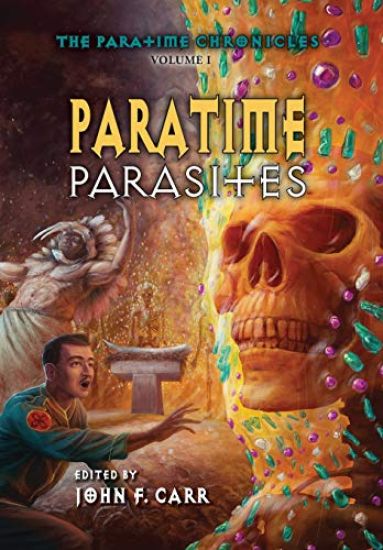
Paratime Parasites contains a new introduction to Paratime, four never before published Paratime stories by John F. Carr and all of H. Beam Piper's Paratime stories except "Time Crime" and the Lord Kalvan yarns. Newer stories include: "Paratime Parasites," a story about a conveyor missing for 10,000 years and Verkan Vall's efforts to find out what happened to the original Paratime Survey Team. "Back From the Dead, a story about a man who returns from the dead only to find himself in his twelve-year-old body. "Paratime Paradox," where an outtimer threatens the Paratime Travel secret itself through his dreams. "The Transtemporal Man," a story about what happens when an outtimer suddenly appears with the ability to transpose to different timelines without a transtemporal conveyer. This is one collection you do not want to miss.

Space Viking is a science fiction novel written by H. Beam Piper and is set in his Terro-Human future history. It tells the story of one man's search for his wife's murderer and its unexpected consequences. The story was originally serialized in Analog magazine.BackgroundTen thousand refugees from the losing side of The Big War (The System States War of The Cosmic Computer) fled far beyond the boundaries of the Terran Federation and colonized the planet Excalibur. By the beginning of Space Viking, they had expanded to a handful of Sword Worlds (so-called because they are named after legendary swords) and had grown to a total population of three and a half billion, organized in a feudal system of kingdoms, duchies, and other small states, ruled by frequently-warring noblemen. Despite their isolation and the political instability, the inhabitants managed to retain a high level of technology, including space flight.One day, a starship rediscovered the Old Federation. Civilization had collapsed, presumably due to the war; many of the planets had regressed to varying stages of semi-barbarism. Taking advantage of the situation, "Space Vikings" (reminiscent of Norse vikings) proceeded to raid the poorly defended Federation worlds over the next three hundred years for loot.

Space Viking is a science fiction novel written by H. Beam Piper and is set in his Terro-Human future history. It tells the story of one man's search for his wife's murderer and its unexpected consequences. The story was originally serialized in Analog magazine.BackgroundTen thousand refugees from the losing side of The Big War (The System States War of The Cosmic Computer) fled far beyond the boundaries of the Terran Federation and colonized the planet Excalibur. By the beginning of Space Viking, they had expanded to a handful of Sword Worlds (so-called because they are named after legendary swords) and had grown to a total population of three and a half billion, organized in a feudal system of kingdoms, duchies, and other small states, ruled by frequently-warring noblemen. Despite their isolation and the political instability, the inhabitants managed to retain a high level of technology, including space flight.One day, a starship rediscovered the Old Federation. Civilization had collapsed, presumably due to the war; many of the planets had regressed to varying stages of semi-barbarism. Taking advantage of the situation, "Space Vikings" (reminiscent of Norse vikings) proceeded to raid the poorly defended Federation worlds over the next three hundred years for loot.