Kirjojen hintavertailu. Mukana 12 595 353 kirjaa ja 12 kauppaa.

Kirjailija

H. Engström

Kirjat ja teokset yhdessä paikassa: 2 kirjaa, julkaisuja vuodelta 2011, suosituimpien joukossa Foundations of Sensory Science. Vertaile teosten hintoja ja tarkista saatavuus suomalaisista kirjakaupoista.

2 kirjaa

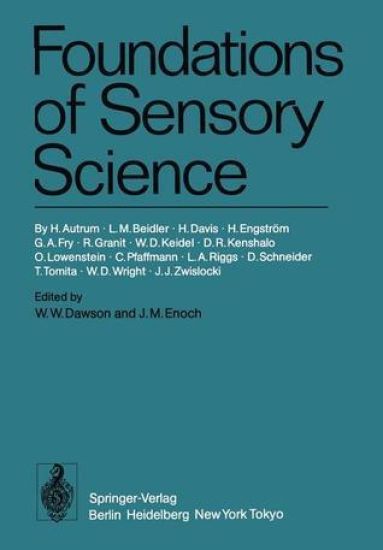
Foundations of Sensory Science

Foundations of Sensory Science

H. Autrum; L.M. Beidler; H. Davis; H. Engström; G.A. Fry; R. Granit; W.D. Keidel; D.R. Kenshalo; O. Lowenstein; C. Pfaffmann; L.A. Riggs; D. Schneider; T. Tomita; W.D. Wright; J.J. Zwislocki

Springer-Verlag Berlin and Heidelberg GmbH Co. K
2011
nidottu
When seen from an outsider's vantage point, the development of knowledge in the sensory sciences must appear massive and the result of some carefully followed master plan. In reality, it is the result of numerous relatively independent human endeavors shaped by application of the scientific method. The comprehensive construction of quantitative theories of sense organ function has occurred only recently -but at an explosive rate prefaced by centuries of expansion in the physical sciences. Predicated on this growth, the twentieth century may become known as the age of the biological sciences. With the exception of a modest number of intellectual giants, there were few contributors to the foundations of the sensory sciences before the dawn of this century. At least 90% of existing knowledge has been produced by scientists working in laboratories founded since 1920. If any single scientist and his laboratory may be identified with the growth in the sensory sciences, it is EDGAR DOUGLAS ADRIAN, First Baron of Cambridge and leader of the Physiological Laboratory at Cambridge University, England. Lord ADRIAN'S influence upon the sensory sciences was great, not only in terms of his contribution to knowledge itself but also through the influence which he exerted upon numerous young scientists who spent weeks or years at the Cambridge laboratory and who later returned to their homelands and colleagues with the seeds of vigorous research and quantitative inquiry firmly implanted.
Auditory System

Auditory System

H. W. Ades; A. Axelsson; I. L. Baird; G. v. Békésy; R. L. Boord; C. B. G. Campbell; O. Densert; D. H. Eldredge; H. Engström; J. Fex; J. M. Harrison; O. W. Henson; M. E. Howe; S. Iurato; A. Michelsen; A. R. Møller; R. R. Pfeiffer; S. Rauch; I. Rauch; E. A. G. Shaw; J. Wersäll; E. G. Wever

Springer-Verlag Berlin and Heidelberg GmbH Co. K
2011
nidottu
In planning The Handbook volumes on Audition, we, the editors, made the decision that there should be many authors, each writing about the work in the field that he knew best through his own research, rather than a few authors who would review areas of research with which they lacked first hand familiarity. For the purposes of the chapters on Audition, sensory physiology has been defined very broadly to include studies from the many disciplines that contribute to our understanding of the structures concerned with hearing and the processes that take place in these structures in man and in lower animals. A number of chapters on special topics have been included in order to present information that might not be covered by the usual chapters dealing with anatomical, physi­ ological and behavioral aspects of hearing. We wish to thank all authors of the volumes on Audition for the contributions that they have made. We feel confident that their efforts will also be appreciated by the many scientists and clinicians who will make use of the Handbook for many years to come. WOLF D. KEIDEL WILLIAM D. NEFF Erlangen Bloomington August 1974 Contents Introduction. By G. v. BEKESY t. With 3 Figures. . . . . . . . 1 Chapter 1 Consideration of the Acoustic Stimulus. By R. R. PFEIFFER. With Chapter 2 19 Figures. . . . . . . . . . . . . . . . . . . . . . . . . 9 Comparative Anatomy of the Middle Ear. By O. W. HENSON Jr. With Chapter 3 23 Figures. . . . . . . . . . . . . . . . . . . . . . . 39 . . . . .