Kirjojen hintavertailu. Mukana 12 390 323 kirjaa ja 12 kauppaa.

Kirjailija

H.J. Haubold

Kirjat ja teokset yhdessä paikassa: 7 kirjaa, julkaisuja vuosilta 1988-2018, suosituimpien joukossa Fractional and Multivariable Calculus. Vertaile teosten hintoja ja tarkista saatavuus suomalaisista kirjakaupoista.

Mukana myös kirjoitusasut: H. J. Haubold

7 kirjaa

Kirjojen julkaisuhaarukka 1988-2018.

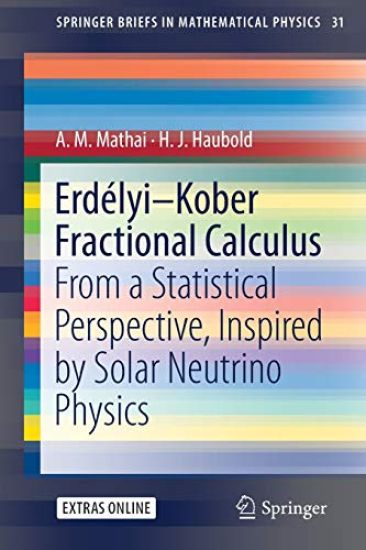
Erdélyi–Kober Fractional Calculus

Erdélyi–Kober Fractional Calculus

A. M. Mathai; H. J. Haubold

Springer Verlag, Singapore
2018
nidottu
This book focuses on Erdélyi–Kober fractional calculus from a statistical perspective inspired by solar neutrino physics. Results of diffusion entropy analysis and standard deviation analysis of data from the Super-Kamiokande solar neutrino experiment lead to the development of anomalous diffusion and reaction in terms of fractional calculus. The new statistical perspective of Erdélyi–Kober fractional operators outlined in this book will have fundamental applications in the theory of anomalous reaction and diffusion processes dealt with in physics.A major mathematical objective of this book is specifically to examine a new de?nition for fractional integrals in terms of the distributions of products and ratios of statistically independently distributed positive scalar random variables or in terms of Mellin convolutions of products and ratios in the case of real scalar variables. The idea will be generalized to cover multivariable cases as well as matrix variable cases. In the matrix variable case, M-convolutions of products and ratios will be used to extend the ideas. We then give a de?nition for the case of real-valued scalar functions of several matrices.
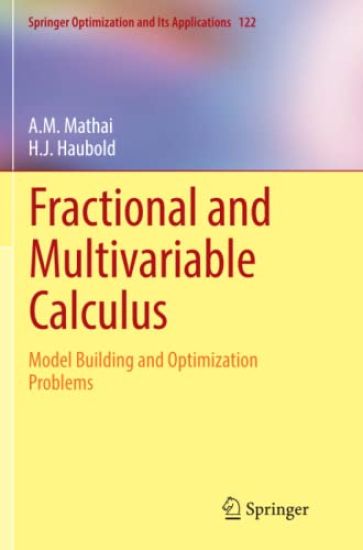
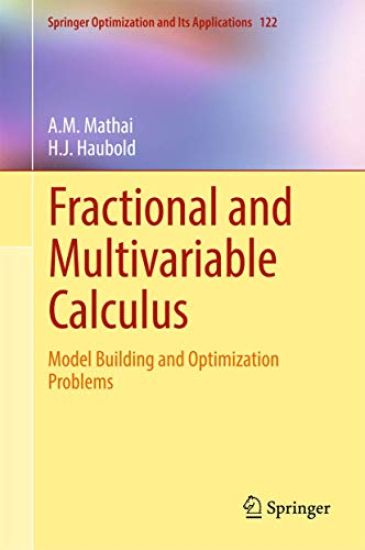
Fractional and Multivariable Calculus

Fractional and Multivariable Calculus

A.M. Mathai; H.J. Haubold

Springer International Publishing AG
2018
nidottu
This textbook presents a rigorous approach to multivariable calculus in the context of model building and optimization problems. This comprehensive overview is based on lectures given at five SERC Schools from 2008 to 2012 and covers a broad range of topics that will enable readers to understand and create deterministic and nondeterministic models. Researchers, advanced undergraduate, and graduate students in mathematics, statistics, physics, engineering, and biological sciences will find this book to be a valuable resource for finding appropriate models to describe real-life situations.The first chapter begins with an introduction to fractional calculus moving on to discuss fractional integrals, fractional derivatives, fractional differential equations and their solutions. Multivariable calculus is covered in the second chapter and introduces the fundamentals of multivariable calculus (multivariable functions, limits and continuity, differentiability, directionalderivatives and expansions of multivariable functions). Illustrative examples, input-output process, optimal recovery of functions and approximations are given; each section lists an ample number of exercises to heighten understanding of the material. Chapter three discusses deterministic/mathematical and optimization models evolving from differential equations, difference equations, algebraic models, power function models, input-output models and pathway models. Fractional integral and derivative models are examined. Chapter four covers non-deterministic/stochastic models. The random walk model, branching process model, birth and death process model, time series models, and regression type models are examined. The fifth chapter covers optimal design. General linear models from a statistical point of view are introduced; the Gauss–Markov theorem, quadratic forms, and generalized inverses of matrices are covered. Pathway, symmetric, and asymmetric models are covered in chapter six, the concepts are illustrated with graphs.
Fractional and Multivariable Calculus

Fractional and Multivariable Calculus

A.M. Mathai; H.J. Haubold

Springer International Publishing AG
2017
sidottu
This textbook presents a rigorous approach to multivariable calculus in the context of model building and optimization problems. This comprehensive overview is based on lectures given at five SERC Schools from 2008 to 2012 and covers a broad range of topics that will enable readers to understand and create deterministic and nondeterministic models. Researchers, advanced undergraduate, and graduate students in mathematics, statistics, physics, engineering, and biological sciences will find this book to be a valuable resource for finding appropriate models to describe real-life situations.The first chapter begins with an introduction to fractional calculus moving on to discuss fractional integrals, fractional derivatives, fractional differential equations and their solutions. Multivariable calculus is covered in the second chapter and introduces the fundamentals of multivariable calculus (multivariable functions, limits and continuity, differentiability, directionalderivatives and expansions of multivariable functions). Illustrative examples, input-output process, optimal recovery of functions and approximations are given; each section lists an ample number of exercises to heighten understanding of the material. Chapter three discusses deterministic/mathematical and optimization models evolving from differential equations, difference equations, algebraic models, power function models, input-output models and pathway models. Fractional integral and derivative models are examined. Chapter four covers non-deterministic/stochastic models. The random walk model, branching process model, birth and death process model, time series models, and regression type models are examined. The fifth chapter covers optimal design. General linear models from a statistical point of view are introduced; the Gauss–Markov theorem, quadratic forms, and generalized inverses of matrices are covered. Pathway, symmetric, and asymmetric models are covered in chapter six, the concepts are illustrated with graphs.
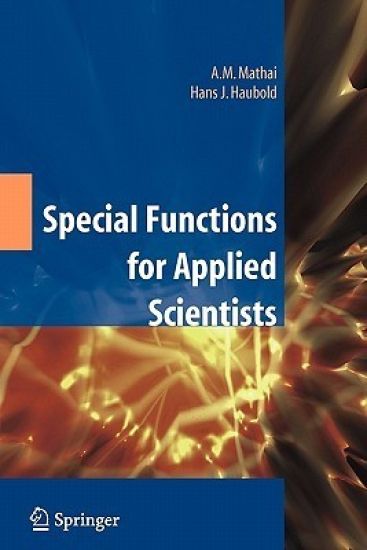
Special Functions for Applied Scientists

Special Functions for Applied Scientists

A.M. Mathai; H.J. Haubold

Springer-Verlag New York Inc.
2010
nidottu
Chapter 1 introduces elementary classical special functions. Gamma, beta, psi, zeta functions, hypergeometric functions and the associated special functions, generalizations to Meijer's G and Fox's H-functions are examined here. Discussion is confined to basic properties and selected applications. Introduction to statistical distribution theory is provided. Some recent extensions of Dirichlet integrals and Dirichlet densities are discussed. A glimpse into multivariable special functions such as Appell's functions and Lauricella functions is part of Chapter 1. Special functions as solutions of differential equations are examined. Chapter 2 is devoted to fractional calculus. Fractional integrals and fractional derivatives are discussed. Their applications to reaction-diffusion problems in physics, input-output analysis, and Mittag-Leffler stochastic processes are developed. Chapter 3 deals with q-hyper-geometric or basic hypergeometric functions. Chapter 4 covers basic hypergeometric functions and Ramanujan's work on elliptic and theta functions. Chapter 5 examines the topic of special functions and Lie groups. Chapters 6 to 9 are devoted to applications of special functions. Applications to stochastic processes, geometric infinite divisibility of random variables, Mittag-Leffler processes, alpha-Laplace processes, density estimation, order statistics and astrophysics problems, are dealt with in Chapters 6 to 9. Chapter 10 is devoted to wavelet analysis. An introduction to wavelet analysis is given. Chapter 11 deals with the Jacobians of matrix transformations. Various types of matrix transformations and the associated Jacobians are provided. Chapter 12 is devoted to the discussion of functions of matrix argument in the real case. Functions of matrix argument and the pathway models along with their applications are discussed.
Special Functions for Applied Scientists

Special Functions for Applied Scientists

A.M. Mathai; H.J. Haubold

Springer-Verlag New York Inc.
2008
sidottu
Chapter 1 introduces elementary classical special functions. Gamma, beta, psi, zeta functions, hypergeometric functions and the associated special functions, generalizations to Meijer's G and Fox's H-functions are examined here. Discussion is confined to basic properties and selected applications. Introduction to statistical distribution theory is provided. Some recent extensions of Dirichlet integrals and Dirichlet densities are discussed. A glimpse into multivariable special functions such as Appell's functions and Lauricella functions is part of Chapter 1. Special functions as solutions of differential equations are examined. Chapter 2 is devoted to fractional calculus. Fractional integrals and fractional derivatives are discussed. Their applications to reaction-diffusion problems in physics, input-output analysis, and Mittag-Leffler stochastic processes are developed. Chapter 3 deals with q-hyper-geometric or basic hypergeometric functions. Chapter 4 covers basic hypergeometric functions and Ramanujan's work on elliptic and theta functions. Chapter 5 examines the topic of special functions and Lie groups. Chapters 6 to 9 are devoted to applications of special functions. Applications to stochastic processes, geometric infinite divisibility of random variables, Mittag-Leffler processes, alpha-Laplace processes, density estimation, order statistics and astrophysics problems, are dealt with in Chapters 6 to 9. Chapter 10 is devoted to wavelet analysis. An introduction to wavelet analysis is given. Chapter 11 deals with the Jacobians of matrix transformations. Various types of matrix transformations and the associated Jacobians are provided. Chapter 12 is devoted to the discussion of functions of matrix argument in the real case. Functions of matrix argument and the pathway models along with their applications are discussed.