Kirjojen hintavertailu. Mukana 12 657 676 kirjaa ja 12 kauppaa.

Kirjailija

H. Micheal Tarver

Kirjat ja teokset yhdessä paikassa: 6 kirjaa, julkaisuja vuosilta 2001-2027, suosituimpien joukossa The History of Venezuela. Vertaile teosten hintoja ja tarkista saatavuus suomalaisista kirjakaupoista.

Mukana myös kirjoitusasut: H Micheal Tarver

6 kirjaa

Kirjojen julkaisuhaarukka 2001-2027.

The History of Venezuela

The History of Venezuela

Francisco Soto Oráa; H. Micheal Tarver

BLOOMSBURY PUBLISHING PLC
2027
sidottu
An indispensable resource for readers interested in Venezuelan history, this book analyzes Venezuela's political, economic, cultural, and social history, up to date with chapters discussing the contested 2024 and 2018 elections and the country's economic crisis and dependence on petroleum. Recent years in Venezuela have been tumultuous, marked by questions of fraudulent elections, economic crisis, effects of the COVID-19 pandemic, and an increase in Venezuelan migration, with over 8 million Venezuelans scattered throughout the American continent and the Iberian Peninsula. This new edition provides up-to-date discussion of all of these recent events and provides readers with the historical knowledge needed to understand present-day Venezuela within the context of the country's past. Exploring Venezuela's history from its earliest times to the present day, the book demonstrates both the richness of Venezuela and its people and the complexity of its political, social, and economic problems. As with all titles in the Histories of the Modern Nations series, this chronological narrative examines political, economic, cultural, philosophical, and religious continuities in Venezuela's long and rich history, providing readers with a concise yet up-to-date study of the nation.

Venezuela and the United States on the Threshold of the Cold War

Venezuela and the United States on the Threshold of the Cold War

Francisco Miguel Soto Oraa; H. Micheal Tarver

BLOOMSBURY PUBLISHING PLC
2026
sidottu
This book offers a vivid account of how Venezuela and the United States reshaped their diplomatic, economic, and security ties between 1945 and 1948, a period that marked Venezuela’s first real attempt at modern democracy. Set against the backdrop of the post–World War II world and the emerging Cold War, it shows how global shifts influenced local politics and vice versa. Drawing on rich archival research from both countries, Tarver and Soto Oraa trace how the new Venezuelan government, the Junta Revolucionaria de Gobierno, secured international recognition, negotiated with U.S. officials and oil companies, and oversaw a surge of foreign investment and military cooperation. The authors revisit key debates about democracy, political upheaval, and foreign involvement, highlighting how party rivalries, labor movements, and the landmark 1943 Hydrocarbons Law converged with U.S. strategic priorities under Presidents Roosevelt and Truman. The result is a clear and compelling narrative of how questions of sovereignty, oil, and ideology shaped a turning point in Venezuela’s history and in inter-American relations.
The United States and Venezuela during the First World War
This book details the diplomatic relations between the United States and Venezuela during a pivotal time in world history. Through the utilization of archival materials and newspaper accounts, the author highlights the words of the major participants to demonstrate how the two nations worked together – sometimes hand-in-hand, sometimes face-to-face – to prevent the European War from spreading to the Western Hemisphere. Despite several efforts to develop hemispheric unity during the War, Venezuelan leaders perceived the policy of neutrality to be in the best interest of the country's national sovereignty. This book explores the personalities of the chief executives and selected diplomats to illustrate how both personnel and personalities molded their nation’s foreign relations. In the end, while perceived as two very different individuals who pursued different paths during the global conflict, the leadership styles of President Woodrow Wilson and General Juan Vicente Gómez were more alike than they realized. The overall cordial relations between the two nations during the period under review helped establish the foundation for the petroleum bonanza that United States companies would enjoy in the following years.
The History of Venezuela

The History of Venezuela

H. Micheal Tarver

Greenwood Publishing Group Inc
2018
sidottu
An indispensable resource for readers interested in Venezuelan history, this book analyzes Venezuela's economic crisis through the context of its political and social history.For decades, the economy of Venezuela has depended on petroleum. As a consequence of a reduction in the price of oil, Venezuela recently experienced an economic downturn resulting in rampant social spending, administrative corruption, and external economic forces that collectively led credit-rating agencies to declare in November 2017 that Venezuela was in default on its debt payments. How did this Latin American nation come to this point?The History of Venezuela explores Venezuela's history from its earliest times to the present day, demonstrating both the richness of Venezuela and its people and the complexity of its political, social, and economic problems. As with all titles in The Greenwood Histories of the Modern Nations series, this chronological narrative examines political, economic, cultural, philosophical, and religious continuities in Venezuela's long and rich history, providing readers with a concise yet up-to-date study of the nation. The volume highlights the country's wide variety of cultures, languages, political ideologies, and historical figures and landmarks through maps, photographs, biographies, a timeline, and a bibliographical essay with suggestions for further reading.
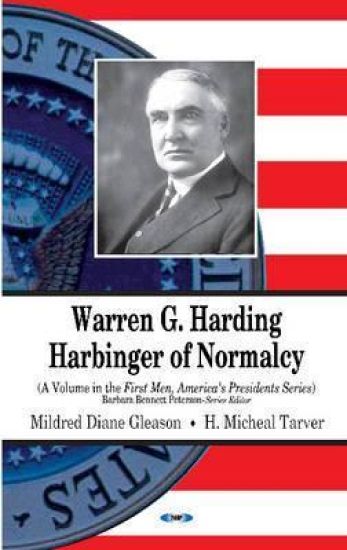
Warren G Harding

Warren G Harding

Mildred Diane Gleason; H Micheal Tarver

Nova Science Publishers Inc
2012
sidottu
Warren Gamaliel Harding was a traditional man in the mode of the late-nineteenth, early-twentieth century. His values, perspective on the world around him, his habits and leisure pastimes, and his opinions about being an American and a man were all extremely traditional. To understand Warren G Harding one must first seek the essence of the man. This work attempts to discover and analyse the essence of Harding through three methods. First, this book presents a biographical overview that examines the person of Warren G. Harding in an effort to understand how he captured the admiration and adoration of so many Americans while at the same time being assailed as an ignorant man, incompetent President, and unethical individual. Second, in order to ascertain and evaluate Harding as a political leader and the effectiveness of his presidency, this book analyses selected key decisions, tactics, and policies pursued by the Harding Administration. Third, this work briefly describes the context of the Harding Era, basically the period from 1920 through 1923.