Kirjojen hintavertailu. Mukana 12 657 676 kirjaa ja 12 kauppaa.

Kirjailija

H. Vincent Poor

Kirjat ja teokset yhdessä paikassa: 11 kirjaa, julkaisuja vuosilta 1994-2023, suosituimpien joukossa MIMO Wireless Communications. Vertaile teosten hintoja ja tarkista saatavuus suomalaisista kirjakaupoista.

11 kirjaa

Kirjojen julkaisuhaarukka 1994-2023.

MIMO Wireless Communications

MIMO Wireless Communications

Ezio Biglieri; Robert Calderbank; Anthony Constantinides; Andrea Goldsmith; Arogyaswami Paulraj; H. Vincent Poor

Cambridge University Press
2007
sidottu
Multiple-input multiple-output (MIMO) technology constitutes a breakthrough in the design of wireless communications systems, and is already at the core of several wireless standards. Exploiting multipath scattering, MIMO techniques deliver significant performance enhancements in terms of data transmission rate and interference reduction. This 2007 book is a detailed introduction to the analysis and design of MIMO wireless systems. Beginning with an overview of MIMO technology, the authors then examine the fundamental capacity limits of MIMO systems. Transmitter design, including precoding and space-time coding, is then treated in depth, and the book closes with two chapters devoted to receiver design. Written by a team of leading experts, the book blends theoretical analysis with physical insights, and highlights a range of key design challenges. It can be used as a textbook for advanced courses on wireless communications, and will also appeal to researchers and practitioners working on MIMO wireless systems.

Peer-to-Peer Energy Sharing

Peer-to-Peer Energy Sharing

Wayes Tushar; Sohrab Nizami; M. Imran Azim; Chau Yuen; David B. Smith; Tapan Saha; H. Vincent Poor

Now Publishers Inc
2023
nidottu
Globally, the demand for electricity is increasing significantly and thus there is a need for more power generation. As a result, environmental pollution from burning fossil fuels is accelerating climate change at an unprecedented pace, as evidenced by recent extreme weather events across the world. As such, several paradigm shifts in power and energy systems are happening to protect the environment, societies, and economies against climate change. As the world is planning for a future with low carbon emissions, today’s power system is transitioning from its existing traditional hierarchical structure to a more decentralized framework through innovative energy management techniques, such as peer-to-peer (P2P) sharing. Due to the potential benefits that P2P sharing can offer to electricity prosumers, consumers, and the grid, research, development, and pilot trials of P2P are advancing rapidly. To capture these developments in this emerging energy management paradigm, present in this monograph is a comprehensive review of various features of P2P sharing.To do so, first introduced is the network and market structures that are required to facilitate P2P sharing within a local community. Thereafter, a comprehensive overview of various challenges of P2P energy-sharing mechanisms at both virtual and physical layers is provided, followed by a discussion of technical approaches used in literature to address these challenges. Third, some emerging technological innovations that will be relevant to, and important for, the development of P2P sharing in future markets are introduced and discussed. Fourth, a summary of existing pilot P2P projects is provided, and this is followed by a summary of potential future research directions and a conclusion. Thus, by providing a holistic view of challenges and contributions to both virtual and physical layers of P2P energy systems simultaneously and in a structured way, this monograph delivers a comprehensive understanding of the core challenges that hinder the integration of P2P sharing in the current market model.
Wireless for Machine Learning

Wireless for Machine Learning

Henrik Hellström; José Mairton B. da Silva; Mohammad Mohammadi Amiri; Mingzhe Chen; Viktoria Fodor; H. Vincent Poor; Carlo Fischione

Now Publishers Inc
2022
nidottu
This monograph covers the topic of Wireless for Machine Learning (ML). Although the general intersection of ML and wireless communications is currently a prolific field of research that has already generated multiple publications, there is little review work on Wireless for ML. As data generation increasingly takes place on devices without a wired connection, ML related traffic will be ubiquitous in wireless networks. Research has shown that traditional wireless protocols are highly inefficient or unsustainable to support ML, which creates the need for new wireless communication methods. This monograph gives an exhaustive review of the state-of-the-art wireless methods that are specifically designed to support ML services over distributed datasets. Currently, there are two clear themes within the literature, analog over-the-air computation and digital radio resource management optimized for ML. A comprehensive introduction to these methods is presented, reviews are made of the most important works, open problems are highlighted and application scenarios are discussed.
Stochastic Disorder Problems

Stochastic Disorder Problems

Albert N. Shiryaev; H. Vincent Poor

Springer Nature Switzerland AG
2019
sidottu
This monograph focuses on those stochastic quickest detection tasks in disorder problems that arise in the dynamical analysis of statistical data. These include quickest detection of randomly appearing targets, of spontaneously arising effects, and of arbitrage (in financial mathematics). There is also currently great interest in quickest detection methods for randomly occurring intrusions in information systems and in the design of defense methods against cyber-attacks. The author shows that the majority of quickest detection problems can be reformulated as optimal stopping problems where the stopping time is the moment the occurrence of disorder is signaled. Thus, considerable attention is devoted to the general theory of optimal stopping rules, and to its concrete problem-solving methods.The exposition covers both the discrete time case, which is in principle relatively simple and allows step-by-step considerations, and the continuous-time case, which often requires more technical machinery such as martingales, supermartingales, and stochastic integrals. There is a focus on the well-developed apparatus of Brownian motion, which enables the exact solution of many problems. The last chapter presents applications to financial markets.Researchers and graduate students interested in probability, decision theory and statistical sequential analysis will find this book useful.
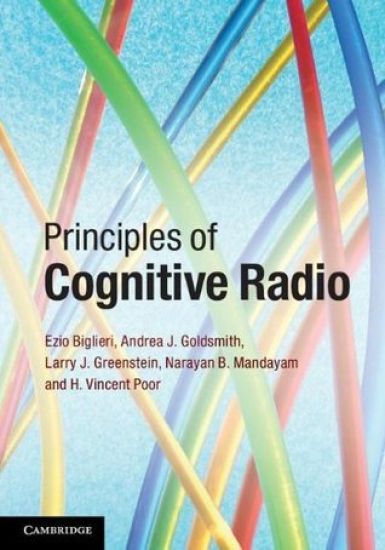
Principles of Cognitive Radio

Principles of Cognitive Radio

Ezio Biglieri; Andrea J. Goldsmith; Larry J. Greenstein; Narayan B. Mandayam; H. Vincent Poor

Cambridge University Press
2012
sidottu
Widely regarded as one of the most promising emerging technologies for driving the future development of wireless communications, cognitive radio has the potential to mitigate the problem of increasing radio spectrum scarcity through dynamic spectrum allocation. Drawing on fundamental elements of information theory, network theory, propagation, optimisation and signal processing, a team of leading experts present a systematic treatment of the core physical and networking principles of cognitive radio and explore key design considerations for the development of new cognitive radio systems. Containing all the underlying principles you need to develop practical applications in cognitive radio, this book is an essential reference for students, researchers and practitioners alike in the field of wireless communications and signal processing.
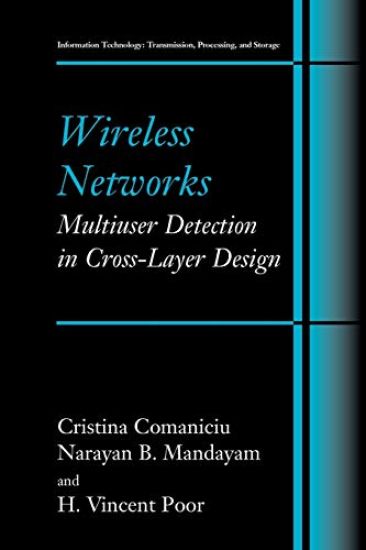
Wireless Networks: Multiuser Detection in Cross-Layer Design

Wireless Networks: Multiuser Detection in Cross-Layer Design

Christina Comaniciu; Narayan B. Mandayam; H. Vincent Poor

Springer-Verlag New York Inc.
2010
nidottu
Cross-layer design seeks to enhance the capacity of wireless networks significantly through the joint optimization of multiple layers in the network, primarily the physical (PHY) and medium access control (MAC) layers. Although there are advantages of such design in wireline networks as well, this approach is particularly advantageous for wireless networks due to the properties (such as mobility and interference) that strongly affect performance and design of higher layer protocols. This unique monograph is concerned with the issue of cross-layer design in wireless networks, and more particularly with the impact of node-level multiuser detection on such design. It provides an introduction to this vibrant and active research area insufficiently covered in existing literature, presenting some of the principal methods developed and results obtained to date. Accompanied by numerous illustrations, the text is an excellent reference for engineers, researchers and students working in communication networks.
An Introduction to Signal Detection and Estimation

An Introduction to Signal Detection and Estimation

H. Vincent Poor

Springer-Verlag New York Inc.
2010
nidottu
The purpose of this book is to introduce the reader to the basic theory of signal detection and estimation. It is assumed that the reader has a working knowledge of applied probability and random processes such as that taught in a typical first-semester graduate engineering course on these subjects. This material is covered, for example, in the book by Wong (1983) in this series. More advanced concepts in these areas are introduced where needed, primarily in Chapters VI and VII, where continuous-time problems are treated. This book is adapted from a one-semester, second-tier graduate course taught at the University of Illinois and at Princeton University. However, this material can also be used for a shorter or first-tier course by restricting coverage to Chapters I through V, which for the most part can be read with a background of only the basics of applied probability, including random vectors and conditional expectations. Sufficient background for the latter option is given for example in the book by Thomas (1986), also in this series. This treatment is also suitable for use as a text in other modes. For example, two smaller courses, one in signal detection (Chapters II, III, and VI) and one in estimation (Chapters IV, V, and VII), can be taught from the materials as organized here. Similarly, an introductory-level course (Chapters I through IV) followed by a more advanced course (Chapters V through VII) is another possibility.
Information Theoretic Security

Information Theoretic Security

Yingbin Liang; H. Vincent Poor; Shlomo Shamai

now publishers Inc
2009
nidottu
Security is one of the most important issues in communications. Security issues arising in communication networks include confidentiality, integrity, authentication and non-repudiation. Attacks on the security of communication networks can be divided into two basic types: passive attacks and active attacks. An active attack corresponds to the situation in which a malicious actor intentionally disrupts the system. A passive attack corresponds to the situation in which a malicious actor attempts to interpret source information without injecting any information or trying to modify the information; i.e., passive attackers listen to the transmission without modifying it.Information Theoretic Security focuses on confidentiality issues, in which passive attacks are of primary concern. The information theoretic approach to achieving secure communication opens a promising new direction toward solving wireless networking security problems. Compared to contemporary cryptosystems, information theoretic approaches offer advantages such as eliminating the key management issue; are less vulnerable to the man-in-the-middle and achieve provable security that is robust to powerful eavesdroppers possessing unlimited computational resources, knowledge of the communication strategy employed including coding and decoding algorithms, and access to communication systems either through perfect or noisy channels.Information Theoretic Security surveys the research dating back to the 1970s which forms the basis of applying this technique in modern systems. It proceeds to provide an overview of how information theoretic approaches are developed to achieve secrecy for a basic wire-tap channel model as well as for its extensions to multiuser networks. It is an invaluable resource for students and researchers working in network security, information theory and communications.
Quickest Detection

Quickest Detection

H. Vincent Poor; Olympia Hadjiliadis

Cambridge University Press
2008
sidottu
The problem of detecting abrupt changes in the behavior of an observed signal or time series arises in a variety of fields, including climate modeling, finance, image analysis, and security. Quickest detection refers to real-time detection of such changes as quickly as possible after they occur. Using the framework of optimal stopping theory, this book describes the fundamentals underpinning the field, providing the background necessary to design, analyze, and understand quickest detection algorithms. For the first time the authors bring together results which were previously scattered across disparate disciplines, and provide a unified treatment of several different approaches to the quickest detection problem. This book is essential reading for anyone who wants to understand the basic statistical procedures for change detection from a fundamental viewpoint, and for those interested in theoretical questions of change detection. It is ideal for graduate students and researchers of engineering, statistics, economics, and finance.
Wireless Networks: Multiuser Detection in Cross-Layer Design

Wireless Networks: Multiuser Detection in Cross-Layer Design

Christina Comaniciu; Narayan B. Mandayam; H. Vincent Poor

Springer-Verlag New York Inc.
2005
sidottu
Cross-layer design seeks to enhance the capacity of wireless networks significantly through the joint optimization of multiple layers in the network, primarily the physical (PHY) and medium access control (MAC) layers. Although there are advantages of such design in wireline networks as well, this approach is particularly advantageous for wireless networks due to the properties (such as mobility and interference) that strongly affect performance and design of higher layer protocols. This unique monograph is concerned with the issue of cross-layer design in wireless networks, and more particularly with the impact of node-level multiuser detection on such design. It provides an introduction to this vibrant and active research area insufficiently covered in existing literature, presenting some of the principal methods developed and results obtained to date. Accompanied by numerous illustrations, the text is an excellent reference for engineers, researchers and students working in communication networks.
An Introduction to Signal Detection and Estimation

An Introduction to Signal Detection and Estimation

H. Vincent Poor

Springer-Verlag New York Inc.
1994
sidottu
The purpose of this book is to introduce the reader to the basic theory of signal detection and estimation. It is assumed that the reader has a working knowledge of applied probability and random processes such as that taught in a typical first-semester graduate engineering course on these subjects. This material is covered, for example, in the book by Wong (1983) in this series. More advanced concepts in these areas are introduced where needed, primarily in Chapters VI and VII, where continuous-time problems are treated. This book is adapted from a one-semester, second-tier graduate course taught at the University of Illinois and at Princeton University. However, this material can also be used for a shorter or first-tier course by restricting coverage to Chapters I through V, which for the most part can be read with a background of only the basics of applied probability, including random vectors and conditional expectations. Sufficient background for the latter option is given for example in the book by Thomas (1986), also in this series. This treatment is also suitable for use as a text in other modes. For example, two smaller courses, one in signal detection (Chapters II, III, and VI) and one in estimation (Chapters IV, V, and VII), can be taught from the materials as organized here. Similarly, an introductory-level course (Chapters I through IV) followed by a more advanced course (Chapters V through VII) is another possibility.