

Kirjailija
H. W. Singer
Kirjat ja teokset yhdessä paikassa: 10 kirjaa, julkaisuja vuosilta 1991-2020, suosituimpien joukossa The Foreign Aid Business. Vertaile teosten hintoja ja tarkista saatavuus suomalaisista kirjakaupoista.
Mukana myös kirjoitusasut: H.W. Singer, H W Singer
10 kirjaa
Kirjojen julkaisuhaarukka 1991-2020.

Drawings of A. Von Menzel By Pr. HW Singer Excerpt FOR two or three decades Menzel was a member of the Institut de France and an Officer of the Legion of Honour, as well as a member of the Royal Society of Painters in Water Colours and the Royal Academy of London. Yet, outside his own country, he was scarcely more than a name, except, perhaps, to the presidents and leading officers of such bodies as I have mentioned. Not long ago I found a French critic attempting to expound Menzel to his countrymen, and he had so far misapprehended his hero that he tried to make him out a sort of excellent German Meissonier. In England, too, he may be put on a line with the League of Cambrai, the Peace of Munster, the Cabal, and other such names, which you at once recognise as very important when you hear them mentioned, but about which you cannot for the life of you remember details and dates. Almost ninety years ago, upon the 8th of December, 1815, Menzel saw the light of day in Breslau. This city was for a long time the third largest of the German Empire, without any attractions to match its size. Menzel's father, originally principal of a girls' seminary, set up a lithographic establishment, in which the lad at an early age found an opportunity of coming into touch with the fine arts. His parents decreed that he should become a scholar, but there were many hindrances in the way of his turning student; and since he had evinced a desire to draw as soon as ever he could hold a pencil, it was easy to prepare him for the work of a practitioner in the lesser arts, if not indeed for an artist. When Menzel was fourteen years of age his father sold his business at Breslau and migrated to Berlin. Here, too, he occupied himself with lithographic work, in which he was assisted by his son. The family had scarcely been a year and a half in the capital when the father died - in January, 1832. Menzel, only sixteen years of age, was now thrown entirely upon his own resources, and, moreover, had to help towards the support of his nearest relatives. For the sake of a living he executed vignettes for tradesmen's bills, letter-headings, designs for stencils, bottle-labels and similar hack-work, and a long period of privation and plodding began for him. What he did at that time gave indication of what there was in the man. For where another would simply have satisfied the crude demands of the trade, he strove conscientiously to do his best and to give his customers more than their money's worth. Many of his early invitation and congratulatory cards, title pages and ephemeral designs are full of happy notions and clever allusions. Instinctively he felt that black-and-white art is a medium that lends itself to argument and...------------------------------------------------------------------------------------------------------------------------------------------ Windham Press is committed to bringing the lost cultural heritage of ages past into the 21st century through high-quality reproductions of original, classic printed works at affordable prices. This book has been carefully crafted to utilize the original images of antique books rather than error-prone OCR text. This also preserves the work of the original typesetters of these classics, unknown craftsmen who laid out the text, often by hand, of each and every page you will read. Their subtle art involving judgment and interaction with the text is in many ways superior and more human than the mechanical methods utilized today, and gave each book a unique, hand-crafted feel in its text that connected the reader organically to the art of bindery and book-making. We think these benefits are worth the occasional imperfection resulting from the age of these books at the time of scanning, and their vintage feel provides a connection to the past that goes beyond the mere words of the text.

Since the 1940s, development thinking has been the subject of fierce debate and continual evolution. The authors of this book trace the ideas that have driven changing approaches to development, focusing also on the Prebisch-Singer Thesis, which seeks to explain the widening gaps between rich and poor nations, caused by unequal distribution of trade benefits. They discuss both aid during and after the cold war, and the rise and subsequent liberalisation crisis of the Asian 'Tiger Economies'.The Economic North-South Divide goes on to explore the structural roots of the debt crisis and considers the impact of debt management on North-South economic relations, exposing certain double standards that tilt global markets further against the South. Encouraged by recent successful opposition to neoliberalism, the authors finally propose ideas for a world where people seem to matter. This book is a welcome addition to the debate and will appeal to anyone interested in economic development and history.

Since the 1940s, development thinking has been the subject of fierce debate and continual evolution. The authors of this book trace the ideas that have driven changing approaches to development, focusing also on the Prebisch-Singer Thesis, which seeks to explain the widening gaps between rich and poor nations, caused by unequal distribution of trade benefits. They discuss both aid during and after the cold war, and the rise and subsequent liberalisation crisis of the Asian 'Tiger Economies'.The Economic North-South Divide goes on to explore the structural roots of the debt crisis and considers the impact of debt management on North-South economic relations, exposing certain double standards that tilt global markets further against the South. Encouraged by recent successful opposition to neoliberalism, the authors finally propose ideas for a world where people seem to matter. This book is a welcome addition to the debate and will appeal to anyone interested in economic development and history.
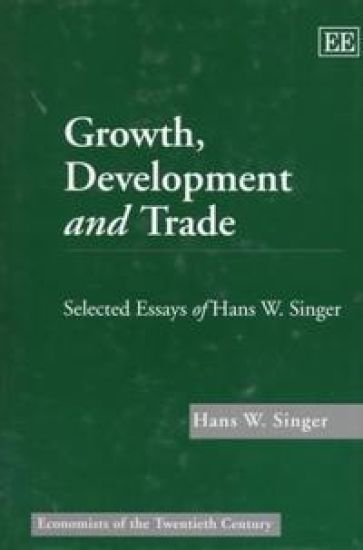
This volume contains 21 selected essays by Professor Sir Hans Singer written over the last two decades. The volume addresses:-development economics in historical perspective and considers where it stands todaythe early pioneers of 'development' thinking including Smith and Keynesgrowth, industrialization and tradecurrent questions of the terms of trade debate and import substitutionNorth-South and South-South linkagesforeign aidThe author gives grateful thanks to Matthew Morris and Hans Ulrich Esslinger for their contributions to this book.

In The Foreign Aid Business, Kunibert Raffer and Hans Singer offer an incisive analysis of aid and development finance, examine the key issues and new trends in aid as well as proposing a series of fundamental improvements.Distinguishing clearly between ‘aid’ and ‘help’ in development finance, the authors discuss aid in the context of other North-South flows, such as trade or debt service, and describe its role and evolution during the Cold War. They address in detail issues such as food aid, the European Union’s Lome co-operation, Japan’s emergence as the largest donor and its specific aid philosophy, the often neglected question of South-South aid and the role of non-governmental organizations. The new trends analyzed in this book include political conditionality, the UNDP’s proposal to reorient aid towards human development and the question of aid diversion to the former communist countries. The Foreign Aid Business concludes by proposing a series of innovative reforms for development aid and finance. The authors advocate major improvements which include combining emergency and development aid, the financial accountability of donors, international insolvency to stop aid bailing-out creditors and the emulation of the Marshall pla’s successful self-monitoring by recipients. Combining a sophisticated analysis of current issues and trends with innovative new ideas for raising the effectiveness of development aid and finance, this substantial new book will be welcomed by academic scholars, policymakers and practitioners as a major contribution to our understanding of the foreign aid business.

In The Foreign Aid Business, Kunibert Raffer and Hans Singer offer an incisive analysis of aid and development finance, examine the key issues and new trends in aid as well as proposing a series of fundamental improvements.Distinguishing clearly between ‘aid’ and ‘help’ in development finance, the authors discuss aid in the context of other North-South flows, such as trade or debt service, and describe its role and evolution during the Cold War. They address in detail issues such as food aid, the European Union’s Lome co-operation, Japan’s emergence as the largest donor and its specific aid philosophy, the often neglected question of South-South aid and the role of non-governmental organizations. The new trends analyzed in this book include political conditionality, the UNDP’s proposal to reorient aid towards human development and the question of aid diversion to the former communist countries. The Foreign Aid Business concludes by proposing a series of innovative reforms for development aid and finance. The authors advocate major improvements which include combining emergency and development aid, the financial accountability of donors, international insolvency to stop aid bailing-out creditors and the emulation of the Marshall pla’s successful self-monitoring by recipients. Combining a sophisticated analysis of current issues and trends with innovative new ideas for raising the effectiveness of development aid and finance, this substantial new book will be welcomed by academic scholars, policymakers and practitioners as a major contribution to our understanding of the foreign aid business.

ECONOMIC PROGRESS AND PROSPECTS IN THE THIRD WORLD
H. W. Singer; Sumit Roy
Edward Elgar Publishing Ltd
1993
sidottu
Economic Progress and Prospects in the Third World combines an elegant and persuasive summary of development progress over the last 40 years with detailed case studies of two major developing countries, Nigeria and India.Beginning with an overview of changes in development theory and practice since 1945, the book distinguishes three main phases: the 'Golden Age' of the 1950s and 1960s, the illusory debt-led growth of the 1970s, and the 'Lost Decade' of the 1980s. It explains how successes in some of the earlier phases led to difficulties later on. The authors then describe the specific ways in which these changes have affected two nations: Nigeria, a relatively open economy, India, a relatively closed economy. In conclusion, they draw on the lessons of global and domestic development for a discussion of prospects in the 1990s.This important study will prove invaluable to policymakers and economists who seek to use the experience of the past to solve the problems of the future.

Development Perspectives for the 1990s
H.W. Singer; Renee Prendergast
Palgrave Macmillan
1991
nidottu
The most pressing problem for most developing countries is how to reverse the adverse trends of the 1980s and create the conditions for sustainable development. The contributors to this volume bring a great variety of experience, background and interest to bear on this issue. Considerable attention is given to the design of appropriate structural adjustment programmes and the role of debt reduction, food aid and the European Community in this context. The need for an adaptive evolutionary approach to problems of development is, perhaps, the central theme to the volume.

Development Perspectives for the 1990s
H.W. Singer; Renee Prendergast
Palgrave Macmillan
1991
sidottu
The most pressing problem for most developing countries is how to reverse the adverse trends of the 1980s and create the conditions for sustainable development. The contributors to this volume bring a great variety of experience, background and interest to bear on this issue. Considerable attention is given to the design of appropriate structural adjustment programmes and the role of debt reduction, food aid and the European Community in this context. The need for an adaptive evolutionary approach to problems of development is, perhaps, the central theme to the volume.