Kirjojen hintavertailu. Mukana 12 595 353 kirjaa ja 12 kauppaa.

Kirjailija

Hal Blythe

Kirjat ja teokset yhdessä paikassa: 13 kirjaa, julkaisuja vuosilta 2004-2019, suosituimpien joukossa It Works for Me with SoTL: A Step-By-Step Guide. Vertaile teosten hintoja ja tarkista saatavuus suomalaisista kirjakaupoista.

13 kirjaa

Kirjojen julkaisuhaarukka 2004-2019.

It Works for Me with Critical Thinking: A Step-By-Step Guide

It Works for Me with Critical Thinking: A Step-By-Step Guide

Hal Blythe; Russell Carpenter; Charlie Sweet

New Forums Press
2019
nidottu
When asked, "What's your elevator pitch for higher education?" Cornell University Professor of Economics Robert Frank offered an explanation that underscored the significance of critical thinking: "When you meet somebody who's well trained in critical thinking, it's immediately apparent to you. We're living in a world now where people can doctor photographs. They can shout fake news. They can spin a conspiracy theory. If you're not equipped to think skeptically about the arguments people make to you, then you're ever more at risk in the environment we inhabit now."Critical thinking has become the central topic of many higher education conversations. And just as Elvis pushed for "a little less conversation, a little more action," so has academia. The purpose of this book is to provide a venue for that action, to allow our colleagues from across the country to share what works for them.Simply put, the academy must become better at instilling critical thinking so that for graduates it becomes a habit of mind.In this book, the twelfth in our "It Works for Me Series," you will find the selections are more evidence-based and focused than when we began twenty years ago, and our contributors seem to be applying more critical thinking to their own writing.

It Works for Me with High Impact Practices

It Works for Me with High Impact Practices

Hal Blythe; Russell Carpenter; Charlie Sweet

New Forums Press
2018
nidottu
High impact practices are a twenty-first-century phenomenon, but if you've read any of the authors' books, you know, for instance, that for many years they have been collaborating, instructing undergraduates how to research like full professors, and teaching writing intensive courses-in short, employing some high impact practices, even though, back then, they were merely effective teaching strategies.What impresses the authors the most about HIPs is that they have been rigorously assessed, and no doubt remains that they work, resulting in deeper learning. Moreover, what started as a top-ten practices list has already grown to eleven with the demonstrated efficacy of the e-portfolio. And that list will surely grow as more and more research is performed.For this title, there is one point the authors would like to stress: No law exists that prevents you from using more than one HIP at a time in a learning experience. In fact, as their PLC experience proved, piggybacking the HIPs makes them even more effective, or, as Mae West said, "Too much of a good thing can be . . . wonderful."
Scaling the Scholarship Mountain: Achieving Scholarly Productivity

Scaling the Scholarship Mountain: Achieving Scholarly Productivity

Hal Blythe; Russell Carpenter; Bill Pyillips Ed D.

New Forums Press
2017
nidottu
This book is intended to aid you in the climb from your formal education experience to the real world of the scholar. Through a combined total of over 150 years of experience in scholarly productivity, the authors have discovered some key steps toward becoming a scholar. In the pages that follow, they will share these steps through explanations, examples, and exercises.Since the authors have also edited several publications in the past, and one currently serves as editor of the prestigious Journal of Faculty Development, we had decided to include a special section in this book to further aid you in scaling the scholarship mountain. "From the Editor's Desk" Post 'Ems are timely observations made in reference to important concepts introduced in the text. Each comment is designed to call attention to a specific point, establishing its place in the successful ascent to scholarly productivity.
Innovating Faculty Development: Entering the Age of Innovation

Innovating Faculty Development: Entering the Age of Innovation

Hal Blythe; Russell Carpenter; Charlie Sweet

New Forums Press
2016
nidottu
From The Authors: Is the term "innovative faculty development" actually redundant? In our way of thinking, faculty development-mostly because of its youth-necessitates innovation. In fact, any new field depends upon creative thinking and its implementation into innovation to progress.In our academic careers, despite a background in traditional studies in English, we have helped develop three new disciplines-pop culture (especially comic book theory), creative writing, and now faculty development. Our careers have coincided with the rise of these three fields.But here we want to focus on faculty development. While the more formal structure we think of as faculty development began around 50 years ago, way back in 1810 Harvard University granted its first sabbatical, and many claim that action as the first instance of faculty development. In Creating the Future of Faculty Development (2006), Sorcinelli et al. posit that faculty development has evolved through five ages: The Age of the Scholar (1960s-mid 70s), The Age of the Teacher (mid-to-late 70s), The Age of the Developer (1980s), The Age of the Learner (1990s), and The Age of the Network (21st century).Obviously such constant change necessitates innovation. It must be done, and within the pages of this work, we're going to demonstrate how. The book's first section contains essays addressing the fundamental theories underlying creative thinking and then its application to faculty development, while the following sections treat practical concerns. For these pedagogical essays, we often include a set of ancillaries to aid the reader in reflecting about and implementing the strategies presented. While we have created an extensive approach to innovating faculty development, we encourage you to take a risk and attempt a few of them at first. If those innovations succeed, feel free to keep borrowing more and more from our suggestions. They work for us.
Transforming Your Students into Deep Learners: A Guide for Instructors

Transforming Your Students into Deep Learners: A Guide for Instructors

Hal Blythe; Bill Phillips; Russell Carpenter

New Forums Press
2016
nidottu
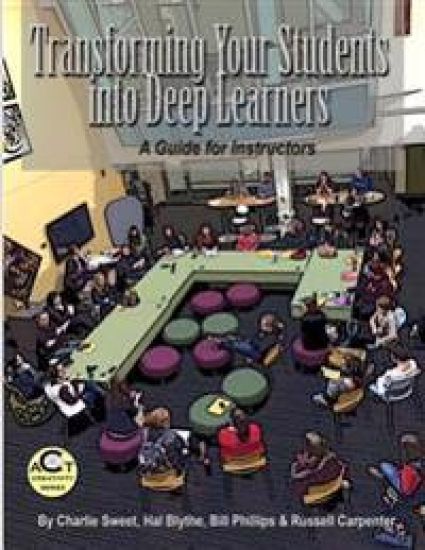
This title is intended as a follow-up to Achieving Excellence in Teaching: A Self-help Guide (2014). In Chapter Three of the latter, the authors posited deep learning the major goal of higher education. This book elaborates on the concept of deep learning and offers a rationale for why K-12 students have difficulty with college teaching-overcoming the learning gap. To help concerned instructors instill deep learning in their students, the book provides the Excellent Eight, specific strategies based on recent research and experience.BACKGROUND TO DEEP LEARNING / 101. Introduction / 302. Deep Learning vs. Surface Learning/ 703. The Making of Academic Surfers: Characteristics of Today's Entering College Students and Culture That Hinder Deep Learning/ 1504. The Learning Gap/ 25EIGHT EXCELLENT STRATEGIES FOR DEEP LEARNING: Using BRIDLE/ 2705. STRATEGY I: Climbing Bloom's Staircase/ 2906. STRATEGY II: Presenting for Deep Learning / 3707. STRATEGY III: Facilitating Retrieving for Deep Learning/ 4508. STRATEGY IV: Fostering Metacognition for Deep Learning/ 5309. STRATEGY V: Developing Critical Thinking for Deep Learning/ 6310. STRATEGY VI: Employing Deep Reading for Deep Learning/ 7311. STRATEGY VII: Creating Spaces for Deep Learning/ 7912. STRATEGY VIII: Motivating Students to be Deep Learners/ 85HONING YOUR SKILLS9313. Conclusion/ 9514. Appendix A: BRIDLE: A Systematic Plan for Self-Improvement in Promoting Deep Learning / 9715. Appendix B: A Selected, Partially Annotated Bibliography / 10316. Appendix C: ARTS, A Student Learning Skills Inventory / 109About the Authors/ 111
It Works for Me, Metacognitively: Shared Tips for Effective Teaching

It Works for Me, Metacognitively: Shared Tips for Effective Teaching

Charlie Sweet; Russell Carpenter; Hal Blythe

New Forums Press
2016
nidottu
We hope readers will consider these threads when reviewing the teaching tips in this collection:1. Teaching metacognition demands intention and modeling of the strategies.2. Using metacognition in the classroom requires establishing the students as willing and interested learners in the first place.3. Teaching students how to apply metacognitive strategies also means that we are teaching students to learn about the learning process.4. Teaching metacognition encourages students to become active, critical, and creative learners.In short, metacognition offers a way for you to rethink instruction while also, as the authors learned at their own institution, reconsidering the relationship between teaching and learning. As you read, however, we encourage you to think differently about the ways you apply metacognitive strategies in your teaching and the ways you ask students to incorporate these concepts in your assignment, course, and service or administrative work on campus. No doubt you'll develop your own effective metacognitive strategies, and referring to this title will go a long way in the right direction.
It Works for Me, Creatively: Shared Tips for the Classroom

It Works for Me, Creatively: Shared Tips for the Classroom

Charlie Sweet; Hal Blythe

New Forums Press
2011
nidottu
The authors' purpose in this seventh book in the "It Works for Me" series is to demonstrate that "everyone possesses creative talent, though it may be latent in some and difficult to bring out in others. It's not just a talent possessed by artists and engineers, mind you, but everyone." Furthermore, "Creative people have figured out consciously or un- that a small seed of creativity can be made to grow by having the proper environment and a minimal set of skills. And people can be taught or self-taught this process."The authors/editors also believe that "all creative ideas link themselves to other creative ideas to develop something new and useful, be it a concept, a process, or a product. In order to disseminate and perpetuate their] belief that the creative impulse resides in all of us, they] have asked a host of friends to demonstrate it with essays and practical tips touching on supportive creative environments, strategies that foster and enhance creativity, and assessments that demonstrate creativity has indeed taken place."This easy-to-follow guide is separated into several sections: -Overviews-The Creative Process-The Creative Environment-The Creative Product-Assessing Creativity.Hal Blythe and Charlie Sweet have each won the prestigious Acorn Award, which is presented annually to the outstanding college professor in the state of Kentucky. In addition, they have over 800 publications, including 12 books, articles running the gamut from literary criticism to educational research, and popular fiction.Other books in the "It Works for Me" series can be ordered from New Forums Press.
It Works for Me, Online!: Shared Tips for Online and Web-Enhanced Teaching
It Works For Me, Online is designed primarily to aid instructors in two major types of classes: fully online and web-enhanced/hybrid courses. Those who teach fully online classes will find tips on such things as tricks you can use with synchronous chats, how to use blogging in your classroom to replace traditional chat-rooms (talk about your superannuation), and even ways of adapting Blackboard to meet administrative needs. Those who prefer web enhancements to the traditional classroom will find advice to navigate between the virtual and real world. And, truthfully, we are hopeful that even dyed-in-the-wool, card-carrying Luddites will skim through these pages and realize it is possible for old dogs to learn new tricks (we and many of our contributors are either retiring or nearing retirement, yet found the brave new world of technology as exciting as we did our Erector Sets as kids or learning to beat our own kids at Pac-Man).Use It Works For Me, Online both as a handy desk companion filled with practical strategies and as a springboard for generating your own strategies for making your classes as effective as possible. Like the first two books in this series, It Works For Me and It Works For Me, Too, this handbook runs the gamut from short to long pieces, from very course-specific suggestions to general pieces, from some theoretical applications to down-to-earth tactics. But the following tips share one important common characteristic-they all work.