Kirjojen hintavertailu. Mukana 12 152 606 kirjaa ja 12 kauppaa.

Kirjailija

Hannah Waite

Kirjat ja teokset yhdessä paikassa: 4 kirjaa, julkaisuja vuosilta 2024-2026, suosituimpien joukossa Playing God. Vertaile teosten hintoja ja tarkista saatavuus suomalaisista kirjakaupoista.

4 kirjaa

Kirjojen julkaisuhaarukka 2024-2026.

Playing God

Playing God

Nick Spencer; Hannah Waite

SPCK PUBLISHING
2025
nidottu
* Will AI ever attain emotional intelligence? * What would it mean to find intelligent life elsewhere in the universe? * Did our human ancestors, or do our mammalian cousins, have a sense of the spiritual? These and other cutting-edge questions are where the action is in the field of science and religion, and this book brings you bang up to date with both the latest thinking and the direction in which current research is taking us. Emerging from a partnership between the UK’s leading religion and society think tank, Theos, and The Faraday Institute for Science and Religion, and incorporating the results of interviews with over 100 leading figures in the field, this is a book for all who are ready to gain a better grasp of contemporary topics that are often bypassed in science and religion conversations, including: aliens and astrobiology; the opportunities and threats of AI; Neanderthals and the origins of morality and religion; the hard problem of consciousness; the complex boundary between natural and supernatural; the promise of human genetic modification; the challenge of climate change; health and well-being; the rise of (post-)truth; and politics, our common life and public reasoning. These are all complex and fast-moving areas of enquiry, but Nick Spencer and Hannah Waite have produced a survey and analysis that will enable you to firmly grasp the issues at stake as well as tracing the main contours of research and debate as they are now developing.
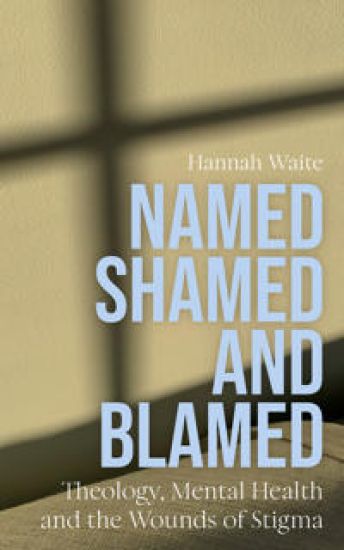
Named, Shamed and Blamed

Named, Shamed and Blamed

Hannah Waite

SCM PRESS
2026
nidottu
Once an individual is formally diagnosed with a mental health condition such as bipolar or depression they enter into a period of disorientation - in which they are unsure of their social standing, relationship with God, self and their community. This period of disorientation is the place in which stigma is rooted and flourishes. Taking liberation theology as a lens in order to understand this phenomena of stigma, Named, Shamed and Blamed explores oppression, injustice and poverty drawn from the lived experience of Christians diagnosed with bipolar disorder and provides rich theological and biblical reflection upon these constructs and what they mean in practice, not only for those with the disorder, but for others facing mental health challenges and suffering stigma as a result.
The Landscapes of Science and Religion

The Landscapes of Science and Religion

Nick Spencer; Hannah Waite

Oxford University Press
2025
sidottu
The relationship between science and religion has long been a heated debate and is becoming an ever more popular topic. The scientific capacity to manipulate and change humans and their environment through genetic engineering, life extension, and AI is going to take a huge leap forward in the twenty-first century, provoking endless debates around humans “playing God”. But what do we mean by this? Asking this question is surprisingly hard work. Attempts to 'essentialise' science, let alone religion, quickly run into trouble. Where are the boundaries? Whose definition of science is definitive? Which concept of religious is the authoritative one? Ultimately, neither “science” nor “religion” can be pinned down to one single meaning or definition. Rather, they encompass a family of definitions that relate to one another in a complex web of shifting ways. Drawing on extensive research with over a hundred leading thinkers in the UK — including Martin Rees, Brian Cox, Susan Greenfield, A.C. Grayling, Ray Tallis, Linda Woodhead, Steve Bruce, Adam Rutherford, Robin Dunbar, Francesca Stavrakopoulou, and Iain McGilchrist — The Landscapes of Science and Religion takes the much-needed step of asking what science and religion actually are, before turning to the familiar question of how they relate to one another. Building on this, by paying particular attention to those who sense some form of conflict here, Spencer and Waite explore where the perceived conflict really lies. What exactly are people disagreeing about when they disagree about science and religion, and what, if anything, can we do to improve that disagreement and bring about a fruitful dialogue between these two important human endeavours.
Playing God

Playing God

Nick Spencer; Hannah Waite

SPCK PUBLISHING
2024
sidottu
Could science one day 'defeat death'? What would alien contact mean for humanity? Has medicine finally found a cure for sadness? Will AI replace us? For too long, the 'science and religion' debate has fixated on creation, evolution, cosmology, miracles and quantum theory. But this, argue Nick Spencer and Hannah Waite, is a mistake. Religious belief has survived, and thrived, under many different models of the universe. It was never intended to be a competing explanation for the science of any age. Where science and religion really do come together - sometimes furiously, sometimes fruitfully - is over the status and nature of the human. And that has never been more important than today. Whether it's the quest for immortality or the search for alien life, the treatment of pandemics or 'animal personhood', AI or mental health, abortion or genetic editing, science is making advances that are posing huge questions about what it means to be human, whether we should change ourselves, and how far we should 'play God'. These developments are only going to grow in significance. Playing God brings readers up to date with the latest developments but also draws out their moral and religious dimensions. In so doing, it shows how the future of science and religion is inextricably tied up with the future of humanity.