
Kirjojen hintavertailu. Mukana 12 595 353 kirjaa ja 12 kauppaa.

Kirjailija

Hannah Zeavin

Kirjat ja teokset yhdessä paikassa: 2 kirjaa, julkaisuja vuosilta 2021-2025, suosituimpien joukossa Mother Media. Vertaile teosten hintoja ja tarkista saatavuus suomalaisista kirjakaupoista.

2 kirjaa

Kirjojen julkaisuhaarukka 2021-2025.

Mother Media

Mother Media

Hannah Zeavin

MIT PRESS LTD
2025
sidottu
An essential history for understanding how we mother now, and how motherhood itself became a medium winner of the Brooke Hindle Award from the Society for the History of Technology. From the nursery to the prison, from the clinic to the commune, Mother Media tells the story of how our contemporary understanding of what a mother is came to be and how understandings of 'bad' mothering formed our contemporary panics about 'bad' media. In this book, leading historian of psychology Hannah Zeavin examines twentieth century pediatric, psychological, educational, industrial, and economic norms around mediated mothering and technologized parenting. The book charts the crisis of the family across the twentieth century and the many ingenious attempts to remediate nursemaid and mother via speculative technologies and screen media. Growing out of her previous award-winning book The Distance Cure, which considered technologized care, the book lays bare the contradictions of techno-parenting and how it relates to conceptions of 'maternal fitness,' medical redlining, and surveillance of children, parents, and other caregivers. The author offers narratives of parenting in its extremity (for example, Shaken Baby Syndrome) and its ostensible banality (for example, the Nanny Cam) and how the two are often intertwined. Ultimately, Zeavin grapples with a simple contradiction: technology is seen and judged as harmful in domestic and educational spaces, even as it is a saving grace in the unending labor of raising a family.
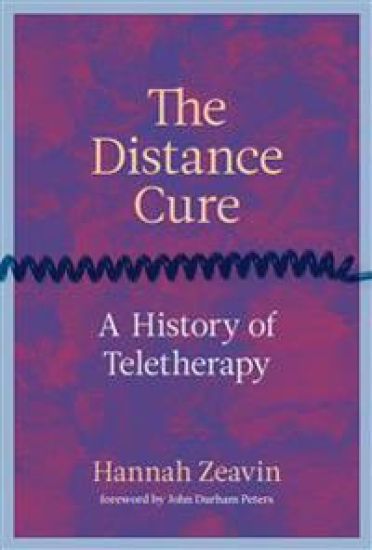
The Distance Cure

The Distance Cure

Hannah Zeavin; John Durham Peters

MIT Press
2021
sidottu
Psychotherapy across distance and time, from Freud's treatments by mail to crisis hotlines, radio call-ins, chatbots, and Zoom sessions. Therapy has long understood itself as taking place in a room, with two (or sometimes more) people engaged in person-to-person conversation. And yet, starting with Freud's treatments by mail, psychotherapy has operated through multiple communication technologies and media. These have included advice columns, radio broadcasts, crisis hotlines, video, personal computers, and mobile phones; the therapists (broadly defined) can be professional or untrained, strangers or chatbots. In The Distance Cure, Hannah Zeavin proposes a reconfiguration of the traditional therapeutic dyad of therapist and patient as a therapeutic triad: therapist, patient, and communication technology. Zeavin tracks the history of teletherapy (understood as a therapeutic interaction over distance) and its metamorphosis from a model of cure to one of contingent help, describing its initial use in ongoing care, its role in crisis intervention and symptom management, and our pandemic-mandated reliance on regular Zoom sessions. Her account of the "distanced intimacy" of the therapeutic relationship offers a powerful rejoinder to the notion that contact across distance (or screens) is automatically lesser, or useless, to the person seeking therapeutic treatment or connection. At the same time, these modes of care can quickly become a backdoor for surveillance and disrupt ethical standards important to the therapeutic relationship. The history of the conventional therapeutic scenario cannot be told in isolation from its shadow form, teletherapy. Therapy, Zeavin tells us, was never just a "talking cure"; it has always been a communication cure.