Kirjojen hintavertailu. Mukana 12 158 262 kirjaa ja 12 kauppaa.
Kirjailija
Hans Föllmer
Kirjat ja teokset yhdessä paikassa: 8 kirjaa, julkaisuja vuosilta 1988-2025, suosituimpien joukossa Paris-Princeton Lectures on Mathematical Finance 2002. Vertaile teosten hintoja ja tarkista saatavuus suomalaisista kirjakaupoista.
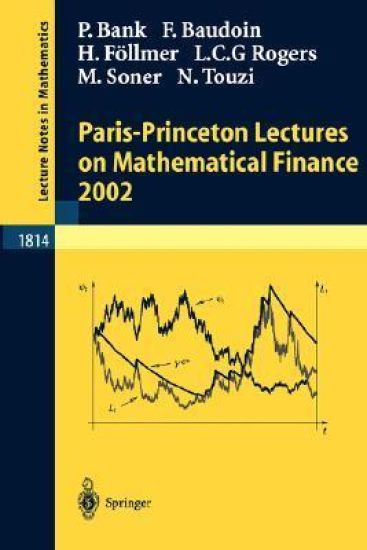
The Paris-Princeton Lectures in Financial Mathematics, of which this is the first volume, will, on an annual basis, publish cutting-edge research in self-contained, expository articles from outstanding - established or upcoming! - specialists. The aim is to produce a series of articles that can serve as an introductory reference for research in the field. It arises as a result of frequent exchanges between the finance and financial mathematics groups in Paris and Princeton. The present volume sets standards with articles by P. Bank/H. Föllmer, F. Baudoin, L.C.G. Rogers, and M. Soner/N. Touzi.
This book provides an introduction to probabilistic methods in finance, based on stochastic models in discrete time. It is aimed primarily at graduate students in mathematics but may also benefit mathematicians in academia and the financial industry. In this fifth edition, the entire text has been thoroughly revised to enhance clarity and completeness. This includes new sections on
This book contains all of Wolfgang Doeblin's publications. In addition, it includes a reproduction of the pli cacheté on l'équation de Kolmogoroff and previously unpublished material that Doeblin wrote in 1940. The articles are accompanied by commentaries written by specialists in Doeblin's various areas of interest. The modern theory of probability developed between the two World Wars thanks to the very remarkable work of Kolmogorov, Khinchin, S.N. Bernstein, Romanovsky, von Mises, Hostinsky, Onicescu, Fréchet, Lévy and others, among whom one name shines particularly brightly, that of Wolfgang Doeblin (1915–1940). The work of this young mathematician, whose life was tragically cut short by the war, remains even now, and indeed will remain into the future, an exemplar of originality and of mathematical power. This book was conceived and in essence brought to fruition by Marc Yor before his death in 2014. It is dedicated to him.
This book is an introduction to financial mathematics. It is intended for graduate students in mathematics and for researchers working in academia and industry.The focus on stochastic models in discrete time has two immediate benefits. First, the probabilistic machinery is simpler, and one can discuss right away some of the key problems in the theory of pricing and hedging of financial derivatives. Second, the paradigm of a complete financial market, where all derivatives admit a perfect hedge, becomes the exception rather than the rule. Thus, the need to confront the intrinsic risks arising from market incomleteness appears at a very early stage.The first part of the book contains a study of a simple one-period model, which also serves as a building block for later developments. Topics include the characterization of arbitrage-free markets, preferences on asset profiles, an introduction to equilibrium analysis, and monetary measures of financial risk.In the second part, the idea of dynamic hedging of contingent claims is developed in a multiperiod framework. Topics include martingale measures, pricing formulas for derivatives, American options, superhedging, and hedging strategies with minimal shortfall risk.This fourth, newly revised edition contains more than one hundred exercises. It also includes material on risk measures and the related issue of model uncertainty, in particular a chapter on dynamic risk measures and sections on robust utility maximization and on efficient hedging with convex risk measures. Contents:Part I: Mathematical finance in one periodArbitrage theoryPreferencesOptimality and equilibriumMonetary measures of riskPart II: Dynamic hedgingDynamic arbitrage theoryAmerican contingent claimsSuperhedgingEfficient hedgingHedging under constraintsMinimizing the hedging errorDynamic risk measures
Gross, Leonard: Thermodynamics, statistical mechanics, and random fields.-Föllmer, Hans: Random fields and diffusion processes.- Nelson, Edward: Stochastic mechanics and random fields.- Albeverio, Sergio: Theory of Dirichlet forms and applications.?
This book is an introduction to financial mathematics. It is intended for graduate students in mathematics and for researchers working in academia and industry. The focus on stochastic models in discrete time has two immediate benefits. First, the probabilistic machinery is simpler, and one can discuss right away some of the key problems in the theory of pricing and hedging of financial derivatives. Second, the paradigm of a complete financial market, where all derivatives admit a perfect hedge, becomes the exception rather than the rule. Thus, the need to confront the intrinsic risks arising from market incomleteness appears at a very early stage. The first part of the book contains a study of a simple one-period model, which also serves as a building block for later developments. Topics include the characterization of arbitrage-free markets, preferences on asset profiles, an introduction to equilibrium analysis, and monetary measures of financial risk. In the second part, the idea of dynamic hedging of contingent claims is developed in a multiperiod framework. Topics include martingale measures, pricing formulas for derivatives, American options, superhedging, and hedging strategies with minimal shortfall risk. This third revised and extended edition now contains more than one hundred exercises. It also includes new material on risk measures and the related issue of model uncertainty, in particular a new chapter on dynamic risk measures and new sections on robust utility maximization and on efficient hedging with convex risk measures.
This book is an introduction to financial mathematics. The first part of the book studies a simple one-period model which serves as a building block for later developments. Topics include the characterization of arbitrage-free markets, preferences on asset profiles, an introduction to equilibrium analysis, and monetary measures of risk. In the second part, the idea of dynamic hedging of contingent claims is developed in a multiperiod framework. Such models are typically incomplete: They involve intrinsic risks which cannot be hedged away completely. Topics include martingale measures, pricing formulas for derivatives, American options, superhedging, and hedging strategies with minimal shortfall risk. In addition to many corrections and improvements, this second edition contains several new sections, including a systematic discussion of law-invariant risk measures and of the connections between American options, superhedging, and dynamic risk measures.