

Kirjailija
Hans-Michael Koetzle
Kirjat ja teokset yhdessä paikassa: 17 kirjaa, julkaisuja vuosilta 2008-2024, suosituimpien joukossa Antje Hanebeck. Vertaile teosten hintoja ja tarkista saatavuus suomalaisista kirjakaupoista.
17 kirjaa
Kirjojen julkaisuhaarukka 2008-2024.

The perfect primer on American street photographer Bruce Gilden, best known for his candid close-up photographs of people on the streets of New York City. Bruce Gilden was born in 1946 and grew up in Brooklyn, New York. After taking photography classes at the School of Visual Arts, he embarked on his first major project: recording tourists and pleasure-seekers visiting Coney Island. Gilden is probably best known for his work on the streets of New York, focusing on the city’s characters and outsiders, but he has also spent many years on projects in Haiti, Japan and Ireland. A member of Magnum Photos since 2001, Gilden has taken the genre of street photography and pushed it in new directions, documenting the essence of the people he sees and the social landscape through which they move.

Michael Dannenmann - Portraits of Artists
Sandra Abend; Hans-Michael Koetzle
morisel Verlag GmbH
2024
nidottu


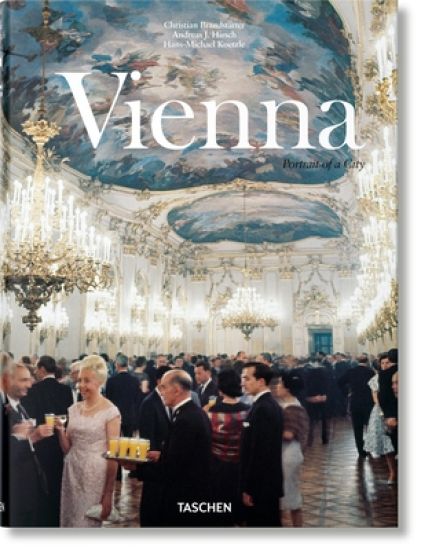
Vienna. Portrait of a City
Andreas J. Hirsch; Christian Brandstätter; Hans-Michael Koetzle
Taschen GmbH
2019
sidottu
Vienna combines drama and elegance like no other. For centuries the heart of the Austro-Hungarian Empire, the stately city on the Danube, has been defined by vast palaces and imperial grandeur—but behind the Baroque opulence, Vienna is also a place of genteel coffee house culture, epicurean tradition, and a heritage of both delicate and daring music, art, and design, from Johann Strauss to Egon Schiele, from Gustav Mahler to Josef Hoffmann. This volume is a treasure trove of photography from the last 175 years, following the evolution of Vienna from imperial capital to modern metropolis. Like a visual walk through time and cityscape, hundreds of carefully curated pictures trace the developments in Vienna’s built environment and the cultural and historical trends they reflect, whether the urban Gesamtkunstwerk of the 19th-century Ringstrasse or the experiments of “Red Vienna” in the 1920s, when the city had a social democrat government for the first time. Through these remarkable photographs, we discover not only the great landmarks and lesser-known corners of Vienna, but also the ubiquity and the tumult of its history. We see the cultural blossoming of the fin de siècle, when radical innovators such as Gustav Klimt, Egon Schiele, Adolf Loos, and Sigmund Freud turned Vienna into a “laboratory of modernity”; the clashes of 1934; the ascent of Nazi dictatorship; and the horrors writ by the Holocaust in what was once one of the most populous and multi-ethnic cities on earth. More recently, fascinating postwar photographs explore the Vienna of the Third Man, at once a city in ruins and a hub for spies. The book closes with the most recent pictures, celebrating the emergence of today’s Vienna—one of the most attractive cities in Europe, in which rich history once again coexists with international flair and vibrant contemporary culture.
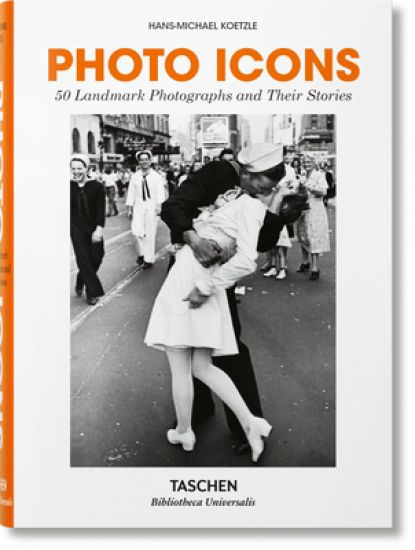
Photo Icons. 50 photographies emblématiques et leur histoire
Hans-Michael Koetzle
TASCHEN GMBH
2019
sidottu
Photographs have a strange and powerful way of shaping the way we see the world. The most successful images enter our collective consciousness, defining eras, making history, or simply touching something so fundamentally human and universal that they have become resonant icons all over the globe. To explore this unique influence, Photo Icons puts some of the most important photographic landmarks under the microscope. From some of the earliest photography, such as Nicéphore Niépce’s 1827 eight-hour-exposure rooftop picture and Louis Daguerre’s famous 1838 street scene, through to Martin Parr, this is as much a history of the medium as a case-by-case analysis of its social, historical, and artistic impact. We take in experimental Surrealist shots of the 1920s and the gritty photorealism of the 1930s, including Dorothea Lange’s Migrant Mother. We witness the power-makers (Che Guevara) and the heartbreakers (Marilyn Monroe) as well as the great gamut of human emotions and experiences to which photography bears such vivid witness: from the euphoric Kiss in Front of City Hall (1950) by Doisneau to the horror of Nick Ut’s Napalm Against Civilians showing nine-year-old Phan Thi Kim Phúc running naked toward the camera from South Vietnamese napalm.
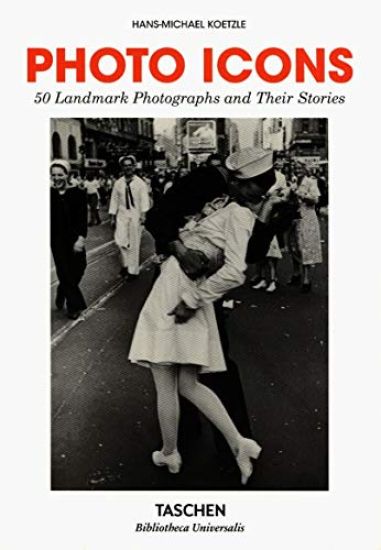
Photo Icons. 50 Landmark Photographs and Their Stories
Hans-Michael Koetzle
Taschen GmbH
2019
sidottu
Photographs have a strange and powerful way of shaping the way we see the world. The most successful images enter our collective consciousness, defining eras, making history, or simply touching something so fundamentally human and universal that they have become resonant icons all over the globe. To explore this unique influence, Photo Icons puts some of the most important photographic landmarks under the microscope. From some of the earliest photography, such as Nicéphore Niépce’s 1827 eight-hour-exposure rooftop picture and Louis Daguerre’s famous 1838 street scene, through to Martin Parr, this is as much a history of the medium as a case-by-case analysis of its social, historical, and artistic impact. We take in experimental Surrealist shots of the 1920s and the gritty photorealism of the 1930s, including Dorothea Lange’s Migrant Mother. We witness the power-makers (Che Guevara) and the heartbreakers (Marilyn Monroe) as well as the great gamut of human emotions and experiences to which photography bears such vivid witness: from the euphoric Kiss in Front of City Hall (1950) by Doisneau to the horror of Nick Ut’s Napalm Against Civilians showing nine-year-old Phan Thi Kim Phúc running naked toward the camera from South Vietnamese napalm.
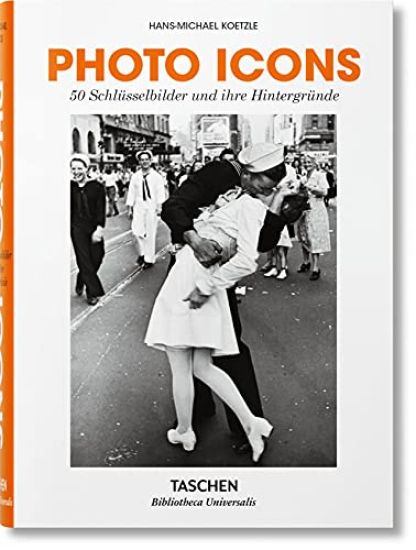
Photo Icons. 50 Schlusselbilder und ihre Hintergrunde
Hans-Michael Koetzle
TASCHEN GMBH
2019
sidottu
From Nicéphore Niépceâ??s 1827 eight-hour-exposure rooftop pictures to the horror of Nick Utâ??s â??napalm girl,â? the 50 photographs in this collection have defined eras, made history, or touched something so fundamentally human that they have become resonant icons around the world. Each image goes under the microscope, revealing the history of the medium and its social, historical, and artistic impact.

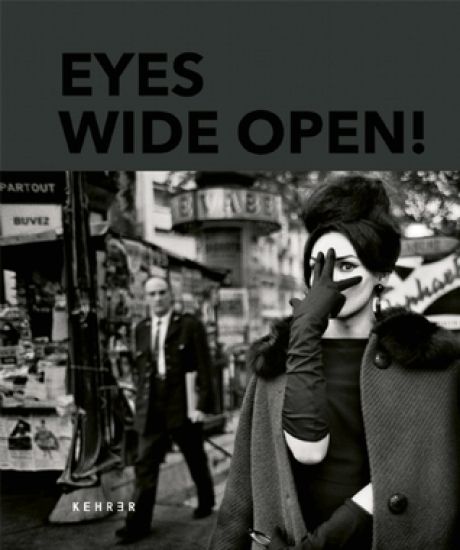
A note in a workshop log proves that in 1914, Oskar Barnack put the finishing touches on the first working model of a compact camera for 35mm standard cinema film. He had not merely invented a new camera--the Leica (=Leitz/camera), not introduced until 1925 due to the war--he in fact ushered in a paradigm shift in photography.Just in time to mark a milestone birthday of the legendary compact camera, and for the first time in this thematic breadth, this volume, with about eight hundred images, offers a wide artistic and cultural history of the Leica from the 1920s to the present day.Essays by international authors examine topics including the technical genesis of the Leica, its influence on photojournalism, and its significance for a wide variety of avant-garde currents in art photography. Heretofore unpublished documents from the archives of the Leica Camera AG round off this multifaceted one-hundred-year cultural chronicle.Includes photographs by Michael Ackerman, Jane Evelyn Atwood, Ilse Bing, Ren Burri, Robert Capa, Henri Cartier-Bresson, Mark Cohen, Bruce Davidson, Michel Vanden Eeckhoudt, William Eggleston, Robert Frank, Lee Friedlander, Alberto Garcia Alix, Gianni Berengo Gardin, Ralph Gibson, Bruce Gilden, Ren Groebli, George Grosz, Ara G ler, Elisabeth Hase, Fred Herzog, Frank Horvat, Thomas Hoepker, Barbara Klemm, William Klein, Robert Lebeck, Saul Leiter, Ulrich Mack, Ram n Masats, Susan Meiselas, Jeff Mermelstein, Joel Meyerowitz, Will McBride, L szl Moholy-Nagy, Alexander Rodtschenko, Paolo Roversi, Erich Salomon, Jeanloup Sieff, Klavdij Sluban, Louis Stettner, Christer Str mholm, Sabine Weiss, Kai Wiedenh fer, Tom Wood, and many others.
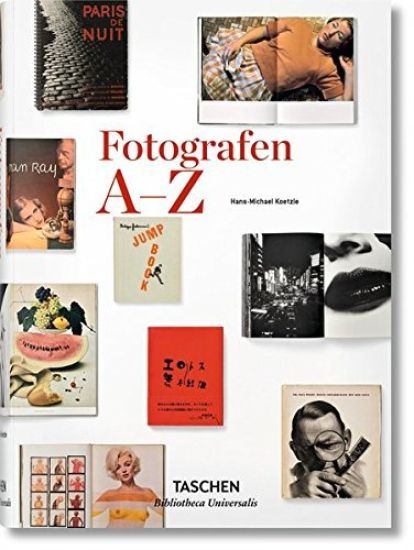
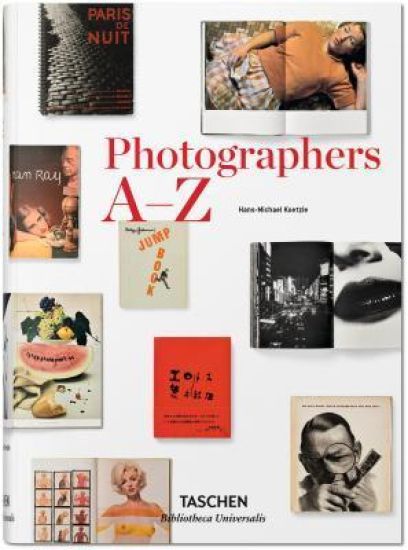
Arranged alphabetically, this biographical encyclopedia features every major photographer of the 20th century alongside her or his most significant monographs. From the earliest representatives of classical Modernism right up to the present day, Photographers A–Z celebrates those photographers who have distinguished themselves with important publications or exhibitions, and who have made a significant contribution to the culture of the photographic image. The entries include photographers from North America and Europe as well as from Japan, Latin America, Africa, and China. Richly illustrated with facsimiles from books and magazines, the collection also features photographers working in “applied” areas, whose work is regarded as photographic art. Star turns include Julius Shulman, Terry Richardson, Cindy Sherman, and David LaChapelle.

1000 Nudes. A History of Erotic Photography from 1839-1939
Hans-Michael Koetzle; Uwe Scheid
Taschen GmbH
2014
sidottu
The history of nude photography is the history of people’s fascination with the topic. Indeed, the photographic depiction of the human body is the only subject that has enthralled photographers, theoreticians, and consumers over such a long period—more than 150 years. No other motif is as prevalent as this one during all the phases of development comprising the history of photography, no other is present, whatever the technique, and is a subject of discussion within the context of nearly all aesthetic movements. Nor has any other pictorial topic produced such a variety of specialities as the nude: from the ethnological interpretation of the body to the glamour shot, from nudist photography to the pin-up of today. No other photographic field of application has inspired as much desire as it has awakened official wrath.1000 Nudes offers a cross section of the history of nude photography, ranging from the earliest nude daguerreotypes and ethnographic nude photographs to experimental nude photography. The period of time spanned by this work is from 1839 to roughly 1939, from the medium’s infancy to the end of the classic modernist period. Content-wise, the book pays tribute to the full range of pictorial approaches, from the manually elaborated artistic nudes of the turn of the century, enveloped in layers of theory, to the “obscene” postcard motifs which had not the slightest artistic pretension and were intended to exert a maximum effect on the buyer’s wallet. All the pictures shown are taken from the late Uwe Scheid’s collection, one of the world’s largest and most important collections of erotic photography.
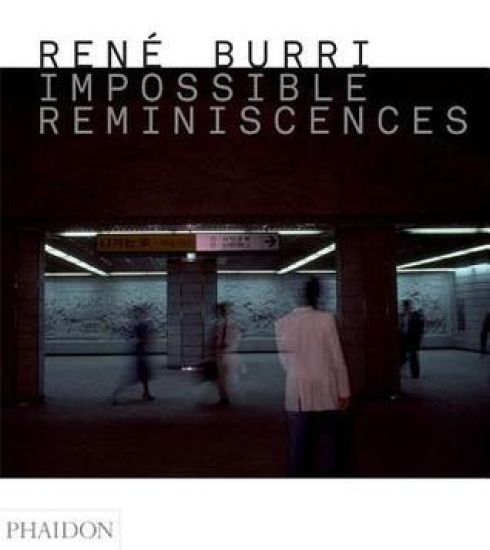
René Burri’s photographs are recognized the world-over as amongst the greatest of the twentieth century. From his iconic shots of Che Guevara and Brasilia, his sensitive war reportage across the globe, to his insightful portraits of such artistic figures as Pablo Picasso and Le Corbusier, Burri’s visual world has shaped our perception of history and politics. In this book, first published in 2013, a year before his death, Burri invites us to view his selection from his archive of colour photographs, taken throughout his career, and tells the stories behind the photographs.
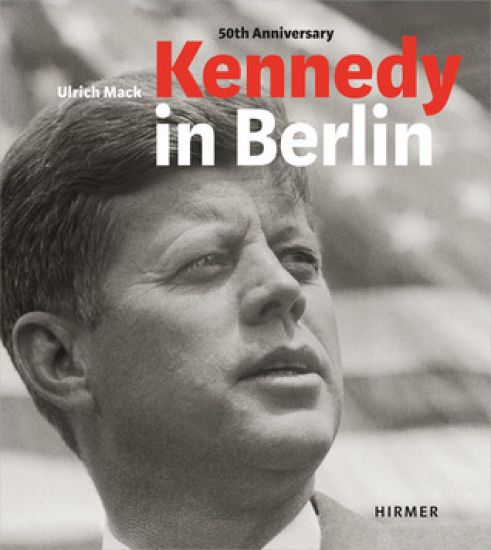
Kennedy in Berlin
Hans-Michael Koetzle; Jasper von Altenbockum; Egon Bahr; Hans-Michael Koetzle
Hirmer Verlag
2013
sidottu
Published to mark the 50th anniversary of John F. Kennedy’s historic visit to Berlin in June 1963, Kennedy in Berlin captures the event in a series of hitherto unpublished photographs by Ulrich Mack. Technically superb, Mack’s photographs feature both the great set pieces of the visit, and candid, unscripted and personal moments in stunning close-up.

Poetic and dramatic, staged and captured in masterly fashion by the pioneers of photography, the Oberammergau Passion Plays as they looked at the end of the 19th century, are here collected in a single volume of photos, some of them never before shown to the public. They are from the private archives of the Lang family.