Kirjojen hintavertailu. Mukana 12 390 323 kirjaa ja 12 kauppaa.

Kirjailija

Hans-Peter Blossfeld

Kirjat ja teokset yhdessä paikassa: 12 kirjaa, julkaisuja vuosilta 1988-2025, suosituimpien joukossa Causal Analysis with Event History Data Using Stata. Vertaile teosten hintoja ja tarkista saatavuus suomalaisista kirjakaupoista.

12 kirjaa

Kirjojen julkaisuhaarukka 1988-2025.

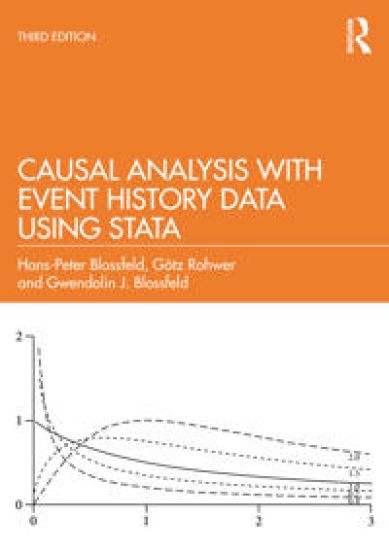
Causal Analysis with Event History Data Using Stata

Causal Analysis with Event History Data Using Stata

Hans-Peter Blossfeld; Götz Rohwer; Gwendolin J. Blossfeld

TAYLOR FRANCIS LTD
2025
nidottu
This third edition of Causal Analysis with Event History Data Using Stata provides an updated introduction to event history modeling along with many instructive Stata examples. Using the latest Stata software, each of these practical examples develops a research question, points to useful contextual background information, gives a brief account of the underlying statistical concepts, describes the organization of input data and the application of Stata statistical procedures, and assists the reader in interpreting the content of the results obtained. Emphasizing the strengths and limitations of continuous-time event history analysis in different fields of social science applications, this book demonstrates that event history models provide a useful approach to uncover causal relation- ships or to map a system of causal relationships. In particular, this book demonstrates how long-term processes can be studied, how different forms of duration dependencies can be estimated using nonparametric, parametric and semiparametric models, and how parallel and interdependent dynamic systems can be analyzed from a causal-analytical point of view using the method of episode splitting. The book also shows how changing contextual information at the micro, meso and macro levels can be easily integrated into a dynamic analysis of longitudinal data. Finally, the book addresses the problem of unobserved heterogeneity of time-constant and time-dependent omitted variables and makes suggestions for dealing with these sometimes difficult methodological problems.Causal Analysis with Event History Data Using Stata is an invaluable resource for both novice and experienced researchers from a variety of fields (e.g. sociology, economics, political science, education, psychology, demography, epidemiology, management research and organizational studies, as well as medicine and clinical applications) who need an introductory textbook on continuous-time event history analysis and who are looking for a practical handbook for their longitudinal research.
Causal Analysis with Event History Data Using Stata

Causal Analysis with Event History Data Using Stata

Hans-Peter Blossfeld; Götz Rohwer; Gwendolin J. Blossfeld

TAYLOR FRANCIS LTD
2025
sidottu
This third edition of Causal Analysis with Event History Data Using Stata provides an updated introduction to event history modeling along with many instructive Stata examples. Using the latest Stata software, each of these practical examples develops a research question, points to useful contextual background information, gives a brief account of the underlying statistical concepts, describes the organization of input data and the application of Stata statistical procedures, and assists the reader in interpreting the content of the results obtained. Emphasizing the strengths and limitations of continuous-time event history analysis in different fields of social science applications, this book demonstrates that event history models provide a useful approach to uncover causal relation- ships or to map a system of causal relationships. In particular, this book demonstrates how long-term processes can be studied, how different forms of duration dependencies can be estimated using nonparametric, parametric and semiparametric models, and how parallel and interdependent dynamic systems can be analyzed from a causal-analytical point of view using the method of episode splitting. The book also shows how changing contextual information at the micro, meso and macro levels can be easily integrated into a dynamic analysis of longitudinal data. Finally, the book addresses the problem of unobserved heterogeneity of time-constant and time-dependent omitted variables and makes suggestions for dealing with these sometimes difficult methodological problems.Causal Analysis with Event History Data Using Stata is an invaluable resource for both novice and experienced researchers from a variety of fields (e.g. sociology, economics, political science, education, psychology, demography, epidemiology, management research and organizational studies, as well as medicine and clinical applications) who need an introductory textbook on continuous-time event history analysis and who are looking for a practical handbook for their longitudinal research.
The New Role Of Women

The New Role Of Women

Hans-peter Blossfeld; Kathleen Kiernan

Routledge
2021
nidottu
This is the first book to systematically track postwar changes in family formation in Western Europe and the United States. Cohabitation and motherhood outside of marriage have become more widespread at the same time that women’s social roles are evolving. Women are attaining higher levels of education, marrying at an older age, more frequently working outside the home, and have more reproductive freedom due to new advances in contraception. In this original collection of essays, sociologists and demographers from eight Western European countries and the United States use longitudinal data to compare national variations and explain the connection between the new role of women and family formation in postwar society. The contributors provide a thorough review of the social demographic literature to advance a variety of hypotheses about the relationships between changing women’s education and family formation outcomes, which are empirically examined and compared across countries.
Rational Choice Theory And Largescale Data Analysis

Rational Choice Theory And Largescale Data Analysis

Hans-peter Blossfeld; Gerald Prein

Routledge
2020
nidottu
The relationship between rational choice theory and large-scale data analysis has become an important issue for sociologists. Though rational choice theory is well established in both sociology and economics, its influence on quantitative empirical sociology has been surprisingly limited. This book examines why there is hardly a link between the t
The New Role Of Women

The New Role Of Women

Hans-peter Blossfeld; Kathleen Kiernan

Routledge
2019
sidottu
This is the first book to systematically track postwar changes in family formation in Western Europe and the United States. Cohabitation and motherhood outside of marriage have become more widespread at the same time that women’s social roles are evolving. Women are attaining higher levels of education, marrying at an older age, more frequently working outside the home, and have more reproductive freedom due to new advances in contraception. In this original collection of essays, sociologists and demographers from eight Western European countries and the United States use longitudinal data to compare national variations and explain the connection between the new role of women and family formation in postwar society. The contributors provide a thorough review of the social demographic literature to advance a variety of hypotheses about the relationships between changing women’s education and family formation outcomes, which are empirically examined and compared across countries.
Rational Choice Theory And Largescale Data Analysis

Rational Choice Theory And Largescale Data Analysis

Hans-peter Blossfeld; Gerald Prein

Routledge
2019
sidottu
The relationship between rational choice theory and large-scale data analysis has become an important issue for sociologists. Though rational choice theory is well established in both sociology and economics, its influence on quantitative empirical sociology has been surprisingly limited. This book examines why there is hardly a link between the t
Event History Analysis With Stata

Event History Analysis With Stata

Hans-Peter Blossfeld; Götz Rohwer

Routledge
2019
sidottu
Nowadays, event history analysis can draw on a well-established set of statistical tools for the description and causal analysis of event history data. The second edition of Event History Analysis with Stata provides an updated introduction to event history modeling, along with many instructive Stata examples. Using the latest Stata software, each of these practical examples develops a research question, refers to useful substantive background information, gives a short exposition of the underlying statistical concepts, describes the organization of the input data and the application of the statistical Stata procedures, and assists the reader in performing a substantive interpretation of the obtained results. Emphasising the strengths and limitations of event history model techniques in each field of application, this book demonstrates that event history models provide a useful approach with which to uncover causal relationships or to map out a system of causal relations. It demonstrates how long-term processes can be studied and how changing context information on the micro, meso, and macro levels can be integrated easily into a dynamic analysis of longitudinal data. Event History Analysis with Stata is an invaluable resource for both novice students and researchers who need an introductory textbook and experienced researchers (from sociology, economics, political science, pedagogy, psychology, or demography) who are looking for a practical handbook for their research.
Event History Analysis With Stata

Event History Analysis With Stata

Hans-Peter Blossfeld; Götz Rohwer

Routledge
2019
nidottu
Nowadays, event history analysis can draw on a well-established set of statistical tools for the description and causal analysis of event history data. The second edition of Event History Analysis with Stata provides an updated introduction to event history modeling, along with many instructive Stata examples. Using the latest Stata software, each of these practical examples develops a research question, refers to useful substantive background information, gives a short exposition of the underlying statistical concepts, describes the organization of the input data and the application of the statistical Stata procedures, and assists the reader in performing a substantive interpretation of the obtained results. Emphasising the strengths and limitations of event history model techniques in each field of application, this book demonstrates that event history models provide a useful approach with which to uncover causal relationships or to map out a system of causal relations. It demonstrates how long-term processes can be studied and how changing context information on the micro, meso, and macro levels can be integrated easily into a dynamic analysis of longitudinal data. Event History Analysis with Stata is an invaluable resource for both novice students and researchers who need an introductory textbook and experienced researchers (from sociology, economics, political science, pedagogy, psychology, or demography) who are looking for a practical handbook for their research.
Event History Analysis

Event History Analysis

Hans-Peter Blossfeld; Alfred Hamerle; Karl Ulrich Mayer

Psychology Press Ltd
2016
nidottu
Serving as both a student textbook and a professional reference/handbook, this volume explores the statistical methods of examining time intervals between successive state transitions or events. Examples include: survival rates of patients in medical studies, unemployment periods in economic studies, or the period of time it takes a criminal to break the law after his release in a criminological study. The authors illustrate the entire research path required in the application of event-history analysis, from the initial problems of recording event-oriented data to the specific questions of data organization, to the concrete application of available program packages and the interpretation of the obtained results. Event History Analysis: * makes didactically accessible the inclusion of covariates in semi-parametric and parametric regression models based upon concrete examples * presents the unabbreviated close relationship underlying statistical theory * details parameter-free methods of analysis of event-history data and the possibilities of their graphical presentation * discusses specific problems of multi-state and multi-episode models * introduces time-varying covariates and the question of unobserved population heterogeneity * demonstrates, through examples, how to implement hypotheses tests and how to choose the right model.
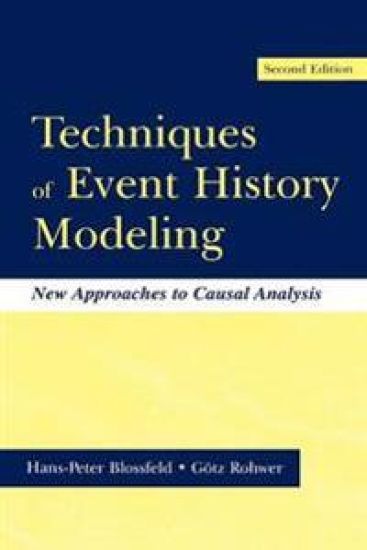
Techniques of Event History Modeling

Techniques of Event History Modeling

Hans-Peter Blossfeld

Psychology Press
2001
nidottu
Including new developments and publications which have appeared since the publication of the first edition in 1995, this second edition: *gives a comprehensive introductory account of event history modeling techniques and their use in applied research in economics and the social sciences; *demonstrates that event history modeling is a major step forward in causal analysis. To do so the authors show that event history models employ the time-path of changes in states and relate changes in causal variables in the past to changes in discrete outcomes in the future; and *introduces the reader to the computer program Transition Data Analysis (TDA). This software estimates the sort of models most frequently used with longitudinal data, in particular, discrete-time and continuous-time event history data. Techniques of Event History Modeling can serve as a student textbook in the fields of statistics, economics, the social sciences, psychology, and the political sciences. It can also be used as a reference for scientists in all fields of research.
Techniques of Event History Modeling

Techniques of Event History Modeling

Hans-Peter Blossfeld

Psychology Press
2001
sidottu
Including new developments and publications which have appeared since the publication of the first edition in 1995, this second edition: *gives a comprehensive introductory account of event history modeling techniques and their use in applied research in economics and the social sciences; *demonstrates that event history modeling is a major step forward in causal analysis. To do so the authors show that event history models employ the time-path of changes in states and relate changes in causal variables in the past to changes in discrete outcomes in the future; and *introduces the reader to the computer program Transition Data Analysis (TDA). This software estimates the sort of models most frequently used with longitudinal data, in particular, discrete-time and continuous-time event history data. Techniques of Event History Modeling can serve as a student textbook in the fields of statistics, economics, the social sciences, psychology, and the political sciences. It can also be used as a reference for scientists in all fields of research.
Event History Analysis

Event History Analysis

Hans-Peter Blossfeld; Alfred Hamerle; Karl Ulrich Mayer

Psychology Press
1988
sidottu
Serving as both a student textbook and a professional reference/handbook, this volume explores the statistical methods of examining time intervals between successive state transitions or events. Examples include: survival rates of patients in medical studies, unemployment periods in economic studies, or the period of time it takes a criminal to break the law after his release in a criminological study. The authors illustrate the entire research path required in the application of event-history analysis, from the initial problems of recording event-oriented data to the specific questions of data organization, to the concrete application of available program packages and the interpretation of the obtained results. Event History Analysis: * makes didactically accessible the inclusion of covariates in semi-parametric and parametric regression models based upon concrete examples * presents the unabbreviated close relationship underlying statistical theory * details parameter-free methods of analysis of event-history data and the possibilities of their graphical presentation * discusses specific problems of multi-state and multi-episode models * introduces time-varying covariates and the question of unobserved population heterogeneity * demonstrates, through examples, how to implement hypotheses tests and how to choose the right model.