
Kirjailija
Hans-Werner Wahl
Kirjat ja teokset yhdessä paikassa: 11 kirjaa, julkaisuja vuosilta 1997-2024, suosituimpien joukossa Die neue Psychologie des Alterns. Vertaile teosten hintoja ja tarkista saatavuus suomalaisista kirjakaupoista.
11 kirjaa
Kirjojen julkaisuhaarukka 1997-2024.
Psychologie für die Arbeit mit Menschen höheren Lebensalters
Hans-Werner Wahl
Juventa Verlag GmbH
2023
nidottu

Successful Ageing
Clemens Tesch-Romer; Hans-Werner Wahl; Suresh Rattan; Liat Ayalon
Oxford University Press
2021
nidottu
The ambition of ageing science to discover the golden fleece of longevity and health is closely connected to the concept of 'successful ageing'. Still, for a large portion of the population, frailty and cognitive impairment is the reality of ageing, and it is by no means certain if health promotion, prevention and other interventions will reduce the probability of its occurrence. This book argues that a narrow understanding of 'successful ageing' as good health, full functioning, and active participation in society excludes a large portion of ageing individuals from the quest for a good life in old age. The challenge is that the term 'successful ageing' comes with ambitions but also with ambivalence. On the one hand, it counteracts the deficit view of ageing and facilitates visionary thinking on what might be possible in the future. On the other hand, its implicitly ageist and derogative features have negative consequences to older people and society at large. So, what is successful ageing? We provide answers at three levels: First, we synthesise the various models used to define successful ageing into a heuristic scheme able to unravel the normative complexity and differences inherent in existing models. Second, we anchor successful ageing models in a tripartite way at micro (individual), meso, and macro analytic levels of human development. Third, we argue that the usefulness of successful ageing in guiding policy will only profit from the concept, if it follows a pluralistic and holistic view without hastily deciding for one model only.

Das Lange Leben Leben - Aber Wie?: Interdisziplinare Blicke Auf Altern Heute Und Morgen
Hans-Werner Wahl; Hans Forstl; Ines Himmelsbach
Kohlhammer
2021
nidottu
English summary: We are living today in a rapidly ageing society, but many 'older' people don't really feel that they are 'old' at all. Ageing has many facets and is perhaps the most enigmatic phase of life. This introductory volume in the series 'Living a Long Life u Shaping the Ageing Process' uses current research on ageing to indicate different ways of interpreting the demands and contradictions involved in growing older. On the basis of these findings, the book offers many suggestions for ways of dealing with central questions that arise not only for older people, but also for people of all ages. German description: In diesem ersten Band der neuen Reihe "Lange Leben leben Altern gestalten" wird in gut verstandlicher Weise dargestellt, dass die gegenwartige Alternsforschung hilfreich ist, um den Potentialen, Anforderungen und Widerspruchlichkeiten des Alterwerdens proaktiv zu begegnen. Auf Grundlage dieser Erkenntnisse bieten die AutorInnen vielfaltige Anstoae zum Umgang mit zentralen Fragen, die sich nicht nur fur altere Menschen, sondern bereits fur Menschen mittleren Alters stellen.
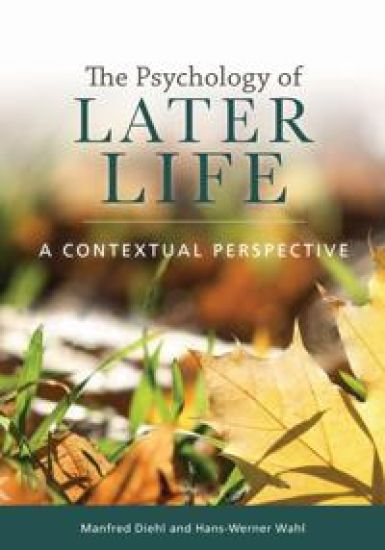
The Psychology of Later Life
Manfred Diehl; Hans-Werner Wahl
American Psychological Association
2020
pokkari
Renowned experts in adult development and aging, Manfred Diehl and Hans-Werner Wahl synthesize decades of psychological research into a comprehensive volume that considers later life in the context of lifespan development, social and physical environmental factors, and historical amp ndash cultural influences. In so doing, they review important research on cognitive functioning, behavioral processes, personality and identity development, and overall well-being in middle to late adulthood. Diehl and Wahl amp rsquo s three-part framework helps readers better understand that the development process is influenced by multiple factors and can take many different trajectories. Through this contextualized perspective, they examine the influence that previous life experiences, beginning in early childhood, can have on the aging process in older adults. This includes social relations, technological advances, societal perspectives on aging, and education. The authors also examine the challenges and opportunities of aging, using a strength-based approach to promote a diverse, nuanced understanding of successful, healthy aging. Chapters also conclude with dialogues from other experts in the field, offering multiple different perspectives on the research.

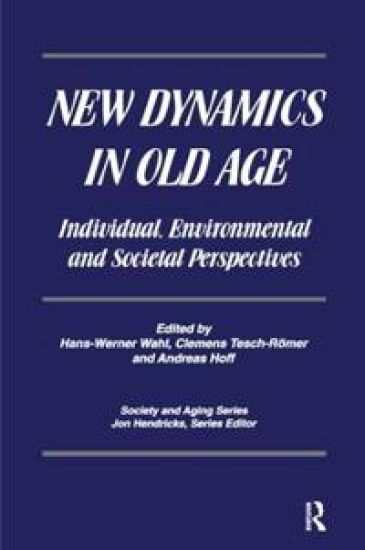
New Dynamics in Old Age
Hans-Werner Wahl; Clemens Tesch-Romer; . Andreas Hoff; Jon Hendricks
Routledge
2017
nidottu
This book was nurtured by the belief that the new dynamics of today's and tomorrow's aging has not yet been treated well in the gerontology literature. Several questions drove the choice of substance for the book: What kind of new dynamics of aging deserves consideration? What kinds of theories and fields are at the core of treating such a new dynamics? And what kind of empirical evidence should be considered? The master hypothesis on which the book is based maintains that the new dynamics of old age is best observed in a range of everyday aging contexts that have been undergoing major change since the second half of the 20th century. In particular, five areas of new and persistent dynamics are treated in depth: the social environment, with a focus on cohort effects in social relations and the consideration of family relations and elders as care redelivers; the home environment, with emphasis on housing and quality of life, relocation and urban aging issues; the outdoor environment, with consideration of out-of-home activity patterns, car-driving behaviour and the leisure world of aging; the technological environment, with treatments of the role of the Internet and the potential of technology for aging outcomes and; and the societal environment with a focus on global aging, the new politics of old age and older persons as market consumers. The book's main purpose is to provide the scholarly gerontology community with a comprehensive and critical discussion of these new trends related to old age. The book will be of interest for the scholarly community of gerontology in a variety of disciplines; sociology, psychology, demography, epidemiology, humanities, social policy and geriatrics; students in gerontology education and in the disciplines named above who have an interest in aging issues (graduate level); professionals in practical and applied fields related to aging such as community and urban planners, health and care providers and policymakers; people involved in senior citizens' organizations and those in industry who wish to serve older people with new products.

Gerontologie ist ein stark interdisziplinar orientiertes Wissenschaftsfeld - Altern kann wohl nur in einer synergiereichen Verknupfung unterschiedlicher Disziplinen verstanden werden. Dieses erstmals 2004 erschienene Werk stellt in seiner vollig neu bearbeiteten zweiten Auflage den interdisziplinaren Charakter der Gerontologie ganz in den Mittelpunkt. Psychologische, soziologische, biologische, geriatrische, gerontopsychiatrische sowie weitere disziplinare Aspekte werden eingebunden in die Darstellung grundlegender theoretischer, empirischer und methodischer Fragen der Gerontologie. Ferner werden die gesellschaftliche Bedeutung der Gerontologie sowie ihre Geschichte von der Antike bis zur Gegenwart herausgearbeitet, bevor es im letzten Kapitel "Quo vadis Gerontologie?" heisst. Das Buch bietet insgesamt ein kompaktes Ordnungsschema fur die heute existierende Flut an Konzepten, Theorien, Befunden und Interventionsmoglichkeiten der Gerontologie an.

Alt werden will jeder. Alt sein nicht nicht unbedingt. Aber was heissen Alter und Altern? Wodurch ist unser Leben im Alter - jenseits von biologischen Faktoren - bestimmt? A. Kruse und H.-W. Wahl, zwei fuhrende Alternsforscher, vermitteln in diesem klar geschriebenen Buch anhand der Befunde moderner Forschung die Botschaft: Alter kann, je nach individueller und gesellschaftlicher Weichenstellung, einen erfullten Lebensabend bedeuten und dabei eine wichtige soziale Funktion erfullen. Und selbst bei Pflegebedurftigkeit oder Demenz finden sich noch sehr verschiedenartige Gestaltungsmoglichkeiten der individuellen Lebensbedingungen. Wir mussen die Weichen jetzt richtig stellen, wenn wir gesellschaftlich und individuell die Herausforderungen des Alterns bewaltigen wollen."
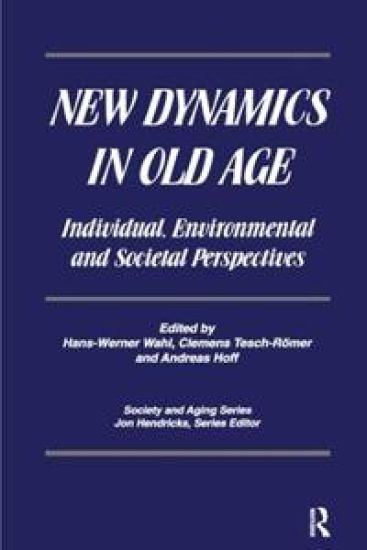
New Dynamics in Old Age
Hans-Werner Wahl; Clemens Tesch-Romer; . Andreas Hoff; Jon Hendricks
Baywood Publishing Company Inc
2006
sidottu
This book was nurtured by the belief that the new dynamics of today's and tomorrow's aging has not yet been treated well in the gerontology literature. Several questions drove the choice of substance for the book: What kind of new dynamics of aging deserves consideration? What kinds of theories and fields are at the core of treating such a new dynamics? And what kind of empirical evidence should be considered? The master hypothesis on which the book is based maintains that the new dynamics of old age is best observed in a range of everyday aging contexts that have been undergoing major change since the second half of the 20th century. In particular, five areas of new and persistent dynamics are treated in depth: the social environment, with a focus on cohort effects in social relations and the consideration of family relations and elders as care redelivers; the home environment, with emphasis on housing and quality of life, relocation and urban aging issues; the outdoor environment, with consideration of out-of-home activity patterns, car-driving behaviour and the leisure world of aging; the technological environment, with treatments of the role of the Internet and the potential of technology for aging outcomes and; and the societal environment with a focus on global aging, the new politics of old age and older persons as market consumers. The book's main purpose is to provide the scholarly gerontology community with a comprehensive and critical discussion of these new trends related to old age. The book will be of interest for the scholarly community of gerontology in a variety of disciplines; sociology, psychology, demography, epidemiology, humanities, social policy and geriatrics; students in gerontology education and in the disciplines named above who have an interest in aging issues (graduate level); professionals in practical and applied fields related to aging such as community and urban planners, health and care providers and policymakers; people involved in senior citizens' organizations and those in industry who wish to serve older people with new products.
