Kirjojen hintavertailu. Mukana 12 595 353 kirjaa ja 12 kauppaa.

Kirjailija

Harald Krogstad

Kirjat ja teokset yhdessä paikassa: 2 kirjaa, julkaisuja vuodelta 2026, suosituimpien joukossa Mathematical Modelling Techniques. Vertaile teosten hintoja ja tarkista saatavuus suomalaisista kirjakaupoista.

2 kirjaa

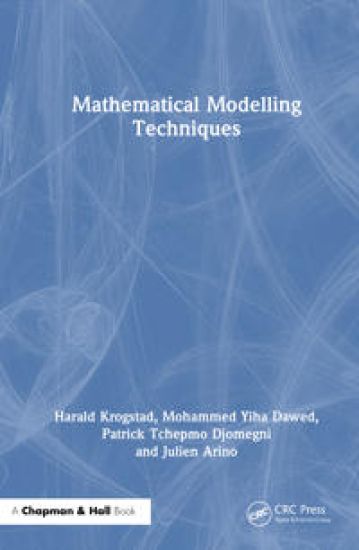
Mathematical Modelling Techniques

Mathematical Modelling Techniques

Harald Krogstad; Mohammed Yiha Dawed; Patrick Tchepmo Djomegni; Julien Arino

TAYLOR FRANCIS LTD
2026
sidottu
This book is based on lecture materials originally developed by Harald E. Krogstad for the MSc course Mathematical Modelling at the Norwegian University of Science and Technology (NTNU) and later adapted for the MASTMO MSc program at Hawassa University, Ethiopia. Following Prof. Krogstad’s passing in 2020, the project was continued by Mohammed Yiha Dawed and Patrick M. Tchepmo Djomegni, with contributions in mathematical epidemiology from Julien Arino. The text offers a structured and comprehensive introduction to mathematical modelling, blending classical methods with original content. Its goal is to equip beginning graduate students and advanced undergraduates in applied mathematics, statistics, and related fields with the tools to formulate, analyze, and interpret models across natural sciences, engineering, and biology. What distinguishes this book is its balance of theory and application, bridging rigorous mathematics with practical modelling problems. Students learn both the conceptual foundations and computational approaches, preparing them to tackle real-world challenges. Key Features Include: Introduction to dimensional analysis, scaling, and perturbation methods Equilibrium, bifurcation, and hysteresis analysis Classical and generalized population and epidemic models, including logistic, Lotka-Volterra, and SIR models Early introduction to partial differential equations through conservation-based modelling Applications to road traffic, mechanics, diffusion, and small project-based exercises Worked examples and chapter-end exercises for self-study. Concise “first aid” guide for solving first-order quasi-linear PDEs. This book is ideal for beginning graduate students and advanced undergraduates in applied mathematics, statistics, and related disciplines. Its combination of theory, applied examples, and project-based
Mathematical Modelling Techniques

Mathematical Modelling Techniques

Harald Krogstad; Mohammed Yiha Dawed; Patrick Tchepmo Djomegni; Julien Arino

TAYLOR FRANCIS LTD
2026
nidottu
This book is based on lecture materials originally developed by Harald E. Krogstad for the MSc course Mathematical Modelling at the Norwegian University of Science and Technology (NTNU) and later adapted for the MASTMO MSc program at Hawassa University, Ethiopia. Following Prof. Krogstad’s passing in 2020, the project was continued by Mohammed Yiha Dawed and Patrick M. Tchepmo Djomegni, with contributions in mathematical epidemiology from Julien Arino. The text offers a structured and comprehensive introduction to mathematical modelling, blending classical methods with original content. Its goal is to equip beginning graduate students and advanced undergraduates in applied mathematics, statistics, and related fields with the tools to formulate, analyze, and interpret models across natural sciences, engineering, and biology. What distinguishes this book is its balance of theory and application, bridging rigorous mathematics with practical modelling problems. Students learn both the conceptual foundations and computational approaches, preparing them to tackle real-world challenges. Key Features Include: Introduction to dimensional analysis, scaling, and perturbation methods Equilibrium, bifurcation, and hysteresis analysis Classical and generalized population and epidemic models, including logistic, Lotka-Volterra, and SIR models Early introduction to partial differential equations through conservation-based modelling Applications to road traffic, mechanics, diffusion, and small project-based exercises Worked examples and chapter-end exercises for self-study. Concise “first aid” guide for solving first-order quasi-linear PDEs. This book is ideal for beginning graduate students and advanced undergraduates in applied mathematics, statistics, and related disciplines. Its combination of theory, applied examples, and project-based