Kirjojen hintavertailu. Mukana 12 595 353 kirjaa ja 12 kauppaa.

Kirjailija

Harald Overhof

Kirjat ja teokset yhdessä paikassa: 3 kirjaa, julkaisuja vuosilta 2003-2013, suosituimpien joukossa Electronic Transport in Hydrogenated Amorphous Semiconductors. Vertaile teosten hintoja ja tarkista saatavuus suomalaisista kirjakaupoista.

3 kirjaa

Kirjojen julkaisuhaarukka 2003-2013.

Electronic Transport in Hydrogenated Amorphous Semiconductors

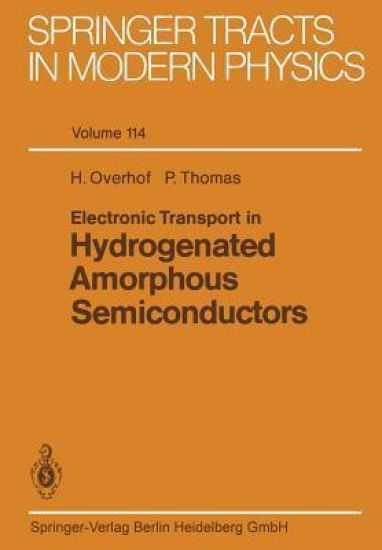
Electronic Transport in Hydrogenated Amorphous Semiconductors

Harald Overhof; Peter Thomas

Springer-Verlag Berlin and Heidelberg GmbH Co. K
2013
nidottu
Currently this is the book providing a thorough introduction and a unified theoretical basis for the interpretation of equilibrium transport processes in amorphous hydrogenated tetrahydrally coordinated semiconductors - a topic of great interest to physicists and material scientists (first devices for practical applications are already being manufactured). Most of the relevant literature is reviewed with particular emphasis on the approach developed by the authors. It explains most of the experimental data and allows the extraction of information about microscopic transport processes and parameters from equilibrium transport data. This work treats electronic transport in the mentioned type of semiconductors and in particular in a-Si:H and a-Ge:H. From elementary concepts the theory is developed towards higher degrees of completeness and sophistication. Further refinements for coping with the complexity of real systems are given. The comparison of theory with experiment is an important part of the book.
Point Defects in Semiconductors and Insulators

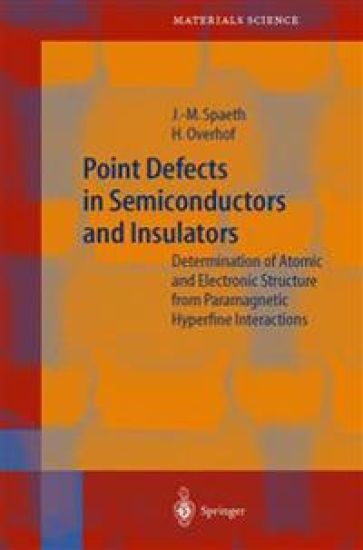
Point Defects in Semiconductors and Insulators

Johann-Martin Spaeth; Harald Overhof

Springer-Verlag Berlin and Heidelberg GmbH Co. K
2012
nidottu
The precedent book with the title "Structural Analysis of Point Defects in Solids: An introduction to multiple magnetic resonance spectroscopy" ap­ peared about 10 years ago. Since then a very active development has oc­ curred both with respect to the experimental methods and the theoretical interpretation of the experimental results. It would therefore not have been sufficient to simply publish a second edition of the precedent book with cor­ rections and a few additions. Furthermore the application of the multiple magnetic resonance methods has more and more shifted towards materials science and represents one of the important methods of materials analysis. Multiple magnetic resonances are used less now for "fundamental" studies in solid state physics. Therefore a more "pedestrian" access to the meth­ ods is called for to help the materials scientist to use them or to appreciate results obtained by using these methods. We have kept the two introduc­ tory chapters on conventional electron paramagnetic resonance (EPR) of the precedent book which are the base for the multiple resonance methods. The chapter on optical detection of EPR (ODEPR) was supplemented by sections on the structural information one can get from "forbidden" transitions as well as on spatial correlations between defects in the so-called "cross relaxation spectroscopy". High-field ODEPR/ENDOR was also added. The chapter on stationary electron nuclear double resonance (ENDOR) was supplemented by the method of stochastic END OR developed a few years ago in Paderborn which is now also commercially available.
Point Defects in Semiconductors and Insulators

Point Defects in Semiconductors and Insulators

Johann-Martin Spaeth; Harald Overhof

Springer-Verlag Berlin and Heidelberg GmbH Co. K
2003
sidottu
The precedent book with the title "Structural Analysis of Point Defects in Solids: An introduction to multiple magnetic resonance spectroscopy" ap­ peared about 10 years ago. Since then a very active development has oc­ curred both with respect to the experimental methods and the theoretical interpretation of the experimental results. It would therefore not have been sufficient to simply publish a second edition of the precedent book with cor­ rections and a few additions. Furthermore the application of the multiple magnetic resonance methods has more and more shifted towards materials science and represents one of the important methods of materials analysis. Multiple magnetic resonances are used less now for "fundamental" studies in solid state physics. Therefore a more "pedestrian" access to the meth­ ods is called for to help the materials scientist to use them or to appreciate results obtained by using these methods. We have kept the two introduc­ tory chapters on conventional electron paramagnetic resonance (EPR) of the precedent book which are the base for the multiple resonance methods. The chapter on optical detection of EPR (ODEPR) was supplemented by sections on the structural information one can get from "forbidden" transitions as well as on spatial correlations between defects in the so-called "cross relaxation spectroscopy". High-field ODEPR/ENDOR was also added. The chapter on stationary electron nuclear double resonance (ENDOR) was supplemented by the method of stochastic END OR developed a few years ago in Paderborn which is now also commercially available.