Kirjailija
Harold C Relyea
Kirjat ja teokset yhdessä paikassa: 11 kirjaa, julkaisuja vuosilta 1989-2008, suosituimpien joukossa Executive Branch Creation & Reorganization. Vertaile teosten hintoja ja tarkista saatavuus suomalaisista kirjakaupoista.
Mukana myös kirjoitusasut: Harold C. Relyea
11 kirjaa
Kirjojen julkaisuhaarukka 1989-2008.
The security classification regime in use within the federal executive branch traces its origins to armed forces information protection practices of the World War I era.
A Brief History of Emergency Powers in the United States
Harold C Relyea
University Press of the Pacific
2005
pokkari
Executive Branch Creation & Reorganization
Harold C Relyea; Thomas P Carr
Nova Biomedical
2003
nidottu
When President George W Bush came into office in January 2001, he arrived from a campaign in which he had emphasised efficiency in government, particularly through the use of information technology, but had not revealed any plans for reorganising the executive branch. Then in the aftermath of the September 11, 2001, terrorist attacks on the World Trade Center and the Pentagon, the organisation of the federal government for maintaining homeland security and combating terrorism became an important consideration for both the President and the 107th Congress. Establishment of the Office of Homeland Security in October 2001 as a co-ordinating entity as an important first step, followed by the President's June 6, 2002 call for the creation of a Department of Homeland Security. This book regards reorganisation and management as involving the alteration of the program administrative structure and operations of the executive branch for reasons of efficiency, economy and direction.
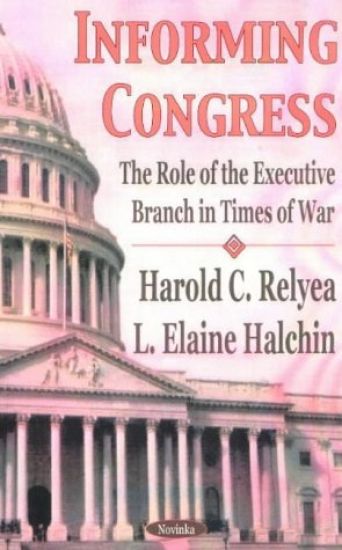
Under the Constitution of the United States, the President is responsible for prosecuting war and directing the armed military conflicts, including attacks upon the nation. Congress is constitutionally empowered to declare war, may otherwise authorise the involvement of American armed forces in military conflict, appropriate funds for government activities and operations, including military actions, and engages in oversight to assess the extent to which government operations have been efficiently, economically and effectively conducted using appropriated funds. Congress also has a role in prescribing intelligence and foreign policy. In order to meet these responsibilities, Congress needs to be kept aware by the executive branch leaders of all the latest developments and actions that are taking place. Consequently, when on 5 October 2001, George W Bush sent a memorandum to top diplomatic, intelligence and law enforcement officials that emphasised the restriction of information disclosures to Congress, this instalment drew fire from various quarters of the House of Representatives and the Senate. Despite the speedy removal of the restrictive policy by the President, questions surfaced pertaining to the executive branches role in times of war and military conflict in informing Congress regarding American involvement in such events. This book, which is intended to provide background information, also sheds light with a brief review explaining the executive-congressional relations in this regard for 1941-2001.
National Performance Review
Harold C Relyea; Marciele J Cornejo Riemann
Nova Biomedical
2002
nidottu
National Performance Review
This book reviews the evolution of the modern vice presidency -- the historical events and developments that have contributed to the expansion of the office beyond its largely legislative branch character to include diverse and important executive branch duties. Each Vice President is briefly discussed along with interesting facts about them.
Government experts provide the first reference history of the Executive Office of the President from its establishment in 1939 through the Bush Administration. Eleven chapters analyze the concept behind the office, its organization and reorganization, and how it developed over the last 55 years in terms of the broad functions that it serves. Chapters offer a careful, dispassionate survey of the office in terms of budget, management, and personnel; economics; national security; science and technology; exigency and emergency; resources development; domestic policy planning; the office of the Vice-President; and reorganizations, presidential style, and staffing matters. This reference is enriched also by biographical profiles of important staff members in the office during the last half-century, descriptions of different agencies, a chronology, and a bibliography. Designed for political scientists, public administrators, and historians, this study is invaluable for students and scholars, policymakers and public administrators, governmental and non-governmental professionals.Government experts provide a thorough and detailed overview of the development of the Executive Office and its components, with related research references. Part I consists of nine authored chapters which explore the creation of the Executive Office, its organization and reorganization, and, within broad functional areas—including budgeting, management and personnel, economics, national security, science and technology, exigency and emergency, resources development, and domestic policy and planning—its primary agencies. Two additional chapters are devoted respectively to the White House Office and the Office of the Vice-President. Throughout these accounts, ample references provide guidance to relevant source materials and authorities.Part II includes profiles of the principal units of the Executive Office and biographical sketches of a large representative sample of the leaders of those units as well as the senior staff of the White House Office. A chronology of Executive Office organizational developments and statistical data, together with a comprehensive bibliography, further enrich this sourcebook, designed to assist the conduct of studies and research by interested readers in the fields of government and history.
Federal Information Policies in the 1990s
Peter Hernon; Charles R. McClure; Harold C. Relyea
Praeger Publishers Inc
1996
nidottu
. . . the editors prevail upon students, scholars, information professionals and policy makers to study the issues further in order to deepen the understanding of government information and positively affect policy decisions. - Journal of Government Information
. . . Relyea's book provides good source material and discussion for an important juncture in American and world history, and also a point of departure for future studies of scientific communication in relation to national security concerns in the so-called Post-Cold War Setting. -Journal of Information Ethics
United States Government Information Policies
Charles R. McClure; Peter Hernon; Harold C. Relyea
Praeger Publishers Inc
1989
sidottu