Kirjojen hintavertailu. Mukana 12 595 353 kirjaa ja 12 kauppaa.

Kirjailija

Harold Garfinkel

Kirjat ja teokset yhdessä paikassa: 12 kirjaa, julkaisuja vuosilta 1984-2022, suosituimpien joukossa More Studies in Ethnomethodology. Vertaile teosten hintoja ja tarkista saatavuus suomalaisista kirjakaupoista.

12 kirjaa

Kirjojen julkaisuhaarukka 1984-2022.

Harold Garfinkel: Studies of Work in the Sciences

Harold Garfinkel: Studies of Work in the Sciences

Harold Garfinkel

TAYLOR FRANCIS LTD
2022
sidottu
This volume includes an unpublished manuscript and selected portions of five seminars by Harold Garfinkel – the founder of ethnomethodology – on the topic of practices in the natural sciences and mathematics. The volume provides a coherent and sustained account of his program for the study of ordinary and specialized social actions. Presenting broader theoretical and methodological initiatives, as well as discussions and summaries of exemplary studies of social phenomena within and beyond the sciences, this work dates to the period in the 1980s during which the field of Science and Technology Studies was taking shape, with ethnomethodological studies of scientific practice forming a major part of its development at the time. Aside from their historical importance, the manuscript and seminars present a distinctive perspective on the natural and social sciences that remains highly original and pertinent to research on science, social science, and everyday life today. Offering critical insights and proposals relating to developments in Ethnomethodology and Conversation Analysis, this volume will appeal to scholars of Sociology and Science and Technology Studies with interests in the work of Garfinkel.The Open Access version of this book, available at www.taylorfrancis.com, has been made available under a Creative Commons Attribution-Non Commercial-No Derivatives 4.0 license.
Harold Garfinkel: Studies of Work in the Sciences

Harold Garfinkel: Studies of Work in the Sciences

Harold Garfinkel

TAYLOR FRANCIS LTD
2022
nidottu
This volume includes an unpublished manuscript and selected portions of five seminars by Harold Garfinkel – the founder of ethnomethodology – on the topic of practices in the natural sciences and mathematics. The volume provides a coherent and sustained account of his program for the study of ordinary and specialized social actions. Presenting broader theoretical and methodological initiatives, as well as discussions and summaries of exemplary studies of social phenomena within and beyond the sciences, this work dates to the period in the 1980s during which the field of Science and Technology Studies was taking shape, with ethnomethodological studies of scientific practice forming a major part of its development at the time. Aside from their historical importance, the manuscript and seminars present a distinctive perspective on the natural and social sciences that remains highly original and pertinent to research on science, social science, and everyday life today. Offering critical insights and proposals relating to developments in Ethnomethodology and Conversation Analysis, this volume will appeal to scholars of Sociology and Science and Technology Studies with interests in the work of Garfinkel.The Open Access version of this book, available at www.taylorfrancis.com, has been made available under a Creative Commons Attribution-Non Commercial-No Derivatives 4.0 license.

More Studies in Ethnomethodology

More Studies in Ethnomethodology

Kenneth Liberman; Harold Garfinkel

State University of New York Press
2014
pokkari
Phenomenological analyses of the orderliness of naturally occurring collaboration. Winner of the 2015 Distinguished Book Award presented by the Ethnomethodology and Conversation Analysis Section of the American Sociological Association Winner of the 2015 Distinguished Book Award presented by the Ethnomethodology and Conversation Analysis Section of the American Sociological Association Pioneered by Harold Garfinkel in the 1950s and '60s, ethnomethodology is a sociological approach rooted in phenomenology that is concerned with investigating the unspoken rules according to which people understand and create order in unstructured situations. Based on more than thirty years of teaching ethnomethodology, Kenneth Liberman-himself a student of Garfinkel's-provides an up-to-date introduction through a series of classroom-based studies. Each chapter focuses on a routine experience in which people collaborate to make sense of and coordinate an unscripted activity: organizing the coherence of the rules of a game, describing the objective taste of a cup of gourmet coffee, making sense of intercultural conversation, reading a vague map, and finding order amidst chaotic traffic flow. Detailed descriptions of the kinds of ironies that naturally arise in these and other ordinary affairs breathe new life into phenomenological theorizing and sociological understanding.
Toward A Sociological Theory of Information

Toward A Sociological Theory of Information

Harold Garfinkel; Anne Rawls

Paradigm
2008
nidottu
In 1952 at Princeton University, Harold Garfinkel developed a sociological theory of information. Other prominent theories then being worked out at Princeton, including game theory, neglected the social elements of "information," modeling a rational individual whose success depends on completeness of both reason and information. In real life these conditions are not possible and these approaches therefore have always had limited and problematic practical application. Garfinkel's sociological theory treats information as a thoroughly organized social phenomenon in a way that addresses these shortcomings comprehensively. Although famous as a sociologist of everyday life, Garfinkel focuses in this new book-never before published-on the concerns of large-scale organization and decisionmaking. In the fifty years since Garfinkel wrote this treatise, there has been no systematic treatment of the problems and issues he raises. Nor has anyone proposed a theory of information like the one he proposed. Many of the same problems that troubled theorists of information and predictable order in 1952 are still problematic today.
Toward A Sociological Theory of Information

Toward A Sociological Theory of Information

Harold Garfinkel; Anne Rawls

Paradigm
2008
sidottu
In 1952 at Princeton University, Harold Garfinkel developed a sociological theory of information. Other prominent theories then being worked out at Princeton, including game theory, neglected the social elements of "information," modeling a rational individual whose success depends on completeness of both reason and information. In real life these conditions are not possible and these approaches therefore have always had limited and problematic practical application. Garfinkel's sociological theory treats information as a thoroughly organized social phenomenon in a way that addresses these shortcomings comprehensively. Although famous as a sociologist of everyday life, Garfinkel focuses in this new book-never before published-on the concerns of large-scale organization and decisionmaking. In the fifty years since Garfinkel wrote this treatise, there has been no systematic treatment of the problems and issues he raises. Nor has anyone proposed a theory of information like the one he proposed. Many of the same problems that troubled theorists of information and predictable order in 1952 are still problematic today.
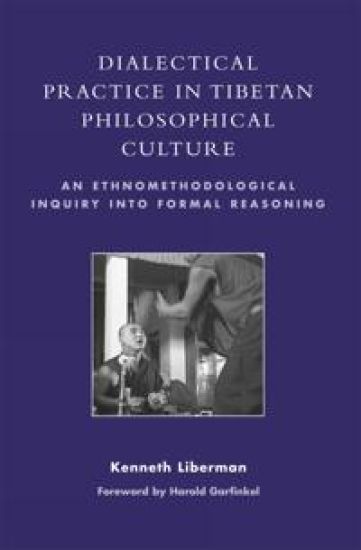
Dialectical Practice in Tibetan Philosophical Culture

Dialectical Practice in Tibetan Philosophical Culture

Kenneth Liberman; Harold Garfinkel

Rowman Littlefield Publishers
2007
nidottu
Tibetan Buddhist scholar-monks have long engaged in face-to-face public philosophical debates. This original study challenges Orientalist text-based scholarship, which has overlooked these lived practices of Tibetan dialectics. Kenneth Liberman brings these dynamic disputations to life for the modern reader through a richly detailed, turn-by-turn analysis of the monks' formal philosophical reasoning. He argues that Tibetan Buddhists deliberately organize their debates into formal structures that both empower and constrain thinking, skillfully using logic as an interactional tool to organize their reflections. During his three years in residence at Tibetan monastic universities, Liberman observed and videotaped the monks' debates. He then transcribed, translated, and analyzed them using multimedia software and ethnomethodological techniques, which enabled him to scrutinize the local methods that Tibetan debaters use to keep their philosophical inquiries alive. His study shows the monks rely on such indigenous dialectical methods as extending an opponent's position to its absurd consequences, "pulling the rug out" from under an opponent, and other lively strategies. This careful investigation of the formal philosophical work of Tibetan scholars is a pathbreaking analysis of an important classical tradition.
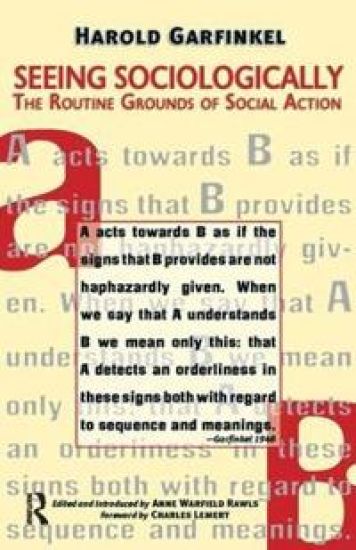
Seeing Sociologically

Seeing Sociologically

Harold Garfinkel; Anne Rawls; Charles C. Lemert

Paradigm
2005
nidottu
This book-never before published-is eminent sociologist Harold Garfinkel's earliest attempt, while at Harvard in 1948, to bridge the growing gap in American sociology. This gap was generated by a Parsonian paradigm that emphasised a scientific approach to sociological description, one that increasingly distanced itself from social phenomena in the increasingly influential ways studied by phenomenologists. It was Garfinkel's idea that phenomenological description, rendered in more empirical and interactive terms, might remedy shortcomings in the reigning Parsonian view. Garfinkel soon gave up the attempt to repair scientific description, and his focus became increasingly empirical until, in 1954, he famously coined the term "Ethnomethodology." However, in this early manuscript can be seen more clearly than in some of his later work the struggle with a conceptual and positivist rendering of social relations that ultimately informed Garfinkel's position. Here we find the sources of his turn toward ethnomethodology, which would influence subsequent generations of sociologists. Essential reading for all social theory scholars and graduate students and for a wider range of social scientists in anthropology, ethnomethodology, and other fields.
Seeing Sociologically

Seeing Sociologically

Harold Garfinkel; Anne Rawls; Charles C. Lemert

Paradigm
2005
sidottu
This book-never before published-is eminent sociologist Harold Garfinkel's earliest attempt, while at Harvard in 1948, to bridge the growing gap in American sociology. This gap was generated by a Parsonian paradigm that emphasised a scientific approach to sociological description, one that increasingly distanced itself from social phenomena in the increasingly influential ways studied by phenomenologists. It was Garfinkel's idea that phenomenological description, rendered in more empirical and interactive terms, might remedy shortcomings in the reigning Parsonian view. Garfinkel soon gave up the attempt to repair scientific description, and his focus became increasingly empirical until, in 1954, he famously coined the term "Ethnomethodology." However, in this early manuscript can be seen more clearly than in some of his later work the struggle with a conceptual and positivist rendering of social relations that ultimately informed Garfinkel's position. Here we find the sources of his turn toward ethnomethodology, which would influence subsequent generations of sociologists. Essential reading for all social theory scholars and graduate students and for a wider range of social scientists in anthropology, ethnomethodology, and other fields.
Ethnomethodology's Program

Ethnomethodology's Program

Harold Garfinkel

Rowman Littlefield Publishers
2002
sidottu
Since the 1967 publication of Studies in Ethnomethodology, Harold Garfinkel has indelibly influenced the social sciences and humanities worldwide. This new book, the long-awaited sequel to Studies, comprises Garfinkel's work over three decades to further elaborate the study of ethnomethodology. "Working out Durkheim's Aphorism," the title used for this new book, emphasizes Garfinkel's insistence that his position focuses on fundamental sociological issues—and that interpretations of his position as indifferent to sociology have been misunderstandings. Durkheim's aphorism states that the concreteness of social facts is sociology's most fundamental phenomenon. Garfinkel argues that sociologists have, for a century or more, ignored this aphorism and treated social facts as theoretical, or conceptual, constructions. Garfinkel in this new book shows how and why sociology must restore Durkheim's aphorism, through an insistence on the concreteness of social facts that are produced by complex social practices enacted by participants in the social order. Garfinkel's new book, like Studies, will likely stand as another landmark in sociological theory, yet it is clearer and more concrete in revealing human social practices.
Ethnomethodology's Program

Ethnomethodology's Program

Harold Garfinkel

Rowman Littlefield Publishers
2002
nidottu
Since the 1967 publication of Studies in Ethnomethodology, Harold Garfinkel has indelibly influenced the social sciences and humanities worldwide. This new book, the long-awaited sequel to Studies, comprises Garfinkel's work over three decades to further elaborate the study of ethnomethodology. 'Working out Durkheim's Aphorism,' the title used for this new book, emphasizes Garfinkel's insistence that his position focuses on fundamental sociological issues—and that interpretations of his position as indifferent to sociology have been misunderstandings. Durkheim's aphorism states that the concreteness of social facts is sociology's most fundamental phenomenon. Garfinkel argues that sociologists have, for a century or more, ignored this aphorism and treated social facts as theoretical, or conceptual, constructions. Garfinkel in this new book shows how and why sociology must restore Durkheim's aphorism, through an insistence on the concreteness of social facts that are produced by complex social practices enacted by participants in the social order. Garfinkel's new book, like Studies, will likely stand as another landmark in sociological theory, yet it is clearer and more concrete in revealing human social practices.
Studies in Ethnomethodology

Studies in Ethnomethodology

Harold Garfinkel

JOHN WILEY AND SONS LTD
1984
nidottu
This is the first appearance in paper back of one of the major classics of contemporary Sociology. Studies in Ethnomethodology has inspired a wide range of important theoretical and empirical work in the social sciences and linguistics. It is one of the most original and controversial works in modern social science and it remains at the centre of debate about the current trends and tasks of sociology and social theory. Ethnomethodology - the study of the ways in which ordinary people construct a stable social world through everyday utterances and actions - is now a major component of all sociology and linguistics courses. Garfinkel's formidable reputation as one of the worlds leading sociologists rest largely on the work contained in this book. Studies in Ethnomethodology was originally published by Prentice Hall in 1967 and has remained in print ever since. It is widely used as a text book in this country and in the United States. This new paperback is a special student edition of Garfinkel's modern classic.