

Kirjailija
Harold Kincaid
Kirjat ja teokset yhdessä paikassa: 6 kirjaa, julkaisuja vuosilta 1995-2025, suosituimpien joukossa Defining Mental Disorder. Vertaile teosten hintoja ja tarkista saatavuus suomalaisista kirjakaupoista.
6 kirjaa
Kirjojen julkaisuhaarukka 1995-2025.

"Thomas Scheff demonstrates why Goffman remains such a key figure for social scientists. Goffman may have been cautious about recognizing the role of emotions in social life, but Scheff boldly and creatively shows why the sociological and the psychological are necessarily intertwined. This is certainly a book for all serious analysts of social behaviour." Michael Billig, Nottingham University "Scheff's critical eye is equal to his subject, shrewdly appreciating Goffman's many virtues while also showing where and how Goffman's thinking needs revision and development. This original and provocative book offers a fresh interpretation of Goffman and will become a benchmark for all subsequent commentary." Greg Smith, University of Salford One of the seminal sociologists of the twentieth century, Erving Goffman revolutionized our understanding of the microworld of emotions and relationships. We all live in this world every day of our lives, yet it is virtually invisible to us. Goffman's genius was to recognize and describe this world as no one had before. The book synthesizes prior scholarly commentary on Goffman's work, and includes biographical material from his life, untangling some of the many puzzles in Goffman's work and life. Scheff also proposes ways of filling gaps and false starts. One chapter explores the meaning of the emotion of love, another of hatred. These and other new directions could facilitate the creation of a microsocial science that unveils the emotional/relational world.

"Thomas Scheff demonstrates why Goffman remains such a key figure for social scientists. Goffman may have been cautious about recognizing the role of emotions in social life, but Scheff boldly and creatively shows why the sociological and the psychological are necessarily intertwined. This is certainly a book for all serious analysts of social behaviour." Michael Billig, Nottingham University "Scheff's critical eye is equal to his subject, shrewdly appreciating Goffman's many virtues while also showing where and how Goffman's thinking needs revision and development. This original and provocative book offers a fresh interpretation of Goffman and will become a benchmark for all subsequent commentary." Greg Smith, University of Salford One of the seminal sociologists of the twentieth century, Erving Goffman revolutionized our understanding of the microworld of emotions and relationships. We all live in this world every day of our lives, yet it is virtually invisible to us. Goffman's genius was to recognize and describe this world as no one had before. The book synthesizes prior scholarly commentary on Goffman's work, and includes biographical material from his life, untangling some of the many puzzles in Goffman's work and life. Scheff also proposes ways of filling gaps and false starts. One chapter explores the meaning of the emotion of love, another of hatred. These and other new directions could facilitate the creation of a microsocial science that unveils the emotional/relational world.
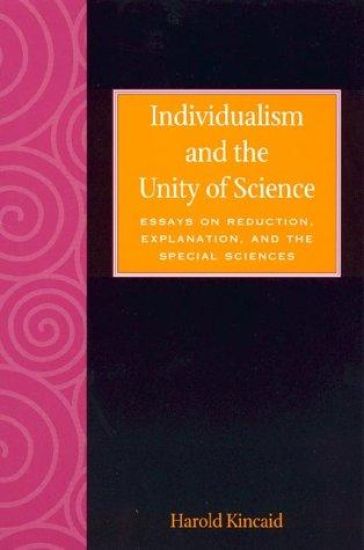
In this original and important book, Harold Kincaid defends a view of the special sciences—all sciences outside physics—as autonomous and nonreducible. He argues that the biological and social sciences provide explanations that cannot be captured by explanations at the level of their constituent parts, and yet that this does not commit us to mysterious, nonphysical entitites like vital forces or group minds. A look at real scientific practice shows that the many different sciences can be unified in a way that leaves them each an autonomous explanatory role. This book will be of great interest to philosophers of science and social scientists.
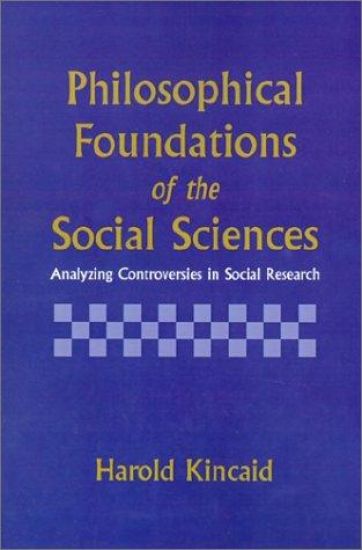
Philosophical Foundations of the Social Sciences
Harold Kincaid
Cambridge University Press
1995
pokkari
This book defends the prospects for a science of society. It argues that behind the diverse methods of the natural sciences lies a common core of scientific rationality that the social sciences can and sometimes do achieve. It also argues that good social science must be in part about large-scale social structures and processes and thus that methodological individualism is misguided. These theses are supported by a detailed discussion of actual social research, including theories of agrarian revolution, organizational ecology, social theories of depression, and supply-demand explanations in economics. Professor Kincaid provides a general picture of explanation and confirmation in the social sciences and discusses the nature of scientific rationality, functional explanation, optimality arguments, meaning and interpretation, the place of microfoundations in social explanation, the status of neo-classical economics, the role of idealizations and non-experimental evidence, and other specific controversies.
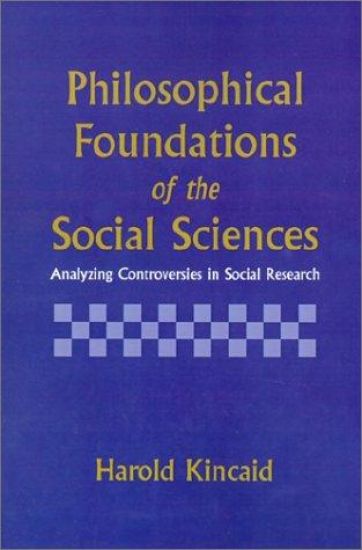
Philosophical Foundations of the Social Sciences
Harold Kincaid
Cambridge University Press
1995
sidottu
This book defends the prospects for a science of society. It argues that behind the diverse methods of the natural sciences lies a common core of scientific rationality that the social sciences can and sometimes do achieve. It also argues that good social science must be in part about large-scale social structures and processes and thus that methodological individualism is misguided. These theses are supported by a detailed discussion of actual social research, including theories of agrarian revolution, organizational ecology, social theories of depression, and supply-demand explanations in economics. Professor Kincaid provides a general picture of explanation and confirmation in the social sciences and discusses the nature of scientific rationality, functional explanation, optimality arguments, meaning and interpretation, the place of microfoundations in social explanation, the status of neo-classical economics, the role of idealizations and non-experimental evidence, and other specific controversies.